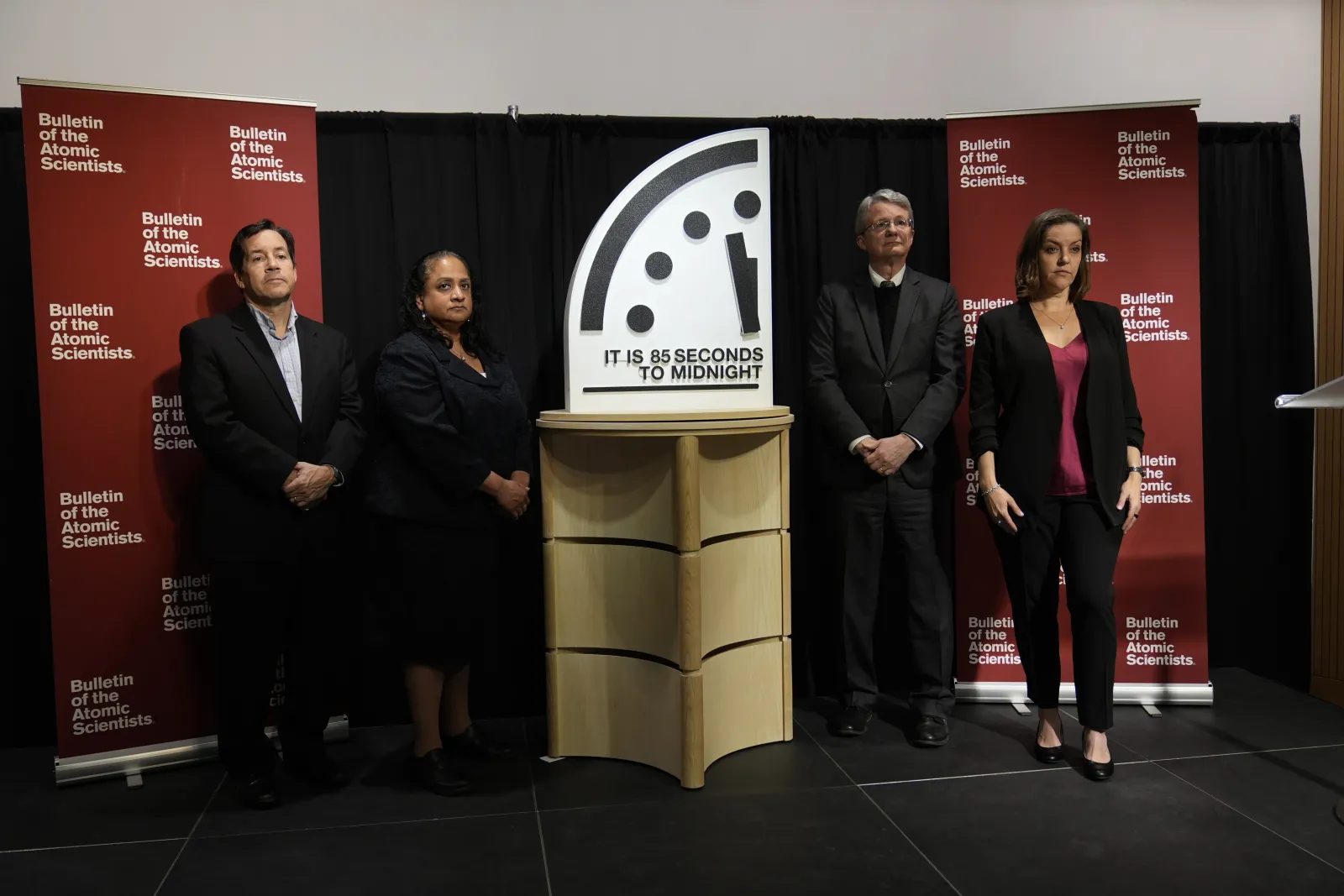
The Doomsday Clock, last adjusted in January, has not moved closer to midnight, yet 2026 headlines suggest the world feels nearer to catastrophe.
Silicon Valley firms Anthropic, OpenAI and xAI say artificial intelligence, rebranded as "super intelligence" by President Trump's executive order, could cause human extinction if unchecked. Anthropic CEO Dario Amodei estimates a 25 percent risk, while Elon Musk puts it at 20 percent.
The Pentagon entered a doomsday posture in late September when Defense Secretary Pete Hegseth announced the Fortress America plan, aimed at keeping major U.S. bases operational for 90 days or more after civilian power grids, supply chains and critical infrastructure are disrupted or destroyed.
Fortress America includes building micro-nuclear reactors and hardening vulnerable networks. Pentagon spokesman Sean Parnell, citing the war in Ukraine, warned, "Power is combat now. Without electricity, you lose communications, assembly lines, and just basic command structures." He added that the nation cannot "rely on standard civilian municipal infrastructure to run our national defense."
Civilian governments are also preparing. Last week the United Kingdom launched its "Be Ready" campaign urging citizens to stockpile 72 hours of food, water, cash, medicine and other essentials.
Russia's hybrid war against Europe, the unfinished war in Iran, and a rise in cyber-attacks, including Tehran's assaults on U.S. water-treatment facilities over the past seven months, are cited as key threats, alongside the expanding use of AI for cyber warfare.
Other European nations have issued similar alerts: Ireland's "Be Emergency Ready" initiative in August, the Netherlands' "Think Ahead" warning earlier this month, France's reminder of its 2025 campaign for a 72-hour survival kit, and Japan's new Disaster Management Agency set to start on November 2.
Space security is also in focus. Under Secretary of State Thomas DiNanno said a Russian military satellite was "exhibiting threatening behavior by intentionally maneuvering dangerously close to a commercial satellite, behaviors consistent with on-orbit weapons operations."
In response to growing Russian and Chinese attempts to "disrupt and degrade U.S. space-enabled capabilities," Chief of Space Operations Gen. Douglas Schiess announced that "guardians operate on-orbit weapons that can defend the joint force against space-enabled attacks."
The Defense Intelligence Agency's latest "Challenges to Security in Space" brief warned that Russia is developing a satellite designed to carry a nuclear weapon, violating the 1967 Outer Space Treaty.
Russia's illegal war in Ukraine remains a chief existential threat. Three of the Royal Navy's four Vanguard-class ballistic-missile submarines are on patrol simultaneously, each armed with Trident II D5 missiles capable of delivering nuclear warheads.
London and its European allies signal to the Kremlin that they will continue military and economic support for Ukraine and resist any attempts by figures such as Steve Witkoff or Jared Kushner, acting for President Trump, to cut sanctions or strike deals with Russia.
The Russian Direct Investment Fund, run by Kirill Dmitriev, is at the center of discussions with Witkoff and Kushner to exchange Russian wealth for concessions on Ukraine.
President Trump, who in a 2025 UN address accused NATO allies of "funding the war against themselves," now appears to be facilitating deals that could accelerate conflict, including a diesel agreement and reports of a potential Alaskan oil deal.
Critics suggest the White House is effectively funding Putin's war, hastening a path to doomsday.
Clocks are set to be adjusted this weekend; some argue Trump should also move the Doomsday Clock back an hour.
Mark Toth writes on national security and foreign policy. Col. (Ret.) Jonathan Sweet served 30 years as a military intelligence officer and led the U.S. European Command Intelligence Engagement Division from 2012 to 2014. They co-found INTREP360 and the INTREP360 Intelligence Report on Substack.