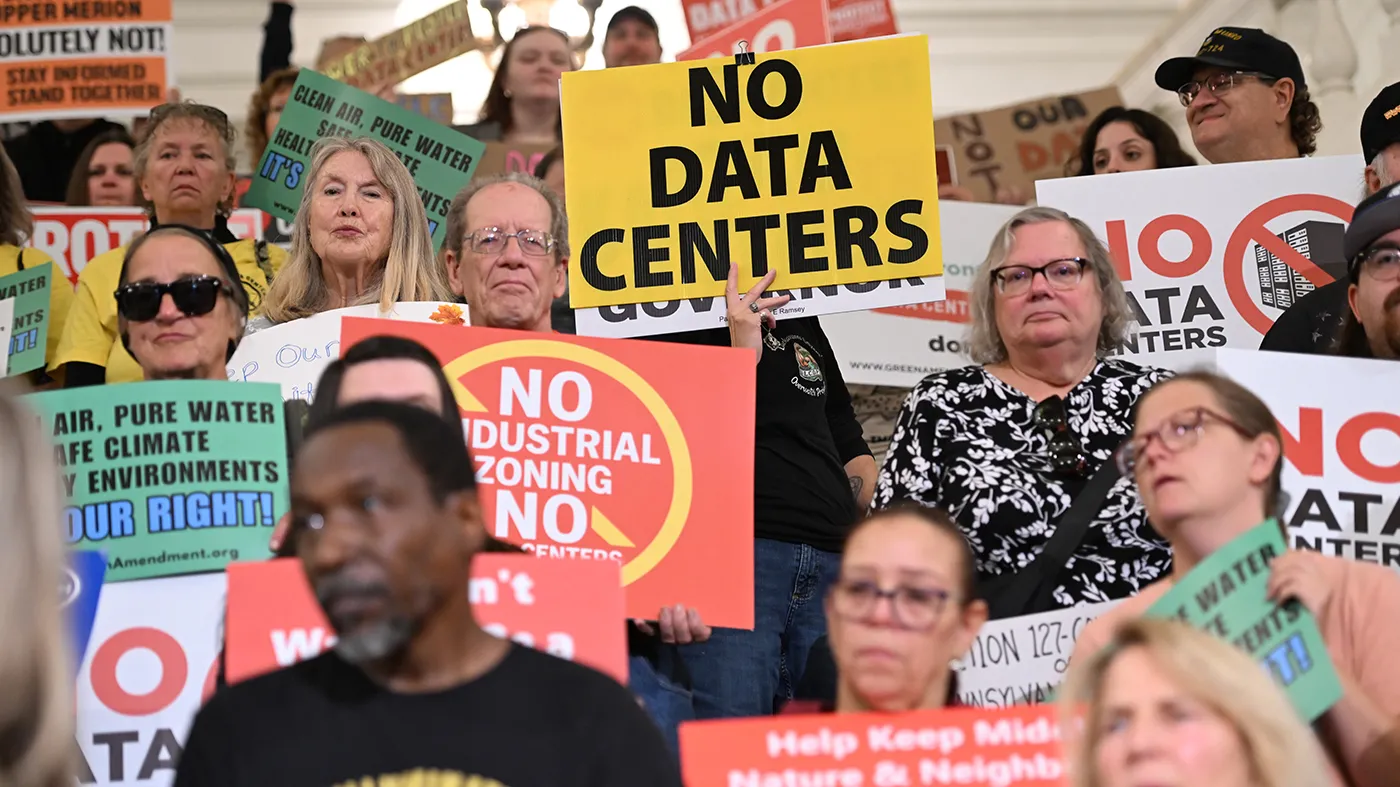
Rural voters in Ohio and Texas are increasingly opposing AI data centers, a trend that could weaken Republican support in key battlegrounds as the 2024 elections approach.
Grassroots activists in counties that gave President Trump double-digit margins are voicing concerns that could erode the GOP's traditional rural base, according to experts and local residents.
The issue is vivid in Pickaway County, Ohio, where Trump beat former Vice President Kamala Harris by roughly 50 points in 2024, and residents are debating EdgeConneX's newest data center.
"That's weighing heavily, especially with the Senate races," said Pickaway County resident Sherri Fahringer, a candidate for county commissioner.
A Pew Research Center study released in April found that 67 percent of planned data-center projects are slated for rural locations.
Fahringer added that the data-center controversy is nudging Ohio Senate voters "further left toward" former Sen. Sherrod Brown (D) against incumbent Sen. Jon Husted (R-Ohio), who has lost support over his past data-center endorsements.
The League of Conservation Voters and other climate groups have attacked Husted, running an ad that labeled him "the face of data centers."
An August memo from the National Republican Senatorial Committee, obtained by Axios, noted that Brown has made opposition to data centers a "centerpiece of his campaign against Husted" because "it works," and warned that data centers are "the anchor hanging around Husted's neck."
Although Trump carried Ohio by over 10 points in 2024, recent polls show the GOP incumbent trailing Brown.
"It's really fascinating because I know a lot of people who are opposed to data centers locally, and these are Republicans. Many of them are MAGA Republicans, very conservative areas," said GOP strategist Brendan Steinhauser, president of the Alliance for Secure AI.
Steinhauser highlighted that the opposition cuts across party lines, calling it a "bipartisan coalition, and that's kind of unique."
A Bowling Green State University poll found that 75 percent of Ohio respondents oppose local data-center construction and 78 percent favor a moratorium until further research is done.
In Pickaway County, Fahringer said the bipartisan push focuses on potential strain on energy grids, noise, and proximity to homes and schools, noting that projects are being placed on former farms near residences.
Analysis by Cleveland.com using Census data shows that all but five of Ohio's 88 counties have over 55 percent of their area classified as rural, a demographic that traditionally leans Republican.
Steinhauser reiterated that while rural Ohio voters supported Trump by wide margins, many are uneasy about data-center projects and do not back the president's stance.
Trump has defended data-center construction, claiming at an Ohio rally that the projects benefit the state's industry, and has generally taken a hands-off approach to AI regulation.
In Texas, Governor Greg Abbott (R), a Trump ally, recently proposed stricter rules for data centers, including water-efficiency requirements and the repeal of tax incentives, after previously promoting Texas as the "epicenter of AI development" for 2025 with new Google investments.
Texas Agriculture Commissioner Sid Miller (R) told NewsNation that GOP candidates could lose the election because of data-center development, specifically criticizing Abbott for not adopting a stronger position.
"Basically, we've just quit listening to the people, and we're gonna pay for it this election," Miller said.
An October poll by the University of Texas and Texas Politics Project reported that 66 percent of rural respondents oppose local data-center construction, while only 17 percent support it.
Steinhauser, a Texas native, said Abbott's shift on data centers serves as a "good barometer" for Texas Republicans, noting the governor has responded to the movement.
Texas holds the nation's largest rural population, a group that Abbott's opponent Gina Hinojosa (D) is courting in her bid for governor. In the same poll, Hinojosa trailed Abbott among rural voters 28 percent to 68 percent, but led overall by a single point within the margin of error.
Hinojosa has targeted Abbott over data centers, telling the New York Times that "rural Texas has felt betrayed" by the governor's AI-infrastructure policies.
"Millions of voters in Texas alone are motivated by this right now, and it's going to have an impact on the election," Steinhauser observed.