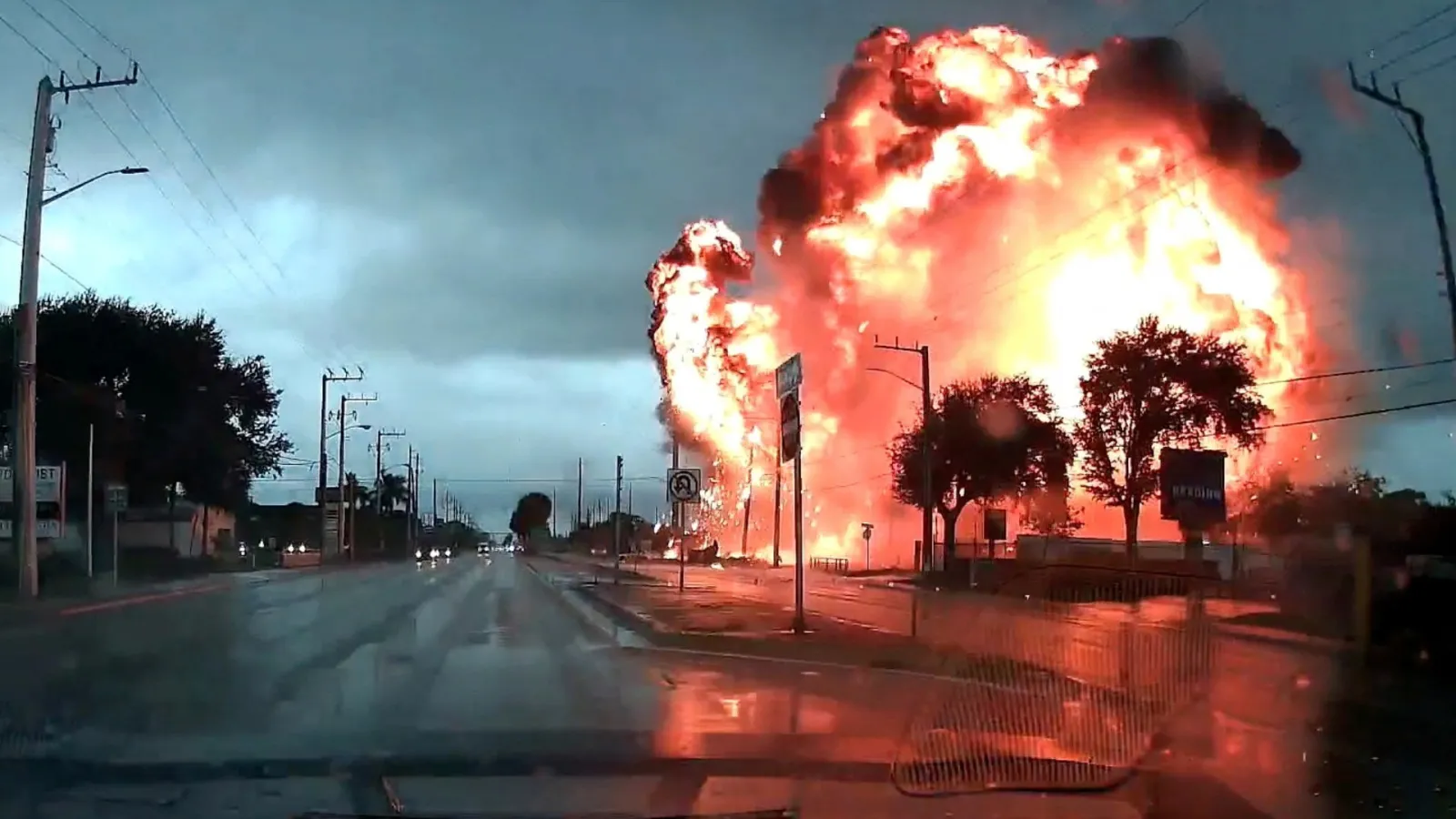
Chilling audio reveals how the crew of a doomed Learjet were reprimanded by air traffic control months before a Florida crash after struggling to maintain altitude in severe turbulence. The Learjet 60 was involved in a deadly crash in Palm Beach County on Sunday, November 1, killing all nine people aboard. The jet was flying from Austin, Texas, to North Eleuthera in the Bahamas.
Among those who lost their lives were tech entrepreneur Adam Robinson, his wife, and their two young children, two close family friends, and the family nanny. The jet captain, Jeffrey Gregory, 55, and co-pilot Nathalia Gadelha Filgueiras, 20, were also killed. In the terrifying final moments of Sunday flight, Filgueiras could be heard reporting the jet rapid descent to air traffic control before warning that they were going to crash.
The U.S. Sun obtained audio of an earlier incident involving the same plane, recorded months before the tragedy, in which a female pilot reported experiencing moderate chop and said they were unable to maintain altitude. But the controller immediately challenged that assessment, telling the crew, If you can not maintain altitude, that is not moderate. That is severe turbulence.
The dramatic exchange, first reported by MailOnline from the ATC App, took place in May as the aircraft flew near Newark, New Jersey. The controller can first be heard asking, November Two Bravo Delta, why are you climbing? The female pilot replied, We were just about to call you. We are experiencing moderate chop and unable to hold altitude, Two Bravo Delta.
The controller responded, That is not moderate. Descend to four thousand immediately, before warning the pilots about another business jet nearby. A male pilot then again described the conditions again, telling the controller, We have got moderate chop, sir. But the controller pushed back, If you can not maintain altitude, that is not moderate. That is severe turbulence. Are you experiencing severe turbulence?
Both pilots repeatedly responded, Affirmative. The controller later asked whether anyone aboard had been injured, with the female pilot replying, No injuries as of now, but we are still experiencing severe turbulence. The identity of the pilots heard speaking during the May incident have not been confirmed, and it remains unclear whether the woman was Filgueiras.
But the aircraft involved in the scare was the exact same Learjet 60 that crashed on Sunday, carrying the same Federal Aviation Administration registration, N722BD. The victims included tech founder Robinson, 45, his wife Helen, 40, and their children Emma, four, and Charlie, two. Also killed were close friends Rachael Reed and Charmi Fehr, as well as the family nanny, Anita Maria Apellido Cetina.
In a statement released Monday, Robinson family remembered Adam and Helen for their warmth and generosity, saying their loss would be deeply felt by everyone who loved them. They said Reed and Fehr were full of joy and adventure, while Cetina was remembered for the tenderness and devotion with which she cared for the children. Filgueiras had earned her private pilot license at 17 while still in high school and had logged more than 1,300 hours of flight time before the Florida plane crash, according to her family.
The disaster unfolded shortly before 12.50 pm after the crew, flying at 35,000 feet, reported light clear ice and moderate turbulence causing altitude deviations of around 700 feet. The pilots then reported precipitation and requested permission to climb to 37,000 feet, which air traffic control approved. Less than 30 seconds later, the aircraft began descending, the crew issued a mayday call and reported an overspeed condition, with the harrowing final audio capturing their desperate attempts to regain control.
At a press conference, National Transportation Safety Board member Tom Chapman said investigators had new details. He said, We do have some evidence that there was some breakup of the aircraft before impact, while investigators said the Learjet debris field and crash crater stretched across the surrounding area. Weather will be a major focus of the investigation, with officials examining the severe turbulence, icing, and storm conditions encountered before the jet suddenly lost altitude.
The National Transportation Safety Board has sent around 20 investigators to examine the jet structures and systems, weather conditions, air traffic control communications, and flight-recording equipment. Federal Aviation Administration records obtained by The U.S. Sun show Jeffrey held an Airline Transport Pilot certificate issued on October 1, 2021, with a Learjet 60 type rating and no pilot-in-command restriction on that aircraft. Nathalia held a Commercial Pilot certificate with an LR-60 type rating, but her Learjet 60 qualification carried a pilot-in-command limitation. The records are consistent with Jeffrey serving as captain and Nathalia as co-pilot.
Background on the Learjet 60 aircraft and air traffic operations
The Learjet 60 is a mid-size twin-turbofan business jet manufactured by Bombardier Aerospace, designed to carry up to eight passengers and operated by a two-pilot crew. Introduced in the early 1990s, the aircraft has a reputation for high performance, climbing rapidly and operating at altitudes up to 51,000 feet. Commercial charter operators frequently use the model for private domestic and international flights across North America and the Caribbean due to its speed and cabin comfort.
Air traffic controllers monitor commercial and private aircraft using radar and radio communications, issuing directives to maintain safe separation distances between planes. When pilots encounter hazardous meteorological phenomena such as severe turbulence, icing, or convective storms, standard aviation protocols require immediate reporting so controllers can coordinate altitude changes or detours. Federal aviation regulations strictly govern pilot qualifications, requiring specific type ratings for different aircraft models to ensure flight safety under challenging operational environments.
Investigation procedures by the National Transportation Safety Board
The National Transportation Safety Board investigates civil aviation accidents and incidents in the United States, deploying multidisciplinary teams to examine wreckage, weather data, and human factors. Investigators reconstruct the final moments of a flight using cockpit voice recorders, flight data recorders, and radar telemetry provided by air traffic control facilities. Technical specialists analyze engine performance, structural integrity, and maintenance records to determine whether mechanical failures contributed to an in-flight breakup or loss of control.
Weather reconstruction forms a critical part of aviation safety probes, involving meteorological radar archives and satellite imagery to evaluate atmospheric conditions along the flight path. Board members hold public press briefings to share verified factual findings while prohibiting speculation during active inquiries. Final safety reports typically take many months to complete and often lead to safety recommendations issued to regulatory authorities like the Federal Aviation Administration.