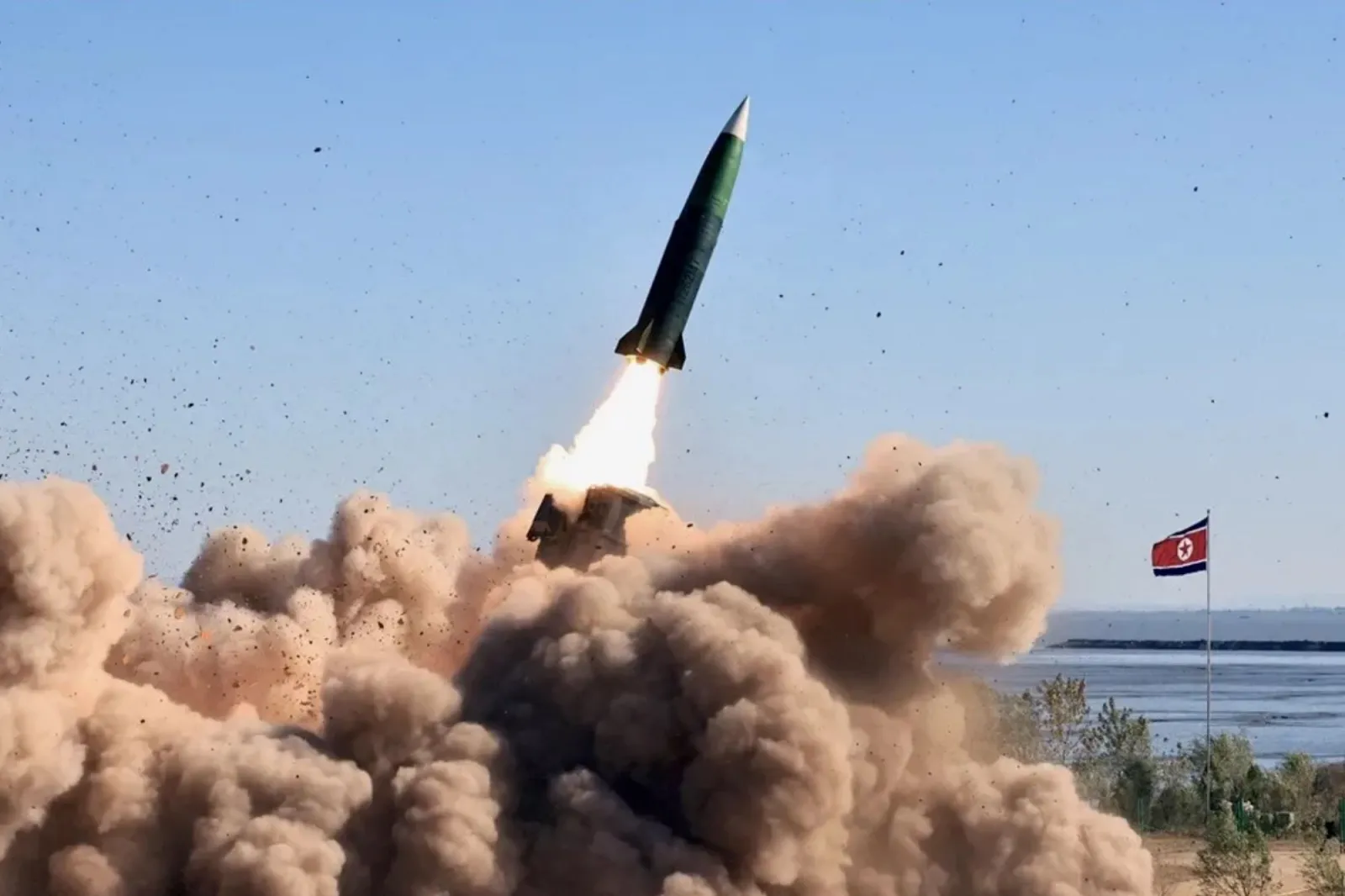
North Korean leader Kim Jong-un has test-fired a new range of cluster bomb warheads capable of turning a 30-acre area to ashes in seconds, according to state media reports published over the weekend. The Hermit Kingdom vowed to produce more variants of the terrifying weapon by the end of the year as it conducts a slew of military drills.
North Korea has ramped up its show of force lately, trialling attack drones, a new precision-guided torpedo system and an intermediate-range hypersonic missile. The latest test, conducted on Saturday, found that a Type 2 cluster bomb warhead can turn a 30-acre area to ashes with its highest density, per a state report.
Cluster bombs scatter dozens, sometimes hundreds, of smaller bomblets across a wide area, enabling it to hit multiple targets simultaneously. North Korea will enable its military units by the end of 2026 to use all types of the bombs, depending on their operational purposes, KCNA said.
It comes amid flaring tensions on the Korean peninsula over a landmine explosion along the heavily fortified border. Three South Korean soldiers were injured in the incident, with the North denying responsibility. Instead, Pyongyang vowed to strengthen its border areas and resume its loudspeaker campaign.
Saturday's test was conducted to "assess adaptation to combat and power of a cluster-bomb warhead to be tipped on tactical ballistic missiles", the official Korean Central News Agency reported Sunday. Officials said it confirmed the weapon "is capable of turning into ashes a target area of 12 to 13 hectares with its highest-density power".
The general director of North Korea's Missile Administration said: "Within this year we will enable units to select and use all those types according to operational aims and specific features of targets." Photos released by KCNA showed a projectile firing from a mobile launcher, with an orange exhaust plume. Another image showed multiple cluster-bomb impacts on an island target.
North Korean leader Kim Jong Un was not present on Saturday, although he had overseen a test-launch of cluster-bomb warheads mounted on a ballistic missile in April, accompanied by his daughter Ju Ae.
It comes as the FBI confirmed that Kim's state-sponsored hacker squad stole $6.3billion in crypto assets from Binance, prompting the exchange to suspend activity. The shady Lazarus group, which has perpetrated some of the most costly attacks on Western banks, gained access to the system by compromising an engineer's computer. Around 90 per cent of the assets were frozen, Binance later announced, and the world's largest currency exchange has begun a phased reopening of customer withdrawals.
Earlier this week, a bombshell investigation revealed that North Koreans are being sold online to Russian businesses as part of a state-sponsored forced labour programme. The twisted scheme allows Vladimir Putin to bolster his war machine with a brutally controlled workforce while Kim snatches their wages to fund his ballistic missile programme, it claims. The Global Rights Compliance exposed how the two states use the network to "bypass international sanctions" and fuel their military "aggression".
GRC Legal Advisor Elise Lauriot Prevost, who worked on the investigation, told The Sun: "Cooperation between the DPRK and Russia is only getting stronger. The DPRK is getting hard cash and fuel while Russia is getting workers to supplement its manpower shortages." The report follows a nine-month undercover investigation into KNDR.su, a broker network run by Moscow businessman Vladimir Sokolov. The platform, which markets North Korean workers for sale, charges a commission of £900 to £1,350 per worker for a minimum of 50 workers. GRC identified nine sites in Russia associated with North Korea through Sokolov's network alone.
Elise said: "Both countries treat people as instruments of state power. But none of this is new. North Korea has exported forced labour for more than two decades. The same can be seen through Russia's aggression in Ukraine and the high death toll of their own soldiers. It seems both countries are willing to sacrifice their own civilians for their military machines."
Background on North Korean Military Developments
North Korea, officially known as the Democratic People's Republic of Korea, maintains one of the largest standing armies in the world and has pursued a nuclear weapons program for decades despite severe international sanctions and diplomatic isolation. The nation's military strategy relies heavily on asymmetrical warfare, artillery systems positioned near the border with South Korea, and the continuous development of ballistic missiles designed to deliver conventional or unconventional payloads across varying ranges.
Cluster munitions, or cluster bombs, are weapons that release multiple smaller submunitions over a targeted zone. Due to their wide area of effect and the historical danger posed by unexploded bomblets left behind on the ground, these weapons have been restricted or banned by more than 100 countries under the international Convention on Cluster Munitions. However, neither North Korea, South Korea, Russia, nor the United States are signatories to that treaty, and several major military powers continue to maintain stockpiles of cluster-type munitions for tactical applications.
Geopolitical Tensions on the Korean Peninsula
The Korean Peninsula has remained in a state of technical conflict since the Korean War ended in 1953 with an armistice rather than a formal peace treaty. The Demilitarized Zone dividing North and South Korea is one of the most heavily fortified borders globally, guarded by millions of landmines, barbed wire, and heavy artillery. Incidents involving landmines, border incursions, and propaganda broadcasts have periodically escalated tensions between Pyongyang and Seoul, prompting both sides to reinforce their military readiness and posture along the frontier.
In recent years, North Korea has accelerated its missile testing schedule, launching various systems including hypersonic gliders, cruise missiles, and intercontinental ballistic missiles capable of reaching distant targets. Analysts note that these tests serve both technical evaluation purposes and domestic political messaging, demonstrating military advancement to external adversaries while reinforcing internal loyalty to the ruling leadership.
International Sanctions and Cybersecurity Operations
To finance its extensive military programs, the North Korean government has faced a comprehensive regime of United Nations Security Council resolutions restricting trade, financial transactions, and arms sales. In response to these strict economic limitations, state-backed entities have increasingly turned to sophisticated cyber warfare and cryptocurrency theft to generate foreign currency.
Intelligence agencies and cybersecurity firms attribute numerous high-profile cyber heists and ransomware attacks to North Korean state-sponsored threat groups, often referred to collectively as the Lazarus Group. These operations target financial institutions, cryptocurrency exchanges, and blockchain networks worldwide, funneled back into state accounts to support weapons development programs and bypass conventional banking channels.