The pilot of the private jet that crashed in Palm Beach County and killed all nine people on board has been identified following a devastating aviation disaster.
A family member told TMZ that Jeff Gregory, 55, was piloting the Learjet 60 with co-pilot Natalia Gadelha, 20.
The National Transportation Safety Board held a news conference Monday, confirming that ice began forming on the plane amid moderate turbulence.
The flight crew requested permission to climb from 35,000 feet to 37,000 feet shortly before declaring an emergency.
The two pilots and seven passengers were killed in the crash.
TMZ are reporting a family of four from Texas, along with their nanny and two friends, also died when the jet exploded into a fireball upon smashing into the ground.
Aboard the Learjet 60 were Austin tech entrepreneur Adam Robinson, 44, his wife, Helen, their two children and two close friends, according to the outlet.
The family also was traveling with their nanny.
The co-pilot's mother, Camila, confirmed to the New York Post that her daughter was aboard the twin-engine aircraft, which had departed Austin, Texas, and was headed to the Bahamas.
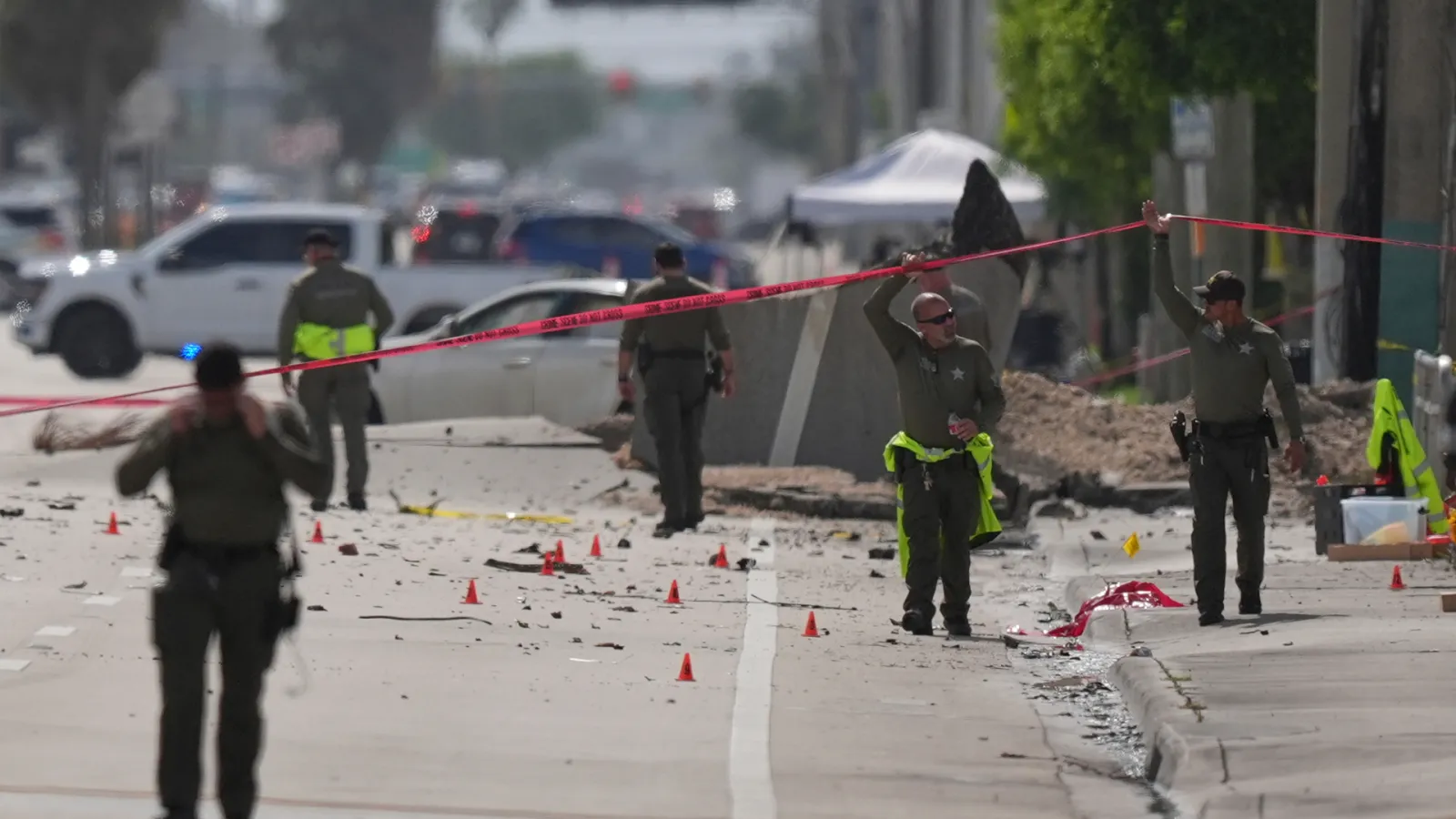
The aircraft came crashing down in a residential area, bursting into a massive fireball on impact. Shocking dashcam footage captured the moment the jet slammed into the ground, leaving behind a large crater and widespread destruction.
Florida Governor Ron DeSantis described the horrifying scene, saying the aircraft looked like "a missile going down."
Even more disturbing was the audio recorded during the plane's final moments, which captured the cockpit crew desperately attempting to regain control of the aircraft.
During the emergency transmission, Filgueiras could be heard reporting the plane's terrifying rate of descent.
"We are in an overspeed condition, descending 20,000 feet per minute," she said.
She later issued repeated warnings as the aircraft continued its rapid descent.
"We're descending 8,000, mayday, mayday, we're descending 10,000 feet per minute."
A male pilot, whose identity has not been released, could also be heard reciting the Lord's Prayer as the situation deteriorated.
At one point, Filgueiras desperately warned, "We're going to crash into the ground."
Her final words included an expletive as the crew appeared to realize there was no time left. The recording then fell silent.
The U.S. Sun said it would not publish the final seconds of the distress call.
Young pilot earned her wings before her driver's license Filgueiras' death is particularly heartbreaking given how young she was when she first achieved her dream of becoming a pilot.
A Palm Beach County native, she earned her private pilot's license in October 2023 while attending West Boca Raton High School. She was just 17 years old at the time.
Her achievement was highlighted in a report by CBS affiliate WPEC, where she proudly explained that she had learned to fly before obtaining her driver's license.
"I definitely do brag because people say, 'Oh, you can't drive,' and I'm like, 'Yeah, but I can fly,'" she said during the interview.
She added that she enjoyed doing something different from her classmates and was proud of accomplishing something many people her age had never considered.
Her aviation journey began in 2020, when she enrolled in Ground School during her sophomore year.
Her interest in flying was also encouraged by her father, who began flying recreational in 2018 and helped introduce her to aviation.
By the time she earned her license, Filgueiras had accumulated 88 hours of flight experience and successfully completed the required aviation knowledge examination.
Her training was funded through the Palm Beach County School District's Aviation Academy.
Nine people killed as investigators examine possible cause All nine people aboard the Learjet were killed in the crash. The identities of the other eight victims have not yet been publicly confirmed in the original report.
The tragedy also sparked false speculation online that legendary musician Lenny Kravitz had been among those onboard. His representative quickly dismissed the claims, telling BocaNewsNow that the reports were "untrue and incorrect."
The National Transportation Safety Board is investigating the circumstances surrounding the disaster.
Meanwhile, former pilot Martin Varsavsky has suggested that severe weather may have played a role in the aircraft's sudden loss of control.
One possibility he raised was a dangerous aerodynamic phenomenon known as coffin corner.
This occurs at high altitudes when an aircraft's minimum safe flying speed approaches its maximum operating speed, leaving pilots with an extremely narrow margin for maintaining control.
If an aircraft flies too slowly, it risks stalling. If it exceeds its safe speed, it can also become dangerously difficult to control.
Varsavsky speculated that the Learjet may have attempted to climb above two storm systems before encountering dangerous atmospheric conditions.
Comparing the possibility to previous aviation disasters, including Air France Flight 447 in 2009, he argued that pilots must maintain a substantial distance from powerful storm systems rather than attempting to fly through them.
However, investigators have not established weather, pilot error or coffin corner as the cause of the Florida crash.
The NTSB investigation will determine what happened during the aircraft's final moments and why a flight carrying nine people ended in such a devastating loss of life.
Background on Learjet 60 Aircraft Operations
The Learjet 60 is a mid-size cabin, twin-turbofan engine business jet manufactured by Bombardier Aerospace in Wichita, Kansas. First taking flight in June 1991, the aircraft type received Federal Aviation Administration certification in January 1993 before entering commercial service. Powered by two Pratt and Whitney Canada PW305A engines, the jet is known for its high cruising speed and performance capabilities at elevated altitudes. Corporate flight departments and charter operators frequently use the Learjet series for regional and transcontinental business travel due to its efficiency and speed.
Operating a private jet at high altitudes requires rigorous adherence to safety protocols, particularly when encountering changing weather patterns. Aviation safety authorities maintain strict guidelines regarding flight crew resource management, emergency procedures, and responding to sudden atmospheric disturbances such as icing and severe turbulence. Private aviation operators are subject to oversight by national regulatory bodies, which mandate regular pilot training, simulator evaluations, and aircraft maintenance inspections to ensure airworthiness.
Understanding National Transportation Safety Board Investigations
The National Transportation Safety Board is an independent U.S. government investigative agency responsible for civil transportation accident investigation. Founded in 1967 and headquartered in Washington, D.C., the agency investigates accidents involving aviation, highway, marine, pipeline, and railroad transport. When an aviation disaster occurs, NTSB investigators deploy to the scene to collect perishable evidence, examine wreckage, interview witnesses, and analyze flight data recorders and cockpit voice recorders.
During a major air crash inquiry, specialists reconstruct the sequence of events leading up to the incident. They analyze meteorological data, air traffic control transcripts, radar tracking information, and mechanical components. The investigative process often takes many months, culminating in the release of a final report that identifies the probable cause of the accident and issues safety recommendations intended to prevent similar tragedies from occurring in future commercial and private aviation operations.