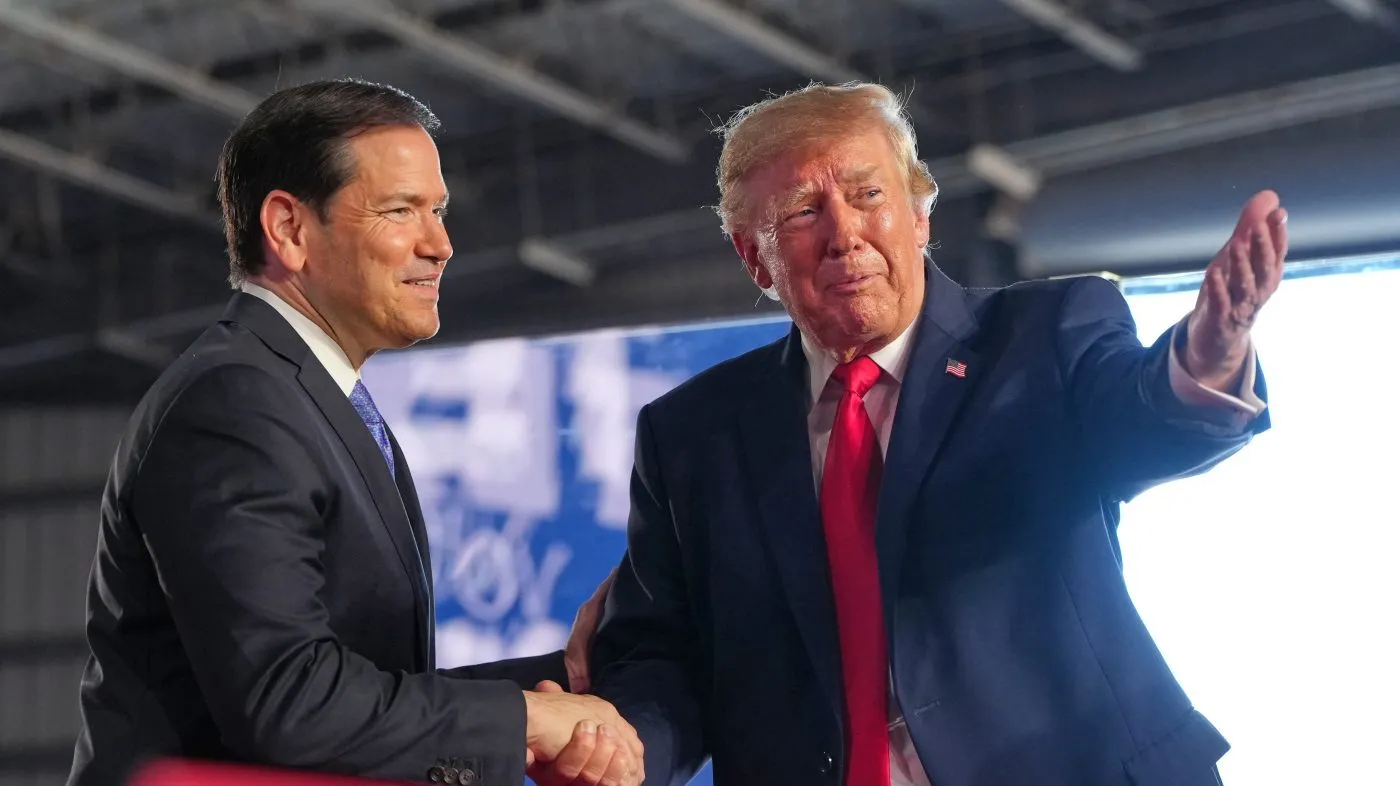
Secretary of State Marco Rubio travelled to Colombia, Ecuador, Peru, Iceland, Greece, Portugal, Uzbekistan and India, while President Donald Trump continues to depend on his son-in-law Jared Kushner and Manhattan real-estate partner Steve Witkoff for major diplomatic negotiations.
The practice of assigning high-stakes diplomacy to family members and business associates would spark outrage in most democracies, yet Trump has made it routine.
In this model of crony diplomacy, personal loyalty, private gain and informal networks routinely override institutional processes and the national interest, while accountability diminishes.
Rubio's itinerary favors lower-risk regions and steers clear of the world's main hot spots, prompting critics to suggest he is protecting his own political future, possibly a presidential run in 2028.
Instead of relying on Rubio or the professional diplomatic corps, Trump repeatedly turned to Kushner and Witkoff as "special envoys" for peace on Ukraine, Russia, Gaza and Iran, despite their lack of diplomatic experience and evident conflicts of interest.
Rubio remains the administration's point man on Venezuela and Cuba, though neither country has enhanced his record. The Trump administration's policy of strangling Cuba has created a severe humanitarian crisis without achieving regime change, while a U.S. military operation in Venezuela that captured the sitting president emboldened Trump's costly war on Iran.
Trump boasted, "We've taken out so much oil in Venezuela, we paid for the cost of the war [on Iran] about 25 times over." Venezuela's oil-export revenues are deposited directly into U.S. Treasury accounts, with Rubio overseeing exports and finances, often described as a "weekly allowance" for approved humanitarian or infrastructure projects.
Rubio's recent trip to India included a private visit to the Jamnagar complex, the world's largest oil-refining facility, to promote greater purchases of Venezuelan heavy crude to ease a global diesel crunch.
Jamnagar can process about 1.4 million barrels per day and is owned by Mukesh Ambani's Reliance Industries, operating an export-only facility within a Special Economic Zone.
India, the world's third-largest oil importer, is unlikely to significantly increase Venezuelan oil imports due to higher transportation and marine-insurance costs, and Indian firms are unlikely to invest directly in restoring Venezuela's oil fields under U.S. oversight.
Rubio's India visit, limited to Mumbai and Jamnagar, highlighted pragmatic cooperation over diplomatic friction, but also underscored the limits of a fragmented foreign policy under Trump's crony diplomacy.
Since Trump's return to office, U.S. diplomacy in the Middle East has increasingly reflected personal and commercial priorities, with Kushner's "New Gaza" proposal criticized as "real estate diplomacy."
By sidelining the secretary of state, Trump has reshaped U.S. diplomacy into a personalized, transactional and opaque approach, reducing America's credibility and effectiveness on the world stage.
Brahma Chellaney is the author of nine books, including the award-winning "Water: Asia's New Battleground."