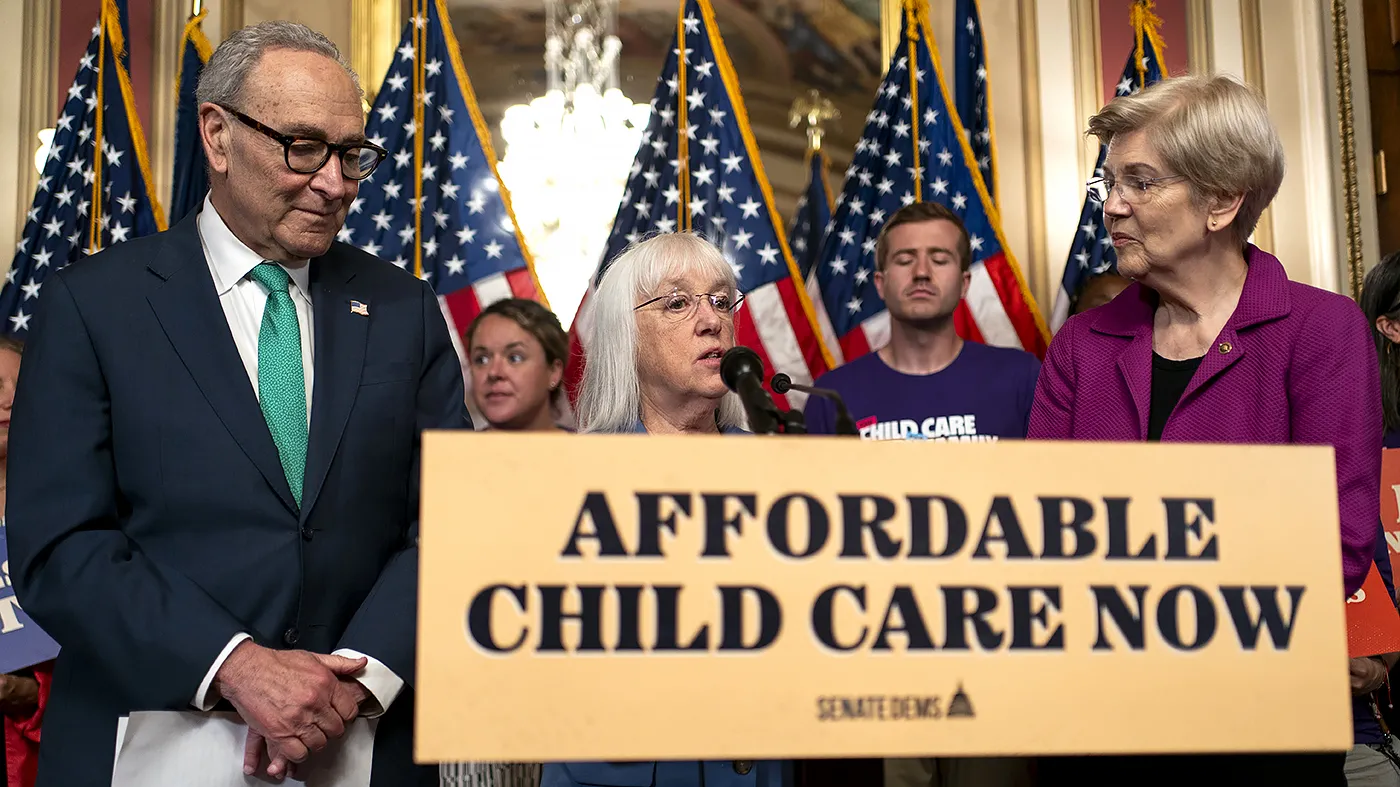
Democratic candidates, lawmakers and advocacy groups say childcare must be addressed as they head toward the November elections, hoping a congressional majority will let them advance a federal affordability plan.
Winning a majority would place childcare among the everyday costs Democrats aim to lower, joining proposals on housing, health and other bills.
Senate hopefuls and many House candidates have highlighted childcare in recent campaigns, and the most notable off-year wins - New Jersey and Virginia governor races and the New York City mayoral contest - leaned heavily on subsidies and expanded access.
Nevertheless, factions differ on the best approach, and the issue will compete with other priorities if Democrats assume control, potentially shaping the 2028 presidential primary.
"I absolutely think it's become a prerequisite for running for president that you need to have a plan to solve for childcare and make sure that families can have safe nurturing care that they need for their kids," said Julie Kashen, founder and principal of Women's Economic Futures.
During the COVID-19 pandemic, Congress poured billions into emergency childcare aid, but most of that funding expired in 2024.
Kashen noted the relief money demonstrated what sustained federal investment could achieve. "The pandemic kind of pulled the invisibility cloak off of this issue that had been there all along, and as a result of that, it became an even hotter topic," she said, adding that state innovations showed the potential for affordable, stable care.
In the Senate, Elizabeth Warren (D-Mass.) and Patty Murray (D-Wash.) co-chair a childcare working group, while Representatives Alexandria Ocasio-Cortez (D-N.Y.) and Bobby Scott (D-Va.) lead the House effort.
Warren and Murray released a June framework that calls for a robust public childcare infrastructure and higher wages for workers, though it offers few specifics.
A Senate Democratic aide told The Hill, "Democrats understand that childcare is fundamental economic infrastructure and an important way we can deliver to lower costs for the American people, affordable and accessible high-quality childcare is a priority for families so childcare will absolutely be a priority for members in the next Congress."
Representative Katherine Clark (Mass.), the Democratic whip, backs a Child Care is Infrastructure Act that would fund new facilities and provide student-loan repayment for early-education teachers.
Other House members, including Suzanne Bonamici (D-Ore.), Sara Jacobs (D-Calif.) and several colleagues, have championed proposals to support Head Start educators and broader childcare reforms.
Local initiatives echo the national push: New York City is rolling out universal free care for 3- and 4-year-olds, Washington, D.C., offers free pre-K for the same ages, and New Mexico enacted a law guaranteeing no-cost childcare funded by oil revenue.
Advocates now urge Congress to pass a comprehensive package that aids both providers and families.
"I do think that any solution must have a supply side answer to it ... you can't just put money into tax credits and hope for the best," Kashen warned, emphasizing the need for more quality slots before offering cash benefits.
Childcare is not exclusively a Democratic issue; a 1971 bipartisan bill for a national daycare system was vetoed by President Nixon, and some Republicans now push to reauthorize the Child Care and Development Block Grant.
The Trump administration has sought to trim federal childcare spending and regulation, proposing to shift Head Start rule-making to states to reduce costs and expand capacity.
Democrats envision ambitious steps, including a federal universal childcare model championed by candidates such as Angie Nixon (Florida), James Talarico (Texas) and Troy Jackson (Maine).
Project 2029, a Democratic strategy document, outlines two options: publicly funded childcare slots for all children, and a "CareCredit" of $1,000 per month for families who opt out of the free slots.
Tara McGuinness of New America, who helped draft the plan, said the flexibility could attract bipartisan support.
"If you listen to parents, we need more than one thing," McGuinness said, noting the need for paid family leave, quality care and public investment.
Daniel Hains of the National Association for the Education of Young Children likened the momentum to the pre-ACA era, suggesting a childcare equivalent of the Affordable Care Act could soon be feasible.