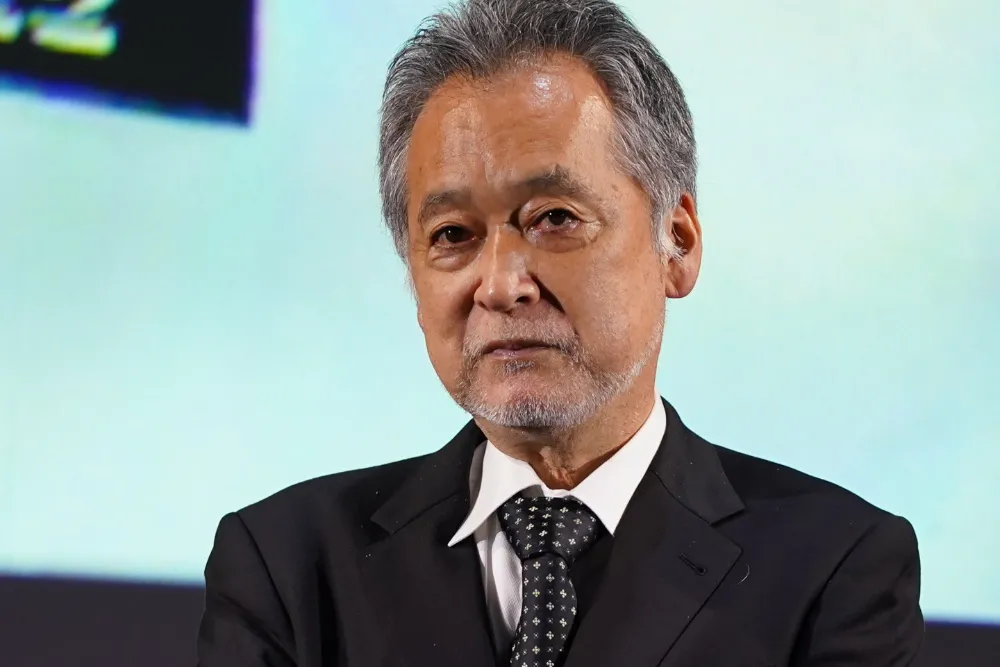
Director Zeze Takahisa, whose film "Sukiyaki" opens the Tokyo International Film Festival, spoke about his early softcore porn and indie projects during a masterclass hosted by the Tokyo Talk program.
The event took place in front of a packed crowd at Tokyo Midtown Hibiya, shifting from Zeze's beginnings in pink cinema to his later works.
Born in Oita Prefecture in 1960, Zeze entered a pink film production house in 1986 as an assistant director before making his directorial bow in 1989 with "Extracurricular Activity: Rape," which earned him the Pink Grand Prix Award for Best New Director. He was recognized alongside Sano Kazuhiro, Sato Toshiki and Sato Hisayasu as one of the "Four Heavenly Kings of Pink."
Because pink films screened in specialty cinemas for male-only viewers, filmmakers needed to include a bed scene roughly every 10 minutes. "I've always been pretty firm in my convictions," Zeze said. "Starting from the early 1990s the culture shifted and I had more freedom to say what I wanted. That kind of thing was important to me."
During that period, Zeze gravitated toward narratives involving female criminals. "It's just different from the male perspective," he stated. "The motives behind the crimes and so on. I found it fascinating."
Zeze scripted "Extracurricular Activity: Rape," which followed delinquent high school girls lingering at Tokyo's Haneda Airport and fighting the yakuza. He gave it the private title "Go to Haneda and You Will See Kids Dressed Like Pirates Ready to Attack."
Discussing his 1994 pink film "Genuine Lesbians: Embarrassing Positions," which he privately titled "Fallen Angels in September" and centered on female soulmates, Zeze noted it captured the era's fascination with mysticism among youths. "Searching for past lives became a sort of trend, and people started seeking connections to this different world," he remarked. "I thought that maybe I could make a movie centered around something like that."
Zeze recalled that the "Four Heavenly Kings" nickname originated at a pink theater in Toyama, or possibly Ishikawa, as he could not recall precisely. The moniker gave the directors a similar cachet to the "Nouvelle Vague" label. "So we figured that, rather than work as individuals, we should debut under a group name," he explained. "We decided to use the 'Four Heavenly Kings' label to our advantage."
International screenings followed, including retrospectives at the Rotterdam festival. "Actually, the overseas reception came first, and then it was sort of re-imported" back to Japan, Zeze noted.
Back home, pink film directors still needed to include erotic content. "No one was telling us to stop doing these politically sensitive things," Zeze stated. "It was just wonderful... there really was a lot of freedom back then."
Makers of pink films also moved outside a pornographic niche. "Things weren't standardized back then," Zeze mentioned. "I worked with directors from my generation who had diverse backgrounds, like Aoyama Shinji and Suzuki Takuji. We'd get together either because we'd met by chance or because we wanted to create something interesting."
In 1997, Zeze transitioned to mainstream filmmaking with the teen horror "Kokkuri-san," continuing to balance pink and mainstream projects over the next decade.
His largest project arrived in 2010 with "Heaven's Story," a 278-minute revenge drama that played in the Forum section of the Berlin Film Festival and secured the FIPRESCI Prize.
"It was different from a so-called 'ordinary movie,'" Zeze said. "I'd been working on commercial films until then, but I realized I had to do something else. Personally, I felt a sense of urgency - or maybe a sense of crisis - that things weren't going well, and that's what pushed me to take on this challenge."
Zeze noted frequent discussions about the difficulty of producing films without existing source material. "But the movies we actually found interesting or the ones I personally found entertaining were all originals."
Although Zeze has directed commercial films adapted from intellectual property, such as the 2016 two-part mystery adaptation "64" based on a bestselling novel, he cautioned against industry trends. "The industry is too focused on the 'source material market.' They think that if the source material is selling well, they should adapt it."
"So I feel that pursuing original concepts and making original films is incredibly important right now," he concluded. "They have a unique, compelling strength."