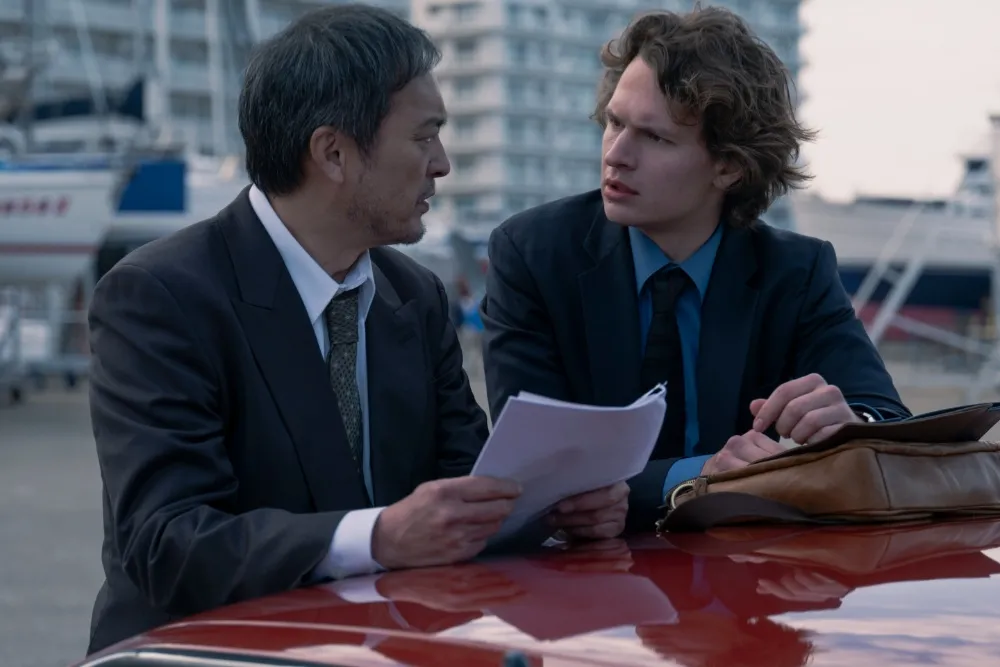
"Tokyo Vice" producer Alex Boden and Netflix production policy director Deb Richards urged reforms to Japan's international production incentive during the Motion Picture Association's annual seminar held at the Tokyo International Film Festival, as the government readies a new agency to centralise fragmented content-industry support.
Boden, a London-based producer who spent nearly two years in Japan shooting two seasons of HBO Max's "Tokyo Vice," traced the incentive's evolution from a 2020 research programme, which the series backed, through the 2023 J-LOD scheme to the current IP360, which offers a 50% rebate on Japanese spend.
He noted that the minimum spend requirement, now JPY800 million ($5.1 million), excludes independent films and co-productions, since most Japanese titles cost between $1.5 million and $3 million. He also advocated replacing the panel-based selection with an automatic approval system, arguing that Japan is among the few territories with a subjective incentive, a factor that can stretch project assembly to three-to-five years.
"So how does a producer know that they can count on the Japan incentive in advance? That's the question, and we need a solution," Boden said, citing Martin Scorsese's "Silence," "Pachinko" and "Shōgun" as Japan-set projects that scouted locally but filmed abroad, and urging training components in the incentive model, pointing to the U.K.'s 0.5% ScreenSkills levy as an example.
"You can have a lower incentive, that's fine, as long as it's certain, as long as the criteria are clear," Richards added during the panel. "And that's one of the things that for the Japan incentive, the criteria is not clear." She said applicants can only infer why they were rejected by reviewing who received approval, describing the process as "opaque."
Paul Muller, the MPA's vice-president of production policy for Asia-Pacific, highlighted Australia's rule that an international production must spend at least AUD20 million ($13.9 million) and allocate 1% of its budget to training. Since that rule took effect in June 2023, over AUD20 million has been invested in training, he said, while the average cost of an hour of Australian TV has risen from AUD2 million ($1.4 million) to roughly AUD5 million–AUD6 million ($3.5 million–$4.2 million) over seven or eight years. Muller welcomed indications that METI, which administers the incentive, is shifting from single-year to two-year financing and raising maximum thresholds.
Georgina Pope, head of production at Toho Tombo Pictures, whose recent Japan work includes A24's "Marty Supreme" and "Monarch: Legacy of Monsters," said permitting in Tokyo remains tough but is improving. Her crew recently closed the road in front of Tokyo City Hall to film a large car sequence. "I'm finding that Japan is really starting to realize the value of having a dynamic international film industry," Pope said.
Boden claimed Japan is currently the world's hottest location for film. "Everyone seems to be in Japan or visiting Japan tomorrow," he warned, adding that allowing years to slip would represent "a real missed opportunity."
On the government side, Nakahara Hirohiko, director-general of the Cabinet Office's Intellectual Property Strategy Promotion Secretariat, told the seminar that a task force for the new entity met for the first time on Oct. 22. The body, ordered directly by the Prime Minister, is intended to dissolve silos among the ministries that each handle a piece of content policy: the Ministry of Internal Affairs and Communications, the Agency for Cultural Affairs, METI and, for overseas expansion, the Ministry of Foreign Affairs. The government plans to launch it in 2027.
The initiative is part of a public-private investment roadmap announced in July, which targets JPY20 trillion ($127 billion) in overseas sales by 2033. Content ranks among 17 strategic fields in Prime Minister Takaichi Sanae's growth strategy. For film, the roadmap includes support for large-scale location shoots, backing for international co-productions based on Japanese IP and stronger anti-piracy measures.
"We hope to become a global hub for film shooting and production," Nakahara said.
Amari Akira, former Liberal Democratic Party secretary-general and METI minister, recalled chairing the parliamentary league behind Japan's basic content law 22 years ago, with future prime minister Kishida Fumio as its secretary-general and Hayashi Yoshimasa running its secretariat. He joked that the lineup proved his foresight. He said the original thinking was sound, but execution lagged, causing Japan to fall behind Korea in exporting its content.
"In our day, we tried to do this through addition. This time, the government is doing it through multiplication," Amari said, describing the 2033 target as a plan to quadruple the industry in ten years and expressing belief that further growth is possible.
TIFF's new festival director Hisamatsu Takeo noted that Japan was the country of honor at this year's Cannes Film Market and that 37 Japanese films screened at the recent Busan International Film Festival.
Looking ten years ahead, Muller said that if the government delivers on the discussed changes, the JPY20 trillion IP360 goal is "well within scope and well achievable."