House Democrats are crying foul on Wednesday after Republicans used a fast-track tactic to pass partisan legislation designed to increase pay for disabled and injured veterans. The unexpected maneuver on the House floor caught the opposition off guard, sparking intense anger from minority leadership and committee members in Washington.
Democrats opposed the GOP's Take Care of America's Veterans Act (TCAVA), saying it would expand some veterans' benefits by slashing others. In her daily whip notice, Rep. Katherine Clark (D-Mass.) urged House Democrats to vote no.
Yet when Rep. Addison McDowell (R-N.C.), the Republican lawmaker presiding over the House chamber on Wednesday afternoon, brought the bill up for consideration, no one on the Democratic side demanded a recorded vote, a curious silence given that Democrats were whipping against the bill. That allowed McDowell to declare the bill passed instantly, by voice vote.
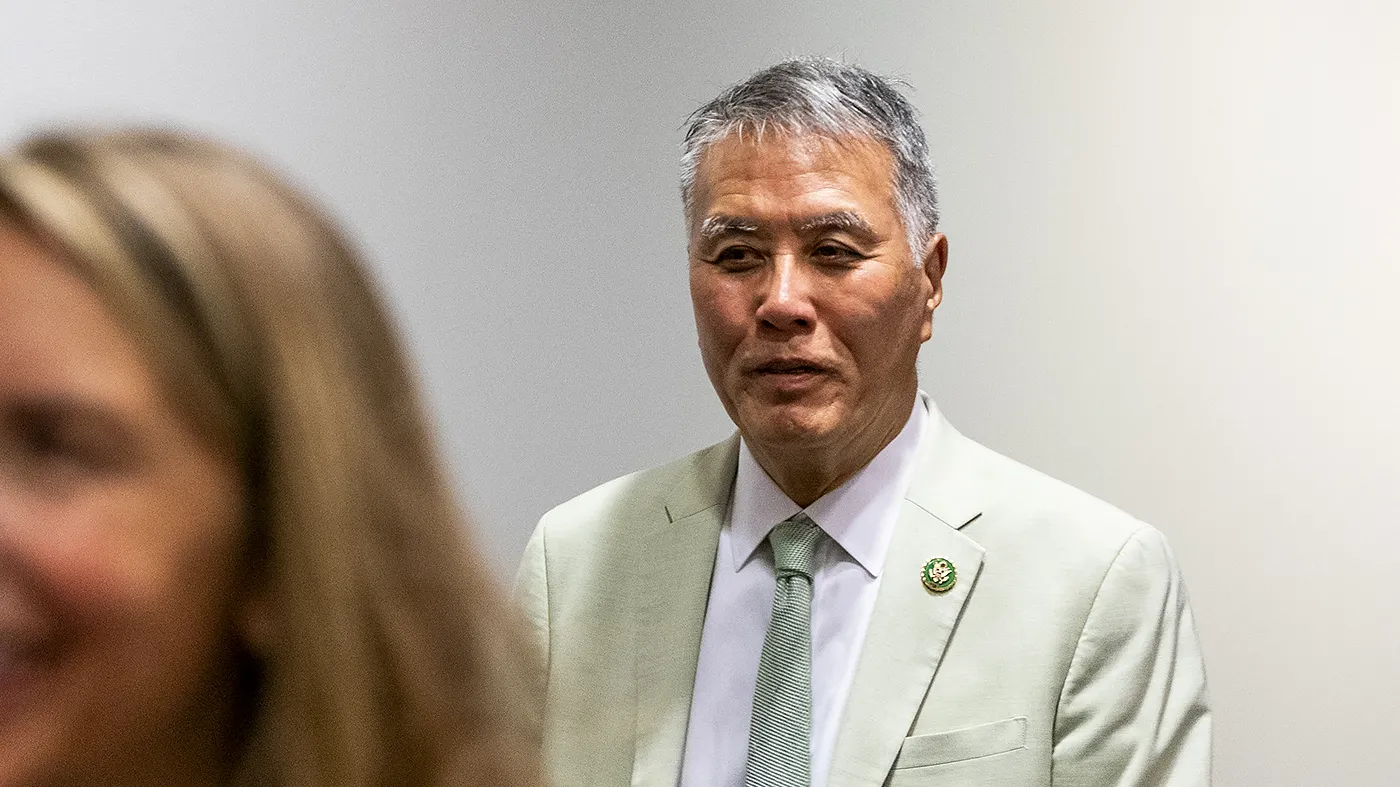
Furious Democrats accused Republicans of playing "dirty pool." They said Republicans pulled Rep. Mark Takano (D-Calif.), the ranking member of the House Veterans Affairs Committee, away from the podium, where he was leading the Democratic side of the debate, in order to discuss changes to the bill. It was during that parlay, while Takano was away from his microphone, that McDowell fast-tracked the proposal, they said.
"After publicly announcing a recorded vote on the TCAVA legislation, House Republicans asked if RM Takano and Democrats would agree to last minute engrossment corrections," a Democratic leadership aide said.
"While members and staff were evaluating these changes away from the podium, House Republicans called the vote up and passed it by voice within seconds, depriving Democrats of the ability to even evaluate the proposed changes and ask for a recorded vote so Members could vote against the biggest cut to veterans benefits in US history.
"On Veterans Day of all days, using dirty tricks to steal from Veterans is a disgrace."
The TCAVA package revises the Veterans Affairs (VA) disability ratings for sleep apnea and tinnitus, expands eligibility for a memorial headstone or marker for the spouse, establishes a standardized screening process for routing admission to some mental health care programs and addresses VA personnel, hiring, and infrastructure matters.
Republicans quickly applauded the bill's passage.
"This historic package of veterans legislation delivers long overdue reforms to strengthen veterans' healthcare, expand benefits, and cut through VA bureaucracy," House Veterans' Affairs Committee Chair Mike Bost (R-Ill.), who sponsored the bill, wrote on X.
"Our veterans kept their promise to America, and this Veterans Day, we're delivering for them," Bost added.
The massive package of bills, which has divided veterans groups, was stalled in the House for months.
In July, House Speaker Mike Johnson (R-La.) pulled the bill from the House floor after GOP leadership realized the massive measure did not have enough Republican support to advance.
Veterans groups supportive of the package celebrated.
"This Veterans Day, Congress did more than thank our veterans for their service and sacrifice. They took meaningful action to honor the promises we made to them," Concerned Veterans for America (CVA) Executive Director John Vick said in a statement. "This is the kind of leadership our veterans have waited far too long to see from Washington, and we thank the lawmakers who worked hard to make it happen."
Democrats are pushing an alternative bill, sponsored by Takano, that also increases benefits for disabled veterans.
That bill, dubbed the Major Richard Star Act, advanced on the floor Wednesday. It was brought up after Democrats had successfully garnered 218 signatures on a discharge petition to force a vote on the bill. It is scheduled for a final vote on Thursday.
The measure, named after a U.S. Army combat engineer who was diagnosed with cancer due to toxic burn pit exposure, would give around 54,000 combat-injured, medically retired service members retirement pay and Veterans Affairs (VA) disability concurrently.
"It is far past time for us to end the wounded warrior tax and to give our combat wounded veterans the compensation they have earned," Takano said on the House floor.
The bill, which was originally introduced in 2023, has been supported by a variety of veterans groups, but its potential passage has been blocked by Republican senators in 2025 and earlier this year over cost concerns.
The Major Richard Star Act received a boost earlier this year after being endorsed by Defense Secretary Pete Hegseth.
Background on Legislative Procedures in the House of Representatives
The United States House of Representatives operates under a complex set of rules governing how legislation is debated, amended, and voted upon by elected members. A voice vote is a standard parliamentary procedure where the presiding officer asks members to voice their approval or opposition collectively by shouting aye or no without recording individual votes. This method is typically used for non-controversial measures or procedural motions to save time during busy legislative sessions. When legislation faces intense opposition, members routinely request a recorded vote, which requires a minimum threshold of support or a specific request from a member before the gavel falls to ensure every representative's stance is officially logged in the congressional record.
Discharge petitions represent another procedural tool available to lawmakers when leadership blocks a bill from coming to the floor for a standard vote. By gathering a majority of signatures from members across the chamber, typically 218 signatures, a lawmaker can force a measure out of a committee and onto the House floor for consideration despite opposition from the majority party leadership. This mechanism bypasses traditional roadblocks and allows rank-and-file legislators to bring high-priority proposals directly to the full chamber for debate and a final decision.
Understanding Veterans Affairs Benefits and Disability Ratings
The Department of Veterans Affairs manages a vast system of benefits, medical care, and financial compensation for former military service members who sustained injuries or developed medical conditions during their time in uniform. Disability ratings are assigned as a percentage based on the severity of a condition, which directly determines the monthly monetary compensation a veteran receives. Conditions such as sleep apnea and tinnitus are among the most common medical issues evaluated by the agency, leading to frequent legislative debates over how evaluation criteria should be structured and funded.
Concurrent receipt of military retirement pay and disability compensation has been a long-standing point of contention for medically retired veterans and advocacy organizations across the United States. Historically, retired service members with service-connected disabilities faced reductions in their retirement pay equivalent to the amount of disability compensation received from the Department of Veterans Affairs. Legislative efforts like the Major Richard Star Act seek to eliminate this offset for combat-injured veterans, ensuring they receive their full earned benefits without financial penalties.
The Role of Advocacy Groups and Congressional Leadership
Advocacy organizations representing former military personnel actively lobby lawmakers in Washington to influence policy outcomes concerning healthcare access, budget allocations, and benefit expansions. Groups such as Concerned Veterans for America engage in public campaigns and policy research to support legislative packages that align with their organizational priorities. These entities work closely with key congressional figures, including committee chairs and party leaders, to build momentum for complex legislative initiatives that often face months of negotiations behind closed doors.
Congressional committee leadership holds substantial influence over the trajectory of bills moving through the legislative process, directing committee hearings, markups, and floor debates. The House Veterans' Affairs Committee handles policy oversight and drafts legislation affecting millions of former service members and their families. Debates within these committees frequently reflect broader partisan divisions in Congress, particularly when disagreements arise over how to fund proposed expansions without creating unintended financial burdens for other programs.