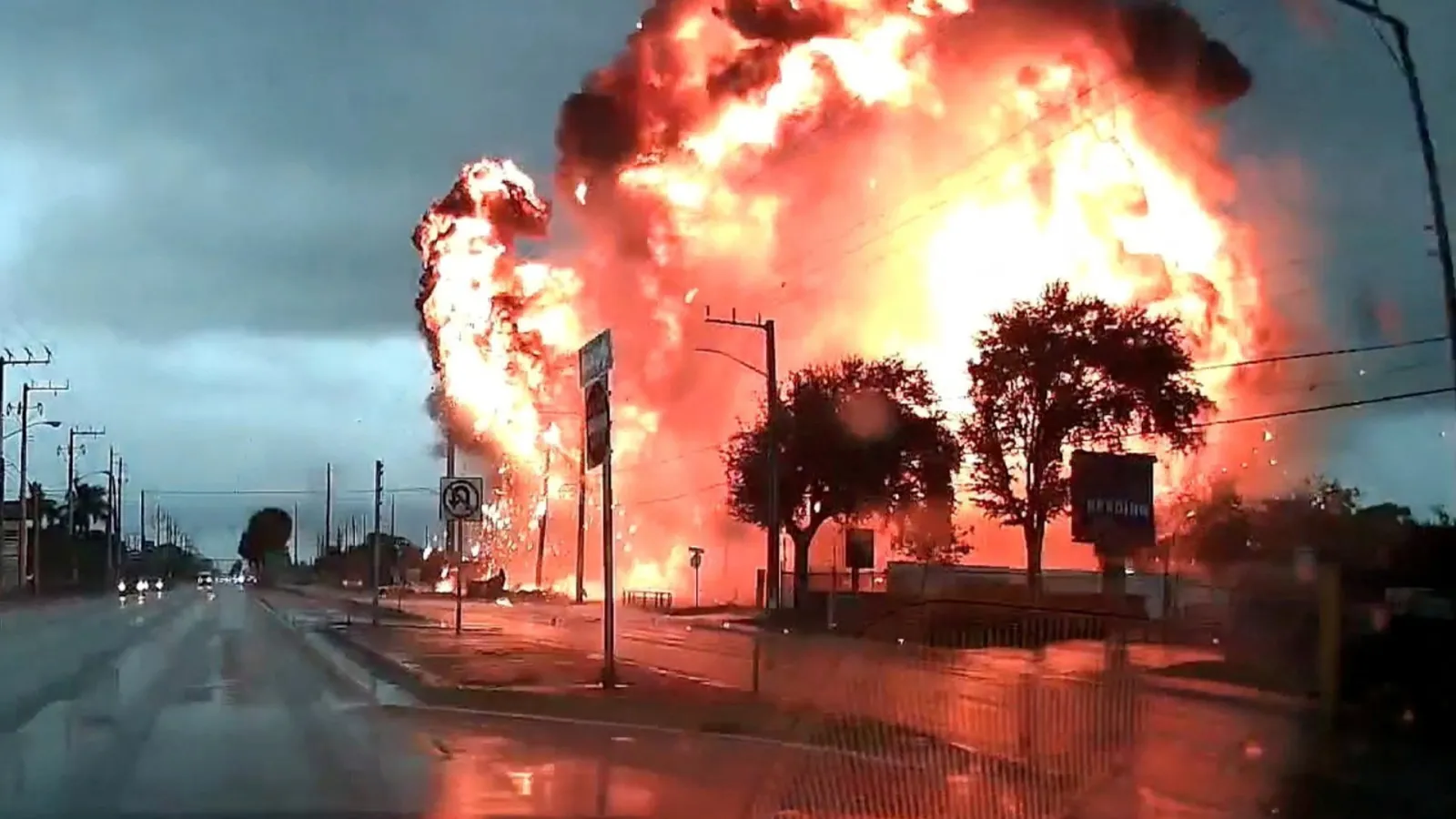
Horrifying 911 calls have laid bare the fear and confusion of those on the ground after a Learjet 60 plunged from the sky and crashed near a busy road, killing all nine people on board during a fatal learjet crash florida event.
Panicked residents described hearing a deafening blast as the plane slammed into the ground in Greenacres, Palm Beach County, on Sunday, November 1.
The newly released recordings capture the chaotic aftermath of the Florida disaster, with terrified locals struggling to understand what had happened as smoke rose above their homes.
One woman compared the terrifying noise to a bomb explosion, telling dispatchers that her home had shaken and the electricity had briefly cut out.
In the emergency calls, a separate frantic witness told dispatchers, We need, I think, police because I think a bomb just landed.
There was an explosion, the first woman said in audio obtained by Fox News Digital.
I think an airplane or rocket, something fell from the sky.
Clearly shaken, she added, We felt our house shake, and then we heard an explosion when we ran outside.
The woman said the blast had briefly knocked out the electricity in her home before the power returned just seconds later.
She rushed outside and spotted sparks and dark smoke rising near where the aircraft had crashed.
It was black, it was dark, like it was burning, she told the dispatcher.
The witness initially wondered whether the loud boom had been caused by lightning, telling the operator she had not heard the usual sound of thunder.
Other emergency operators questioned whether an electrical transformer or explosive device might have been responsible as reports flooded in from the surrounding neighborhood.
The emergency calls were made at approximately 12.51 pm, just moments after the aircraft crashed near a busy roadway.
The doomed jet had departed Austin-Bergstrom International Airport in Texas at approximately 10.37 am and was heading to North Eleuthera Airport in the Bahamas.
Among the victims was Austin technology entrepreneur Adam Robinson, 45, who was traveling with his wife, Helen Sharp, 40, and their two young children.
Their daughter Emma, four, and son Charlie, two, were also killed in the devastating crash.
The children's nanny, Anita Maria Cetina, was among those who lost their lives, along with family friends Rachael Reed and Charmi Fehr, who were a couple.
The aircraft's two pilots, Jeffrey Gregory, 55, and Nathalia Gadelha Filgueiras, 20, were also killed, bringing the death toll to nine.
The tragedy unfolded as powerful thunderstorms and heavy rain swept across parts of South Florida, with investigators now examining whether the severe weather contributed to the disaster.
Flight-tracking data and air traffic control recordings have since revealed the jet's terrifying final minutes before it plunged toward the ground.
At approximately 12.47 pm, co-pilot Filgueiras reported that the aircraft was experiencing light, clear ice and moderate turbulence while flying at around 35,000 feet.
The young pilot initially described the conditions as manageable, but the situation rapidly deteriorated as the aircraft encountered precipitation.
At approximately 12.48 pm, Filgueiras requested permission to climb to 37,000 feet in an apparent attempt to escape the hazardous weather.
Air traffic controllers approved the climb, but less than 30 seconds later, the crew issued a desperate mayday as the jet began plummeting.
Filgueiras warned controllers that the aircraft was descending at 8,000 feet per minute before the rate increased.
We are in an overspeed condition, descending 20,000ft per minute, she told air traffic controllers.
Filgueiras then issued a chilling warning, We're going to crash into the ground.
One controller desperately attempted to reassure the crew, telling them, I'm here with you. Talk to me.
The crew fought to regain control, while captain Gregory could reportedly be heard reciting the Lord's Prayer in the background.
In the final seconds before the radio fell silent, Filgueiras cried out, Holy f***, we're out of time!
Moments later, the Learjet smashed into the ground, erupting into a fireball and leaving a huge crater in the roadway.
Aviation experts have since raised concerns that ice accumulation on the aircraft's wings or tail may have contributed to the sudden loss of control.
Veteran pilot and aviation attorney Ed Booth told The U.S. Sun that those on board may have endured deafening wind noise and extreme forces as the aircraft hurtled toward the ground.
Investigators have also recovered sections of the jet's left elevator, a crucial flight-control surface, nearly four miles from the crash site, indicating that parts of the aircraft separated before impact.
The National Transportation Safety Board is examining the recovered wreckage and flight recordings, but the official cause of the crash has not yet been determined.
Background on the Learjet 60 Aircraft Family
The Learjet 60 is a mid-size cabin, twin-turbofan engine business jet built by Bombardier Aerospace. Production of the model began in the early 1990s as an evolution of the earlier Learjet 55 design, featuring a longer fuselage and more powerful Pratt and Whitney Canada PW305A engines. The aircraft is widely operated by private owners, charter companies, and corporate flight departments around the world for fast executive transport. It typically seats between six and eight passengers in a club configuration, though configurations can vary based on the specific interior completion chosen by the owner.
Safety records for the Learjet series are monitored closely by civil aviation authorities such as the Federal Aviation Administration in the United States. Operating high-performance business jets requires rigorous pilot training, adherence to strict maintenance schedules, and continuous monitoring of weather hazards. High-altitude operations, particularly involving swept-wing aircraft, demand precise handling during encounters with turbulence, icing conditions, or rapid depressurization events. Pilots undergo recurring simulator training to manage emergencies, including engine failures and sudden flight control anomalies at high speeds.
National Transportation Safety Board Investigation Protocol
The National Transportation Safety Board is the independent federal agency charged with investigating civil transportation accidents in the United States. When a fatal aviation incident occurs, a team of specialist investigators deploys to the scene to document wreckage distribution, collect perishable evidence, and interview witnesses. Specialists in aerodynamics, air traffic control, meteorology, powerplants, and human performance analyze every available data point. This meticulous process often takes many months or even more than a year to complete before a final report is published.
Investigators examine cockpit voice recorders and flight data recorders, commonly known as black boxes, to reconstruct the final moments of a doomed flight. Radar data, air traffic control audio recordings, and maintenance logs are cross-referenced with physical evidence recovered from the accident site. Debris scatter patterns help aerospace engineers determine whether an inflight breakup occurred before ground impact. The agency also reviews historical weather data and air traffic communications to establish the complete chronological sequence of events leading up to the disaster.
Weather Patterns and Aviation Safety in South Florida
South Florida experiences complex meteorological phenomena, ranging from fast-moving tropical thunderstorms to heavy seasonal downpours and atmospheric instability. Aviation meteorology pays close attention to high-altitude hazards such as clear-air turbulence, convective activity, and upper-level icing conditions. When warm, moist air meets cooler air masses at high altitudes, rapid cloud development and turbulence can challenge even experienced flight crews. Meteorological reports are continually updated and transmitted to pilots via automated systems and air traffic control channels during flight operations.
In-flight icing remains a critical concern for jet aircraft operating at high altitudes where ambient temperatures drop below freezing. Ice accumulation alters the aerodynamic profile of wings and control surfaces, potentially reducing lift and increasing drag unexpectedly. De-icing and anti-icing systems on modern business jets are designed to mitigate these risks, but severe environmental conditions can sometimes overwhelm onboard protective equipment. Flight manuals provide specific operational limitations and recovery procedures for crews encountering unexpected ice accumulation or severe turbulence.