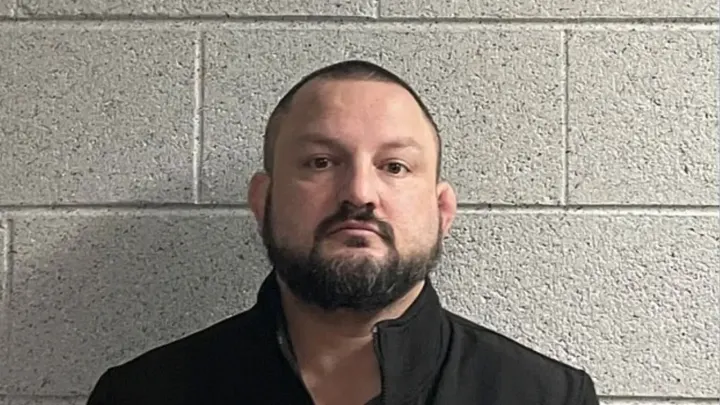
A British doctor has been charged with murdering a South American model after bragging to the press that he had a lock-tight England match alibi. Colombian prosecutors have formally indicted Matthew Foster-Smith over Natalia Villalba and her death in her rented apartment after a five-month-long investigation. A cleaner found the lifeless 36-year-old brunette stuffed inside a suitcase under a running shower in the country capital, Bogota. She was discovered four days after being bludgeoned to death on June 18. Convicted stalker Foster-Smith was arrested at Quito International Airport in neighbouring Ecuador four days later. After crossing the border, he told a reporter that he was watching a football match on a big screen in an Irish bar so it could not have been him.
Prosecutors have now confirmed the 47-year-old from Bournemouth, Dorset, will be tried for his alleged victim aggravated femicide as well as a second crime of concealment, alteration, or destruction of physical evidence. He faces a prison sentence of up to 50 years if convicted. Incriminating CCTV evidence revealed in September is expected to be shown in court when he is put in the dock. The footage shows him wiping the floor outside Natalia flat after suspected blood spilled onto the ground from bin bags he was carrying. Images also show him peering out of the rented seventh-floor apartment, appearing to check the coast is clear before leaving. He is seen wearing different trousers to those he had on when he entered the residential block just over two hours earlier for an arranged rendezvous with his alleged victim.
A recycling worker who told police he found clothes with red stains on them in a black bag in the building rubbish bins is expected to testify. A housekeeper who found the suitcase containing Natalia body is also expected to give evidence after telling investigators her apartment, including her bed, was covered in badly cleaned blood. Colombia National Forensic Medicine Institute director Ariel Cortes revealed the murder victim, who also worked as a graphic designer, died after being hit over the head with a heavy object. Her dismembered body parts were then stuffed into the suitcase in which she was discovered. He said early on in the investigation that Natalia Villalba died from blunt trauma caused by a blow to the head and then she was placed in a suitcase. When a person body ends up in a suitcase it is normally introduced in different parts and that was what happened in this case. She was dismembered.
He added that the fact the suitcase was left under a running shower accelerated the decomposition. If a body is in a situation where there is no moisture or dampness, decomposition is delayed and when there is water it is quicker and that makes things like taking fingerprints more difficult. Despite that and because of the techniques available, authorities were able to determine the body was that of Natalia Villalba. Foster-Smith was jailed for 18 months in 2020 at Bournemouth Crown Court after stalking an ex and posting revenge porn online. After his release he began stalking another woman in her 40s by hanging around outside her workplace and engineering chance meetings with her in public. Dorset Police publicly warned people not to approach him and call emergency services if they saw him after he was charged with stalking in September 2024 but skipped bail and went on the run for a month. The search was called off in October 2024 after he was tracked down to London and arrested. In October last year Foster-Smith was handed a new two-year, two-month prison sentence at Bournemouth Crown Court.
Detective Constable Thomas Norman said at the time his second victim continued to live in fear and her life had been destroyed by her convicted stalker behaviour. The British medic, struck off from the General Medical Council register after his first stalking conviction, is understood to have been released on licence in January. Shortly after his June 26 arrest in Ecuador and extradition to Bogota the following day, it emerged he was facing a new accusation from a US holidaymaker he shared a room in a hostel with before Natalia was beaten to death. The tourist is said to have told the hostel owner, who contacted police, that he had woken up feeling dizzy with pain in his private parts. It was not clear today how far that probe has gone. A date for Foster-Smith murder trial has yet to be set.
Background on the Investigation and Extradition
The investigation into the death of Natalia Villalba spanned five months across multiple countries before formal charges were brought against the suspect. Colombian law enforcement agencies worked alongside international authorities to track Matthew Foster-Smith after he fled across the border into Ecuador following the incident in Bogota. Border controls and airport security protocols played a crucial role in locating the fugitive at Quito International Airport just days after the discovery of the crime. Extradition proceedings moved swiftly to return the British national to Colombian soil to face the judicial system in the capital city where the offense took place. Legal experts in South America have noted that cases involving foreign nationals require extensive coordination between diplomatic channels, consular services, and local police departments to ensure proper jurisdiction and due process are maintained throughout the pre-trial phase.
Forensic experts at the National Forensic Medicine Institute in Bogota used advanced scientific techniques to identify the remains despite the accelerated decomposition caused by the running water. Pathologists and crime scene technicians analyzed trace evidence, dental records, and DNA samples to confirm the identity of the graphic designer. The use of closed-circuit television footage recovered from the residential building provided investigators with a chronological timeline of movements leading up to and immediately following the fatal attack. Prosecutors assembled a comprehensive dossier containing witness testimonies from building staff, recycling personnel, and the housekeeper who initially raised the alarm upon discovering the gruesome scene inside the seventh-floor apartment. The accumulation of physical and digital evidence forms the foundation of the prosecution case as the matter moves toward a formal trial in the Colombian courts.
Prior Criminal History and Legal Proceedings in the United Kingdom
Matthew Foster-Smith accumulated a significant criminal record in the United Kingdom prior to the events in South America, primarily involving harassment and stalking offenses. Bournemouth Crown Court served as the venue for multiple hearings addressing his persistent targeting of former partners and other women in Dorset. Law enforcement agencies in the UK issued public appeals and warnings regarding his whereabouts when he breached bail conditions and went on the run from authorities. Detective work by Dorset Police eventually led to his apprehension in London during October 2024, culminating in a prison sentence handed down by British judges for violations related to his stalking campaign. The General Medical Council took disciplinary action by removing his medical license following his initial convictions, effectively ending his professional practice within the British healthcare system.
The cumulative impact of these domestic convictions drew scrutiny from law enforcement bodies and regulatory panels concerned with public safety. Courts heard harrowing victim impact statements detailing the psychological toll inflicted upon those targeted by his persistent surveillance and intimidation tactics. The transition from domestic stalking offenses to allegations of extreme violence abroad highlighted concerns among investigators regarding escalation in criminal behavior. Legal frameworks in both the United Kingdom and Colombia handle extradited individuals through established treaties designed to address serious felonies, ensuring that suspects face accountability for allegations spanning international borders. The upcoming court proceedings in Bogota will address the specific charges of aggravated femicide and evidence concealment under local statutes.