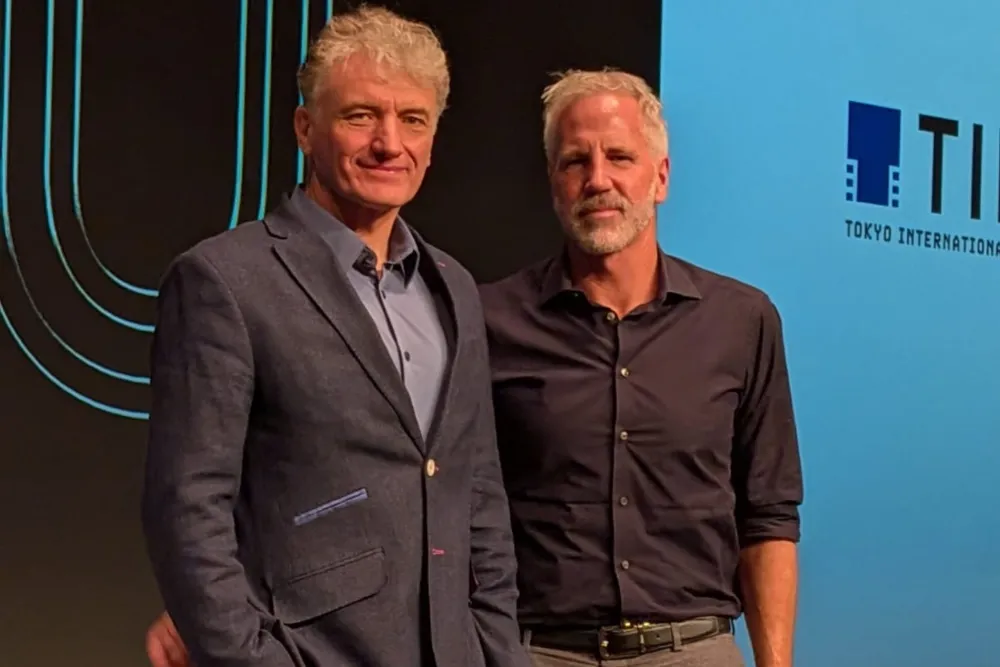
AGBO partners Chris Brearton and chief scientific officer Dominic Hughes presented a keynote at TIFFCOM, the content market of the Tokyo International Film Festival, on Thursday, discussing AI's impact on filmmaking and its role as a tool for creators.
Brearton, a partner and business leader at AGBO, and Hughes, the company's chief scientific officer, represent the Los Angeles-based studio that produces cross-platform properties such as Extraction (2020), Everything Everywhere All at Once (2022), The Gray Man (2022), Extraction 2 (2023) and The Electric State (2025).
Brearton recalled that early in the Russo brothers' careers, while working on the Emmy-winning comedy Arrested Development, they received a script that would normally be too long and costly to shoot. Instead of discarding it, they employed digital cameras and editing to bring it to life, saying, "They looked at technology as a solution that empowered them to tell the story they wanted to tell." He said that mindset now runs through AGBO's corporate DNA.
He also cited Walt Disney as an inspiration, noting Disney's move of characters into theme parks. "In 2026 we are using technology to build a virtual theme park, a virtual community bringing people together," Brearton said.
Brearton emphasized that "creative artists are special" and that humans remain uniquely positioned to tell stories, adding that AGBO's approach to technology always puts artists first.
Hughes pointed to Pixar's evolution of 3D rendering, explaining that technology alone was insufficient; it served storytelling. "Technology played a supporting role. That's how we think about these things at AGBO," he said.
With a strong academic background in algorithms and machine learning, Hughes described his childhood fascination with Disney cartoons and teenage immersion in 3D rendering and video-game creation, as well as his experience playing cello in orchestras.
He said his creative side finds expression at "the intersection of media and technology," believing that humans must curate algorithms to prevent them from running unchecked. At AGBO, his role "is really about supporting artists to be more and more creative."
Brearton added that AGBO's LA studio places technologists and creatives side by side, fostering collaboration.
While AI excitement grows, Brearton warned of misinformation surrounding its role, noting concerns that AI might replace creators. He argued the human element makes a favorite performance special and that AI will be most impactful in the midterm for process efficiencies.
He described AI as an empowerment tool that handles tedious tasks, allowing creators to enjoy their work. Hughes echoed that AI helps storytellers become better, handling "annoying things that keep you from enjoying yourself."
Regarding artificial general intelligence, Hughes said it will not doom artists; even the greatest composers cannot be replicated by machines. He said AGBO's technologists build tools that boost creativity and productivity without taking jobs.
Hughes observed that AI excels at regurgitating past work but lacks the novelty required for true creation. He noted AI can critique, for example, identifying whether an attic-found play might be Shakespeare's, yet a AI-written Shakespeare would read like a 12-year-old's work.
Brearton gave scriptwriting as another use case: AI can supply data when a writer struggles with a third-act character, offering information, not solutions.
He said AI can democratize storytelling, enabling new filmmakers to produce movies that otherwise wouldn't be made because AI helps them achieve their vision on affordable budgets.
Hughes cautioned that AI can generate endless mediocre content that consumers cannot absorb, stressing the need to raise quality standards.
When asked if AI will replace lower-level creative work, Hughes replied that producing timeless works still requires many humans in the loop.
Addressing concerns about AI strip-mining content without compensation, Brearton said AGBO tracks every tool and usage, maintaining a comprehensive copyright paper trail.
Looking ahead, Brearton described the future of entertainment as "concurrence," noting his son consumes multiple media sources simultaneously. He said creators must build worlds that tell stories across platforms concurrently while delivering quality entertainment.
He concluded that, regardless of technology, "you still have to create incredible stories with wonderful characters in a rich world to live in."
The keynote was moderated by Variety's Asia Editor Naman Ramachandran.