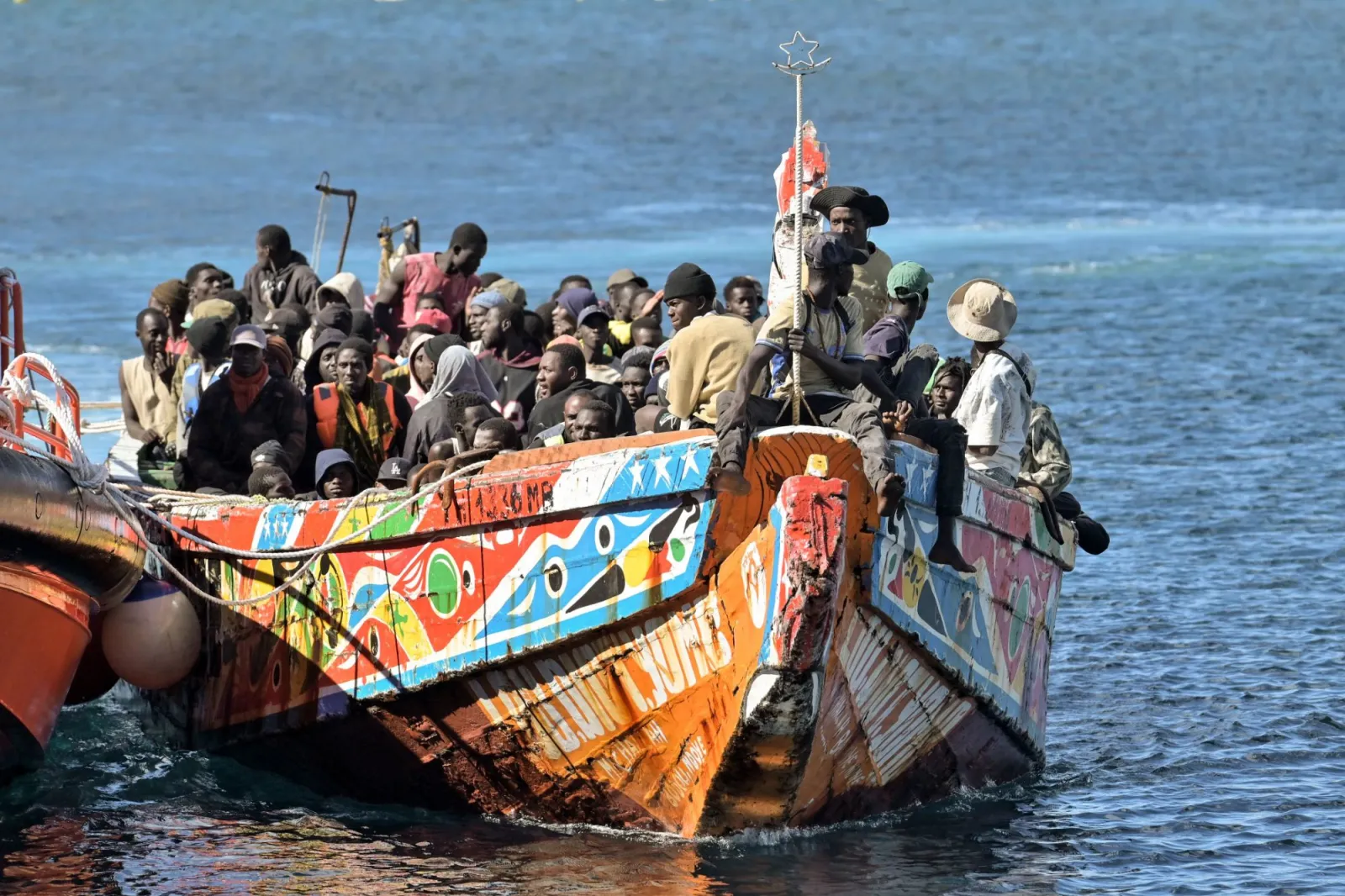
Growing fears suggest that smuggler motherships might be towing thousands of migrants toward a popular canary island population doubles as thousands of migrants arrive left on the edge of collapse by an unprecedented influx. Spanish authorities declared a state of emergency after the tiny island of El Hierro was flooded by more than 12,000 migrants in just weeks, exceeding its entire permanent population.
Some 1,580 people were rescued at sea on Saturday alone, smashing the previous record for single-day arrivals in the Canaries and sparking fears of another Ceuta-style crisis. In total, more than 3,900 men, women and children arrived over the weekend aboard 23 overcrowded wooden boats, pushing emergency services and local reception centres to breaking point.
Thousands of migrants have been forced to sleep rough on the docks amid growing local unrest, with local ambulances, hospitals and Red Cross teams operating beyond capacity. Others are being urgently transferred to neighbouring islands, including Tenerife, where an old reception facility is being reopened in La Laguna to ease the mounting pressure.
Serious questions are also being raised over how so many tiny, fragile wooden boats, known as cayucos, are managing to survive the treacherous Atlantic crossing from west Africa. Politicians and locals fear organised smuggling gangs are deploying large motherships to tow the smaller vessels across the open ocean, or carry migrants for hours before releasing them onto the ramshackle boats just miles from the Canaries.
The explosive theory has triggered urgent demands for the Spanish Navy to be called in to patrol the waters off El Hierro and intercept the alleged smuggling vessels. Xavier Garcia Albiol, a senior politician with the opposition People's Party, or PP, is among those demanding immediate naval intervention.
While there is currently no evidence proving motherships are operating on the Atlantic route, a similar tactic was uncovered by Italian authorities near Lampedusa in the central Mediterranean back in June 2019. Many of those rescued off El Hierro arrived suffering from severe hydration, hypothermia and skin abrasions after spending weeks at sea.
The majority of arrivals set off from countries in Africa including Mauritania, Senegal and Gambia. Canary Islands president Fernando Clavijo has slammed Madrid's response to the crisis, warning that the wave of arrivals is overwhelming the regional health service.
He has demanded increased patrols off the coasts of Senegal and Gambia as well as the deployment of EU border agency Frontex to stop boats setting off in the first place. Clavijo also accused the Spanish government of failing to honour promises of financial aid and extra medical staff, warning that the Spanish government is not honouring the agreement it reaches and this is generating widespread frustration among the population.
He previously stated that more personnel, resources for healthcare and emergency response, and swift transfers are needed to ease the pressure on the island and its professionals. However, he rejected calls to use the army to intercept boats at sea, arguing soldiers would simply end up acting as lifeguards and bringing the migrants ashore anyway.
Territorial policy minister Angel Victor Torres visited the fishing port of La Restinga on Sunday, where the surge in arrivals since mid-October has triggered protests from furious locals worried about safety and damage to the island's tourist image. Just 3,708 people reached the picturesque islands between January and June, according to interior ministry figures.
But more than 6,000 people arrived in October alone, followed by around 11,000 migrants in the first half of November. In total, around 17,000 people have reached El Hierro so far this year, with around 27,000 making it to the Canary Islands as a whole.
The months after the summer are typically the busiest of the year, when hostile trade winds ease and the crossing becomes more navigable. However, the crossing between the west African coast and the Canaries remains one of the world's most dangerous migration routes.
El Hierro is the second smallest of the Canary Islands, an idyllic tourist favourite boasting volcanic landscapes, hiking trails and historic towns. The island receives around 30,000 tourists per year, making it the least-visited of the main Canary Islands.
The migration emergency comes just two weeks before Spanish voters head to the polls for a snap general election. Left-wing Prime Minister Pedro Sanchez, who offered amnesty to around one million illegal migrants earlier this year, could be replaced by a right-wing coalition, according to polls. The surge also comes as the enclave of Ceuta continues to grapple with its migration crisis after more than 80,000 migrants stormed its borders in July. Many migrants, including unaccompanied minors, remain sleeping in the streets despite local efforts to shelter, register and deport people back to Morocco.
Geographic Background of the Canary Islands Route
The Canary Islands form an autonomous community of Spain located just off the southern coast of Morocco in the Atlantic Ocean. Because of this geographic proximity to the African continent, the archipelago serves as a major gateway for maritime migration toward Europe. El Hierro is the southwesternmost and smallest inhabited island of the group, leaving its limited infrastructure particularly vulnerable when maritime arrivals spike rapidly over short periods.
The Atlantic Migration Route Challenges
Migrants attempting the sea journey to the Canary Islands typically depart from various points along the western coast of Africa, including nations such as Morocco, Western Sahara, Mauritania, Senegal and Gambia. This maritime corridor spans hundreds of miles of open ocean with powerful currents and unpredictable weather patterns. Vessels used by travellers are frequently overcrowded, poorly maintained wooden fishing boats that lack basic navigation and safety equipment.
Response From Regional and National Authorities
Management of migration in Spain involves a division of responsibilities between regional administrations like the Canary Islands government and central state authorities in Madrid. Regional leaders have repeatedly called for greater financial allocations, specialized medical deployment and enhanced naval assets to secure territorial waters. Meanwhile, national ministries coordinate border protection operations in conjunction with European agencies to monitor departures across countries of origin in west Africa.