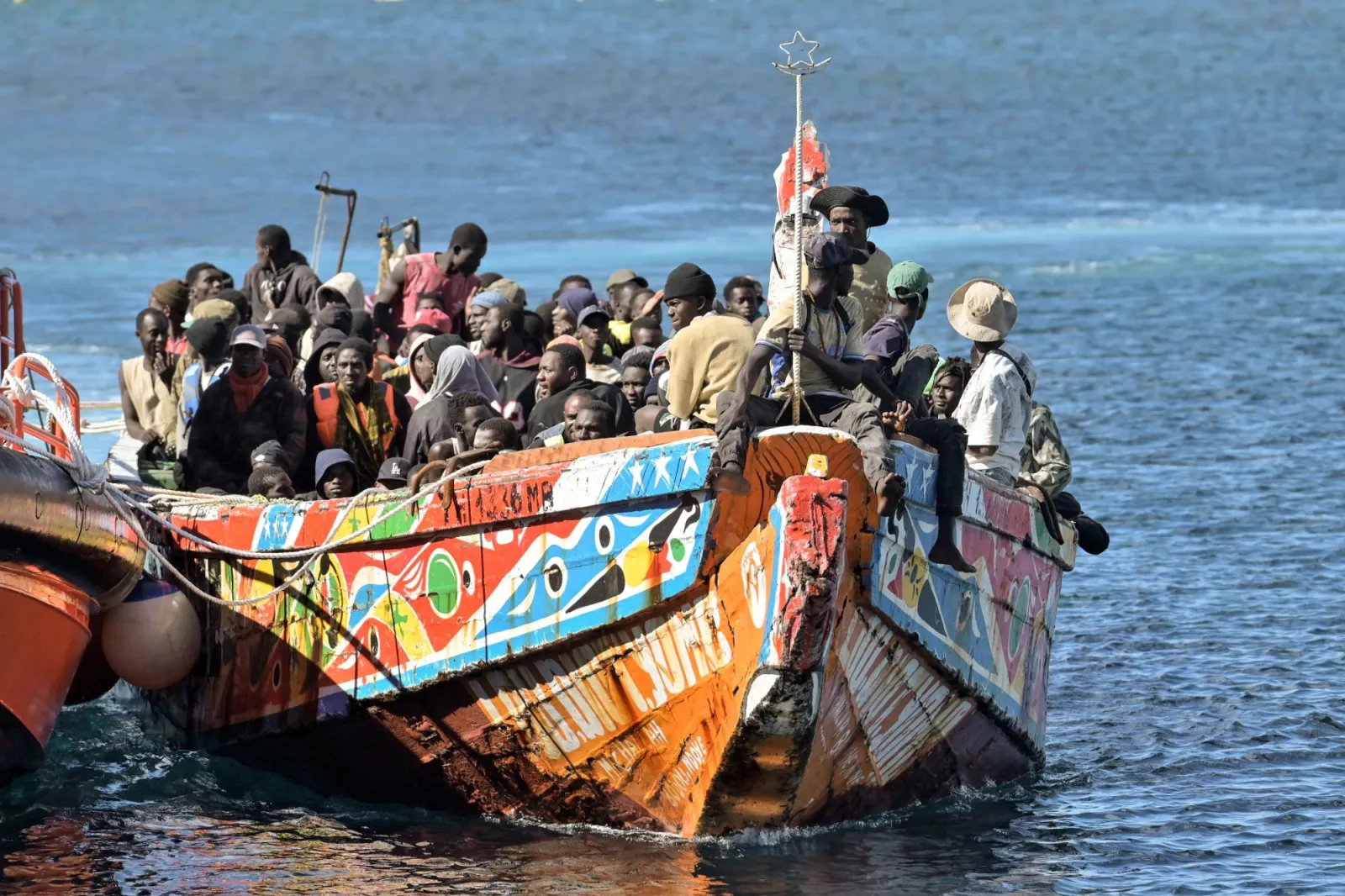
A popular Canary island is teetering on the edge of collapse after more than 12,000 migrants flooded the tourist hotspot in a matter of weeks.
Spanish authorities have been forced to declare an emergency as local services buckle under the unprecedented number of arrivals, surpassing the entire island's permanent population.
The surge has generated growing concerns that the situation in El Hierro, which is home to roughly 11,500 residents, could transform into a full-blown Ceuta-style crisis.
This development follows a record-breaking weekend in the sun-kissed archipelago, which recorded its highest single-day total of migrant arrivals ever on Saturday after 1,580 people were rescued at sea.
Eight Maritime Rescue and Civil Guard vessels scrambled to intercept 15 overcrowded wooden boats, breaking the previous record of 1,461 set on November 7, 2020.
A further 1,261 migrants packed onto seven more boats reached El Hierro on Sunday, pushing the total number of arrivals since Friday to a staggering 3,684.
Local authorities declared a state of emergency and have pressed Madrid for urgent assistance as reception centres reach breaking point.
Canary Islands president Fernando Clavijo warned that the sharp increase in migrant arrivals on El Hierro demands an immediate response from the State, adding that the island cannot continue to face this pressure without the necessary reinforcements.
He added that more personnel, more resources for healthcare and emergency response, and swift transfers are needed to ease the pressure on the island and its professionals.
Around 1,600 migrants currently remain on El Hierro.
The rest have been transferred to other islands or the Spanish mainland to ease pressure on the island's overwhelmed immigration services.
The majority of arrivals came from countries in Africa including Senegal, Mauritania, Gambia and Guinea.
The autumn surge comes after arrivals by sea to the islands collapsed by 67 per cent in the first half of the year.
Just 3,708 people reached the picturesque islands between January and June, according to interior ministry figures.
However, more than 6,000 people arrived in October alone, followed by around 11,000 migrants in the first half of November.
In total, around 17,000 people have reached El Hierro so far this year, with around 27,000 making it to the Canary Islands as a whole.
The months after the summer are typically the busiest of the year, when hostile trade winds ease and the crossing becomes more navigable.
Nevertheless, that does not mean the journey becomes safe.
Whatever the weather, the crossing between the west African coast and the Canaries is one of the world's most dangerous migration routes.
The islands are roughly 65 miles from the closest point in Africa, but many migrant boats take longer routes to avoid police patrol, with the perilous journey sometimes taking up to three weeks.
Authorities estimate around 40 per cent of those who attempt the crossing die at sea, meaning the lives of tens of thousands of migrants have likely been lost already this year.
Last week, the central government agreed a €15.8 million emergency package to help transfer more migrants to the mainland.
The funds will also be used to purchase an extra rescue boat, recruit more Red Cross staff and compensate the island's struggling hospitality sector.
El Hierro is the second smallest of the Canary Islands, an idyllic tourist favourite boasting volcanic landscapes, hiking trails and historic towns.
The island receives around 30,000 tourists per year, making it the least-visited of the main Canary Islands.
The migration emergency comes just two weeks before Spanish voters head to the polls for a snap general election.
Socialist Prime Minister Pedro Sanchez, who offered amnesty to around one million illegal migrants earlier this year, could be on the way out, according to polls.
A right-wing coalition of the People's Party and Vox is widely expected to take power after the November 29 vote.
The surge also comes as the enclave of Ceuta continues to grapple with its migration crisis after more than 80,000 migrants stormed its borders in July.
Most returned to Morocco in the following days, but the government said 5,000 remain, angering residents and straining resources.
Following the Ceuta border rush in July, the Spanish government has been facing mounting pressure over its handling of the migration crisis.
Despite its claims that only 5,000 are still in the enclave, Ceuta's mayor says as many as 15,000 remain.
Many migrants, including unaccompanied minors, remain sleeping in the streets despite local efforts to shelter, register and deport people back to Morocco.
Geography of the Canary Islands Migration Route
The Canary Islands are an autonomous community of Spain located in the Atlantic Ocean off the northwest coast of mainland Africa. El Hierro is the most southwestern and smallest of the inhabited islands in the archipelago, possessing a rugged terrain born from volcanic activity. The geographical proximity to the African coastline makes the islands a primary target for individuals attempting to reach European soil via the Atlantic ocean. The journey requires navigating open ocean waters where deep sea currents and unpredictable weather patterns create extreme hazards for small watercraft.
History of Maritime Crossings from West Africa
Migratory movements from West African nations toward Spanish territory have fluctuated over decades due to changing economic conditions, political instability, and security enforcement along Mediterranean pathways. Countries such as Senegal, Mauritania, Gambia, and Guinea serve as common departure points for individuals seeking employment or asylum in Europe. Coastal surveillance enhancements in North Africa over the years have frequently pushed departure zones further south along the Atlantic seaboard, extending the distance travellers must cover on wooden pirogues and inflatable dinghies.
Response from National and Local Authorities
Emergency management structures in Spain involve cooperation between municipal councils, regional autonomous governments like the Canary Islands administration, and national ministries in Madrid. State agencies such as Sociedad de Salvamento y Seguridad Maritima operate rescue vessels at sea, while national police forces and the Civil Guard handle reception protocols upon arrival. Funding allocations from the central budget are periodically adjusted to provide temporary housing, medical screenings, and logistical support for administrative processing centres across affected regions.