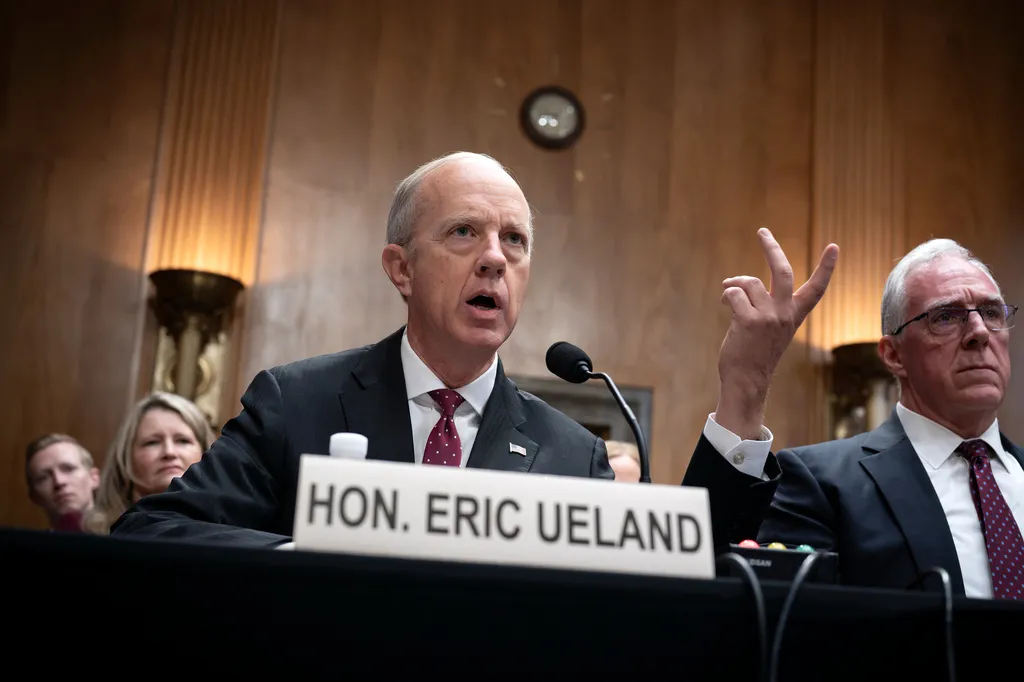
Senate Republicans are advancing the nomination of Eric Ueland to the 15-year term of U.S. Comptroller General without the statutory bipartisan commission review or a public hearing, a move critics say violates law and erodes congressional oversight.
Who Is Eric Ueland?
Eric Ueland currently serves as deputy director at the Office of Management and Budget. He has been nominated by President Donald Trump to lead the Government Accountability Office (GAO), the congressional watchdog agency that audits and evaluates federal programs.
What Is The Comptroller General's Role?
The Comptroller General heads the GAO, an independent agency that provides Congress with data and analysis on the performance and efficiency of federal programs. The position is designed to be nonpartisan, and the law requires a rigorous vetting process to preserve that independence.
How The Nomination Process Is Designed
Under U.S. law, Congress must convene a bipartisan commission composed of House and Senate leadership and oversight committee chairs from both parties. The commission must vet candidates for the Comptroller General position for up to a year, recommending three names to the President. The President then submits a nominee to the Senate for confirmation. This process ensures that the office remains free from partisan influence.
What Is Happening Now?
Senator Rand Paul (R-Ky.), who chairs the Senate Committee on the District of Columbia and is responsible for convening the commission, has not held the required commission meeting. President Trump bypassed the commission entirely and nominated Ueland directly. The Senate has scheduled a hearing this week that will include Ueland's nomination among several others, but the hearing lacks the comprehensive review that the law mandates.
Why Is This Controversial?
Critics argue that the expedited process would allow the GOP to appoint Ueland before the 2024 election cycle ends, potentially locking the GAO in a partisan position. The GAO's mandate is to provide objective oversight of the executive branch, and a rushed nomination could compromise that neutrality. The move is seen as a direct challenge to congressional authority and a means to sidestep the Constitution's system of checks and balances.
What Are The Legal Arguments?
The law requires a bipartisan commission to vet candidates for the Comptroller General position. By skipping this step, the nomination process may violate statutory requirements. Moreover, the lack of a public hearing denies citizens the opportunity to provide input on a role that directly affects federal accountability.
What Is The Political Context?
The nomination comes as the GOP faces a backlash following the 2024 election, which many view as a referendum on President Trump and the broader congressional response to his administration. The decision to move forward with Ueland's confirmation is seen by some as an attempt to solidify Republican control of a key oversight body before the political landscape shifts.
What Are The Implications for Congress?
If the nomination proceeds, Congress may be perceived as compromising its own oversight responsibilities. The move could further erode public trust in legislative checks on the executive branch, especially after a period where congressional approval of the President's policies has been low.
What Is The Next Step?
Senate Republicans are expected to hold a confirmation hearing for Ueland, but the process will likely be expedited. Opponents call on the Senate to halt the nomination, convene the required bipartisan commission, and ensure a thorough public review before any confirmation vote.
Who Is Involved?
Key figures include Senator Rand Paul (R-Ky.) who chairs the relevant Senate committee, President Donald Trump who nominated Ueland, and Eric Ueland himself, the current deputy director of the Office of Management and Budget.
Why Should Readers Care?
The GAO's independence is essential for transparent governance. A rushed, partisan appointment could diminish the agency's ability to hold the executive branch accountable, affecting how federal programs are scrutinized and how taxpayer dollars are spent.
What Is The Public's Role?
Citizens can voice concerns through public comments, contact their representatives, or engage with advocacy groups that monitor congressional oversight. Public pressure may influence the Senate's decision-making process regarding Ueland's nomination.
Key Points
- Eric Ueland is nominated for a 15-year Comptroller General term.
- Senate Republicans plan to confirm him without a bipartisan commission review.
- The GAO's independence is at stake, as the role is designed to be nonpartisan.
- Critics argue the process violates statutory requirements and undermines congressional oversight.
- Opponents urge the Senate to halt the nomination and follow proper procedures.
Why It Matters
The GAO's independence is vital for holding the executive branch accountable. A rushed, partisan confirmation could reduce transparency and erode public trust in federal oversight.
FAQ
- What is the Comptroller General's role? The Comptroller General leads the GAO, auditing and evaluating federal programs to provide Congress with independent oversight.
- Why is the nomination controversial? It bypasses the required bipartisan commission, potentially compromising the GAO's nonpartisan nature.
- Who is responsible for convening the commission? Senator Rand Paul (R-Ky.) chairs the Senate Committee on the District of Columbia and is tasked with forming the commission.