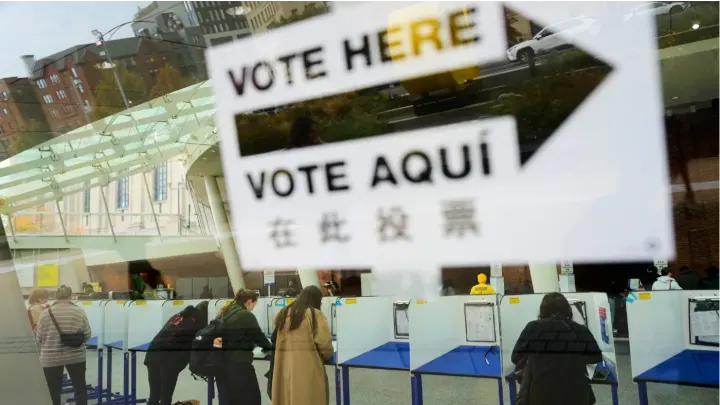
Nobody predicted the stunning sweep and depth of Democratic gains in last week's midterm elections. More than a wave, it was an avalanche that revealed new contours in America's political geography.
It is probably time to toss those red-blue election maps we have become so used to since 2000. They show the main parties hunkered down behind static battle lines, with serious electoral competition confined to a dwindling number of swing states and districts.
The post-midterm map looks strikingly different. In addition to giving Democrats imposing majorities in Congress, U.S. voters in nearly every county in the country shifted in a blue direction. They won federal and state races across the upper and deep South and the broad middle from Ohio to Iowa and Kansas, enlarging the political battlefield and potentially adding a slew of new swing states.
Shifting Control of State Governments
Shifting control of state governments followed the broader national trend as Democrats scored big down ballot gains. They are poised to control 30 governor's mansions, up from 24, and have 22 trifecta wins, meaning governors plus both legislative houses, to the Republicans' 18.
What happened in Texas was jaw-dropping. Democratic State Rep. James Talarico trounced Republican Ken Paxton by 12 points in a state Trump carried by nearly 14 points. Gina Hinojosa ousted Gov. Greg Abbott (R), another MAGA favorite, to become Texas's first Democratic governor since 1995 and its first Latina governor ever. Democrats also flipped the Texas House for the first time since 2003.
With 40 Electoral College votes, Texas was the grandest midterm prize of all. It has been the mainstay of Republican strength in the Trump era, and if it truly becomes competitive in presidential years, the Republicans' path to power could narrow to a rocky goal trail.
Gerrymandering and Congressional Races
Gerrymandering and congressional races saw unexpected reversals as Republican efforts to protect their seats by redrawing district boundaries before the next census backfired. Their strategy galvanized Black voters in the South and yielded just two seats while Democrats claimed six seats.
Euphoric Democrats need to keep reminding themselves that the midterm vote was a harsh reprimand of Trump, not a vote of confidence in them. Many of his 2024 voters saw his inflationary tariffs and attack on Iran as breaking his campaign promises to drive the cost of living down and avoid embroiling the nation in endless wars.
Republicans got walloped as lots of those disillusioned voters stayed home and groups that moved toward him four years ago, including Hispanics, young voters, independents and moderates, swung back to Democrats.
Voter Coalitions and Demographic Shifts
Voter coalitions and demographic shifts played a decisive role when conservative political analyst Sean Trende noted that the president's coalition is shattered and depressed, with every faction blaming the other, leading to a generational wipeout.
Compared to 2024, Democrats saw net gains of 30 points among Hispanics, 34 points among young voters and 20 points among independents in House races. Most encouraging of all, Democrats at least temporarily stopped the defection of working class, non-college voters from their coalition. White non-college voters moved 14 points towards Democrats.
These voters historically had backed Democrats at a higher rate than voters with college degrees until 2012. After Barack Obama won them by four points in his 2012 reelection, working class voters backed the insurgent Trump by six points in 2016. In 2024, he won them by 13 points, the biggest winning margin for a Republican presidential candidate since Ronald Reagan.
Educational Polarization and Party Realignment
Educational polarization and party realignment have reshaped both major parties in this century. Trump's ability to bond with non-college voters seemed to cement this shift based on educational polarization. In recent elections, Democrats have gained ground mainly with college grads and urban professionals, while Trump kicked traditional conservatives to the curb and turned Republicans into a populist blue-collar party.
Trading social bases has been a disaster for Democrats. First off, non-college voters far outnumber degree holders in the electorate, standing at 59-41 in the last presidential election. And the ascendance of college grads in the party has opened a cultural rift between educated elites and ordinary Americans who, in Bill Clinton's words, work hard and play by the rules.
Democrats lurched left after 2000 as millennials came of political age. U.S. voters, however, didn't move with them. According to Gallup, by 2024 55 percent of Democrats identified as liberal, 34 percent as moderate and 9 percent as conservative. In last week's Fox News exit poll, 26 percent of U.S. voters identified as liberal, 41 percent as moderate and 33 percent as conservative.
Building a New Center-Left Majority
Building a new center-left majority is essential because Democrats can't build stable majorities on a base of white college liberals. But the midterm results show that, with the right kind of candidates focused on pocketbook concerns, pragmatic rather than dogmatic, and culturally mainstream, they can win anywhere in the country.
Democrats should seize the opportunity now to build a new center-left majority that strikes a better balance between the aspirations and interests of voters on both sides of America's diploma divide.
Last week's vote cracked open the door to a new political alignment in the post-Trump era. It can't get here soon enough.
Will Marshall is founder and president of Progressive Policy Institute.
Background on United States Midterm Elections
United States midterm elections occur midway through a four-year presidential term, determining all seats in the United States House of Representatives and roughly one-third of the seats in the United States Senate. Numerous state governorships, state legislative seats, and local ballot measures are also decided during these cycles. Historically, the party holding the White House tends to lose seats in Congress during midterm elections due to a combination of voter fatigue, disapproval of current federal policies, and enthusiasm among the political opposition. Analysts study these contests as a referendum on the sitting administration, measuring shifting public sentiment across diverse demographic groups and geographic regions.
Voter turnout patterns in midterm elections traditionally fall below presidential election years, though recent cycles have seen significant spikes in participation. Political scientists closely monitor shifts among suburban voters, rural communities, union members, and ethnic minorities to understand long-term demographic trends. The outcomes frequently dictate the legislative agenda for the remainder of a presidential term, often leading to divided government when opposition parties capture one or both chambers of Congress. State-level results carry profound implications for policy areas ranging from education funding and taxation to environmental regulations and reproductive rights.
Historical Context of Electoral Realignment
Electoral realignment refers to a relatively permanent shift in the voting patterns and demographic coalitions supporting major political parties. Throughout American history, several major realignments have redefined the political landscape, moving the nation from the New Deal coalition forged by Franklin D. Roosevelt to the conservative ascendancy championed by Ronald Reagan. These shifts typically occur in response to major economic disruptions, social transformations, or foreign policy crises that alter how voters perceive their personal economic well-being and national identity.
In recent decades, educational attainment has emerged as a primary dividing line in American politics. Voters holding university degrees have increasingly aligned with the Democratic Party, while non-college-educated voters have gravitated toward the Republican Party. This educational polarization has superseded traditional economic class lines in many regions, transforming voting behavior in industrial states across the Midwest as well as suburban communities nationwide. Observers track these educational and cultural divides to evaluate the stability of contemporary political coalitions.