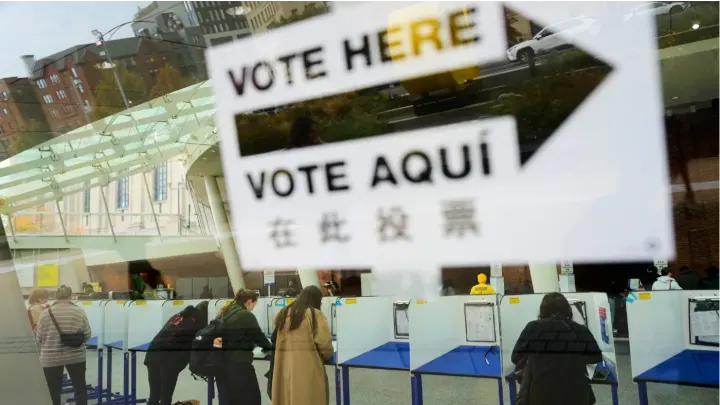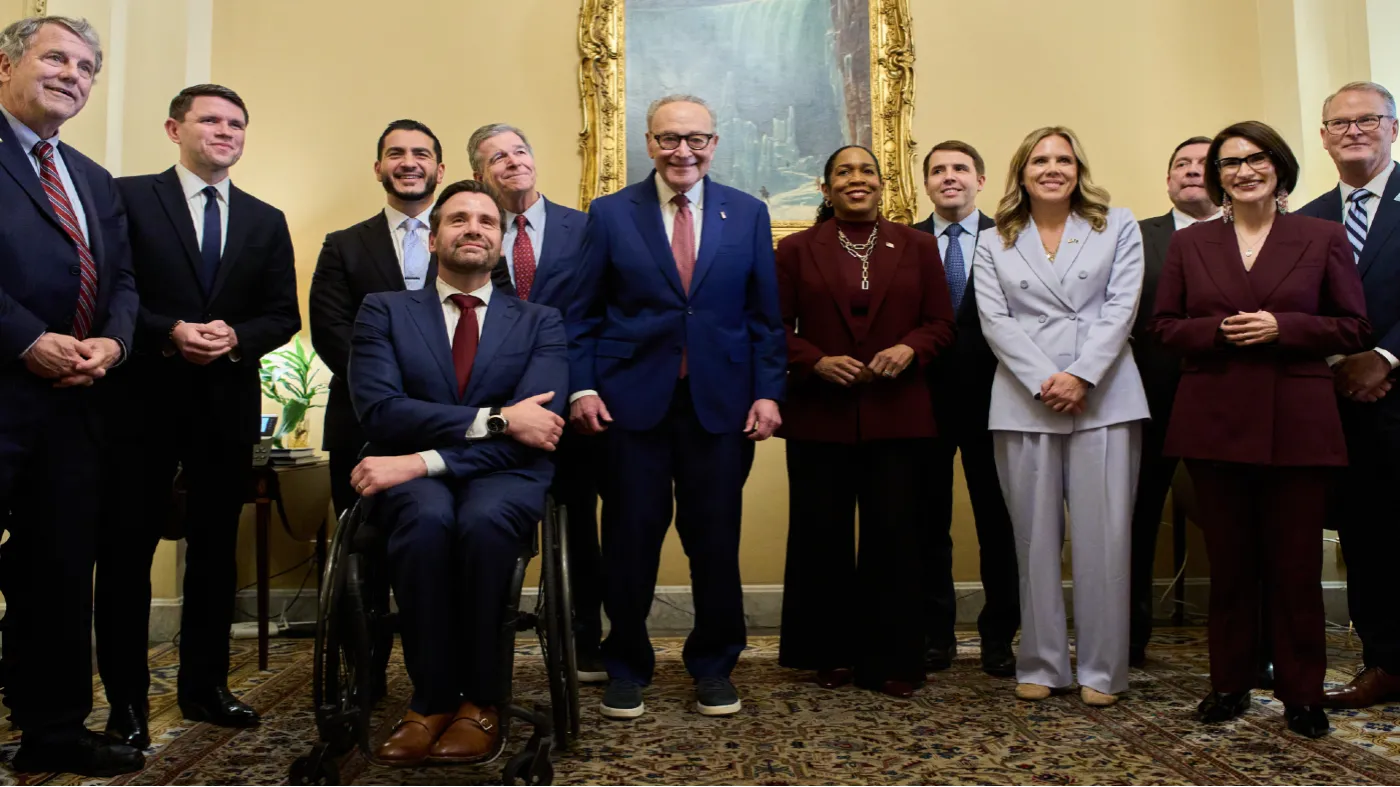
Recent election results delivered the worst night for Republicans in decades alongside the best performance for Democrats since 2008. Tabulations from the Associated Press as of Friday placed the Democratic House tally at 255 won seats against 169 for Republicans, with 11 contests still undecided. Within the Senate, the Associated Press recorded 55 seats for Democrats compared to 44 for the GOP, while the Alaska race remained uncounted for either faction.
Even amid these sweeping victories, exit polling conducted by NBC revealed that 52 percent of voters held an unfavorable view of the Democratic Party. This glaring contradiction characterizes the outcomes of the 2026 midterms, though it remains the exact reality Democrats are most prone to ignoring. November 4 functioned as a sharp repudiation of President Trump alongside the wider Republican Party rather than a genuine embrace of their political rivals.
The underlying cause is straightforward because President Trump reentered the Oval Office on promises to reduce costs, and the electorate concluded he achieved the exact opposite. Roughly two-thirds of participants stated his economic stewardship left conditions worse, and nearly eight in ten among that group cast ballots for Democrats. Furthermore, close to six in ten attributed high prices directly to presidential policies instead of external factors, while approximately two-thirds of House voters asserted that imposed tariffs harmed both national and local commerce.
Republicans compounded presidential unpopularity by running flawed candidates across various regions. Roughly two-thirds of voters in Texas declared that Republican Ken Paxton lacked the necessary character for a seat as a United States Senator. Concurrently, nearly six in ten residents in South Carolina stated that Darline Graham lacked sufficient experience for the role.
Although the Democratic Party successfully capitalized on this perfect storm to create a blue tsunami, the numbers fail to guarantee that these participants will remain loyal. For instance, the 15 percent of voters expressing unfavorable views toward both major parties, commonly designated as double haters, broke 62 to 32 in favor of Democrats after dividing evenly in 2018 and backing Republicans in 2022. By definition, these individuals hold no inherent allegiance to the Democratic platform.
Independent voters, who comprise roughly one-third of the total electorate, favored Democratic candidates by 20 points to mark the largest margin in exit polling history. Yet those identical independents rate Democrats positively at 42 percent and unfavorably at 58 percent. Additionally, seven in ten voters under the age of 30 supported House Democrats after splitting evenly during the 2024 cycle, yet they represented only about 10 percent of total turnout and frequently described their choice as a rejection of Trump.
Hispanic voters also shifted, with roughly six in ten supporting the Democratic candidate. However, the party identification edge among Latino individuals sits at 17 points, which stays well below the 33-point advantage recorded in 2018. Individuals earning under $50,000, representing roughly 30 percent of the electorate, voted majority Democratic after dividing evenly in 2024, and roughly six in ten called living expenses crucial to their decision.
Every single demographic group shifted in response to price pressures, meaning that if living costs fail to drop under a blue Congress, the foundational reason for their shift vanishes. The electoral mandate consequently proves far narrower than the raw seat margins imply.
Roughly eight in ten registered voters across majorities in both parties want living expenses positioned among the highest priorities for the incoming legislative session. When asked about expectations for a Democratic Congress, 44 percent emphasized reducing expenses for groceries, housing, and utilities, while 22 percent mentioned investigating the administration and 21 percent cited impeachment.
Simultaneously, the electorate demands governmental oversight. Roughly seven in ten respondents, which includes approximately 40 percent of Republicans, argue that Congress fails to provide adequate checks against the executive branch. Yet oversight must not be confused with retribution, particularly while citizens continue struggling with everyday kitchen-table issues that candidates promised to resolve upon taking office. Only 36 percent want investigations established as a top priority, and while 39 percent expect Democrats to prioritize impeachment, just 21 percent actually desire it.
Crucially, accountability does not automatically serve as a Democratic asset since Democrats lead on the issue of corruption by a mere 8 points, standing at 38 to 30 percent, while one-third of voters trust neither organization. What Democrats are least inclined to recognize is that a victory of this magnitude actually empowers them to govern directly from the political center.
The New Democrat Coalition recently inducted 40 members-elect to mark its largest freshman class in history, bringing total membership to 142 legislators, which exceeds half of the incoming House Democratic Caucus, while the Congressional Progressive Caucus holds roughly 100 members. Although neither internal faction claims exclusive ownership of the electoral outcome, the dominant segment clearly originates from the center rather than the left.
The wider electorate reflects that centrist balance. Moderates constituted the largest ideological bloc at 41 percent of voters. Conservatives still outnumbered liberals by single digits, but Democrats secured victory because moderates supported them overwhelmingly by 66 percent to 32 percent. Notably, the liberal share of participating voters barely moved, shifting merely two points from 23 percent in 2024 to 25 percent.
In alternative terms, Democrats triumphed not by expanding the progressive left, but by capturing the political middle. That crucial middle ground remains merely on loan.
Ultimately, this dynamic establishes the primary test for Democrats heading toward 2028. Lowering living expenses while holding Trump and Republicans accountable, without sacrificing broader economic concerns, represents the path required to retain these voters.
Devoting the legislative majority to impeachment proceedings and culture wars will undoubtedly drive double haters right back to their previous allegiances, especially since Trump will not appear on the ballot for Democrats to run against in 2028.
Background on the Authors and Polling Research
Douglas E. Schoen and Carly Cooperman operate as professional pollsters and partners within Schoen Cooperman Research, a public opinion analysis firm headquartered in New York. Both individuals maintain active roles in political polling and commentary, and they collaborated as co-authors of the published text titled America: Unite or Die.