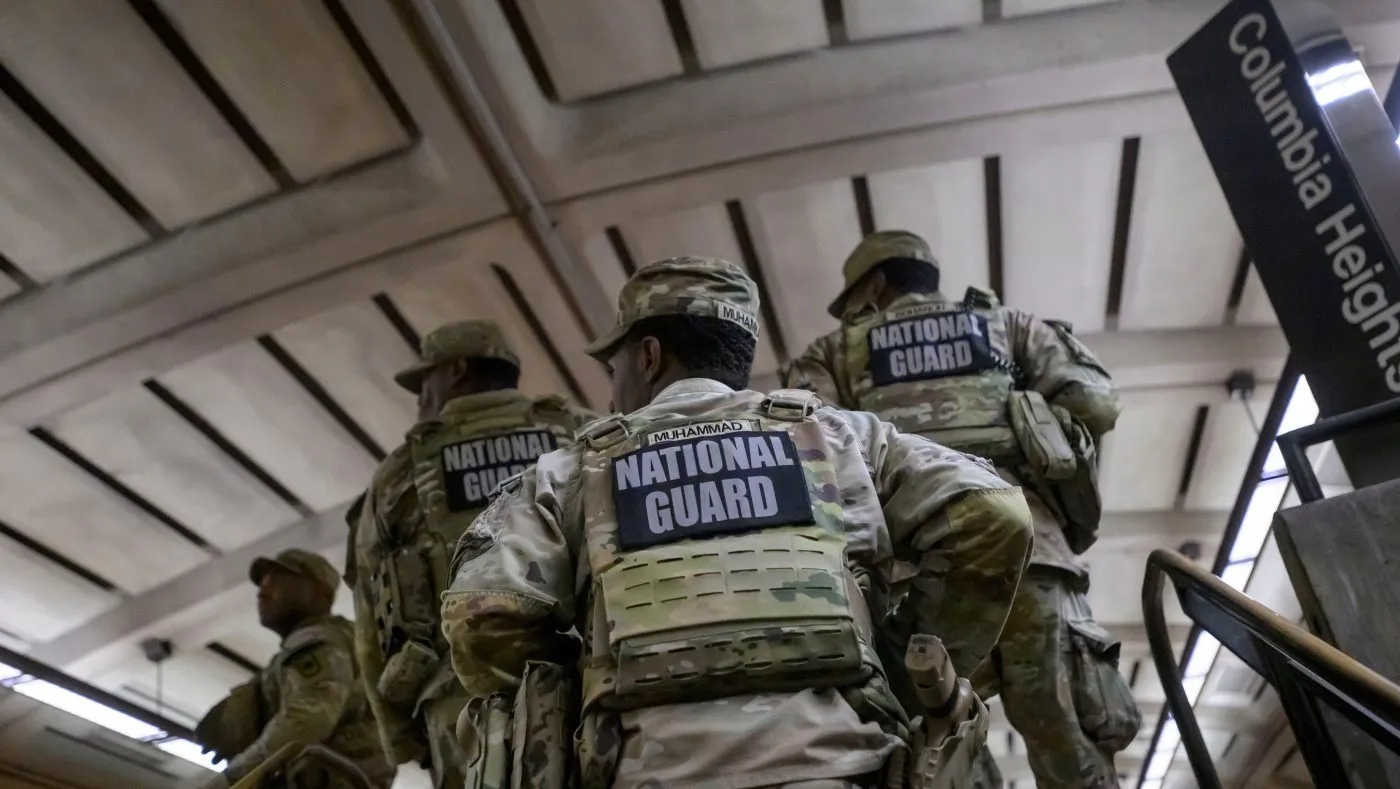
Washington, D.C., officials are calling on incoming Democratic governors in five states that flipped blue to recall their National Guard troops from the nation's capital. During a D.C. Council hearing on Thursday, council member Brooke Pinto, the chair of the public safety committee, said she would soon send a letter on behalf of the council to ask the governors-elect in Iowa, Georgia, Nevada, Ohio and Texas to immediately withdraw their soldiers back to their states.
"It's something they can do their first day in office," she said. Pinto noted that while they had asked governors across the country in the past to pull back their troops, they met a lot of resistance from leaders following the lead of President Trump. She added that they now have the opportunity, with Tuesday's election results, to turn the tide of what they are seeing in Washington, D.C., and to have some real accountability to the federal government.
Some 3,100 National Guard troops are deployed in Washington as part of President Trump's "Making the District of Columbia Safe and Beautiful" mission, which was announced last summer. Of that number, just fewer than 760 troops are part of the D.C. National Guard, which is controlled by the sitting president, and 2,341 have been sent to the city by states and territories, nearly all of which are currently controlled by Republican governors, according to the mission's joint task force.
While Texas, Ohio and Nevada currently only have one or two guard troops sent from each of their states, Georgia and Iowa can make a far bigger dent if they pull their 514 and 110 troops, respectively. Should Alaska also flip to a Democratic governor, with the race yet to be called but having former state Rep. Jonathan Kreiss-Tomkins currently leading, it would mean an additional 34 guard members could be recalled. That means a total of 662 troops could be recalled from D.C. on come January.
Background on the Washington D.C. Deployment
The deployment of military personnel to the nation's capital stems from federal security directives initiated under the current administration. The "Making the District of Columbia Safe and Beautiful" mission brought thousands of service members into the federal district. Local municipal leaders have continuously expressed concerns regarding the presence of out-of-state forces operating within local jurisdictions, arguing that local law enforcement agencies should retain primary authority over public safety matters inside the city limits.
State Contributions to the Federal District Mission
Governors across various states hold the constitutional authority to deploy units of their state militias, known as the National Guard, under specific domestic operational frameworks or federal requests. The division between local control and state-contributed forces creates a complex jurisdictional structure within the capital. States governed by both political parties have historically navigated requests from federal authorities regarding the stationing of troops in the federal enclave for various security initiatives.
Implications of Gubernatorial Transitions
Electoral outcomes in statehouse races directly influence the command structure and deployment status of state military units participating in federal missions. Incoming state executives possess the statutory power to order the return of their state forces upon assuming office. The potential shift in leadership across multiple state governments opens a new avenue for local municipal authorities in Washington, D.C., to press for reductions in the total number of external personnel stationed within the urban center.