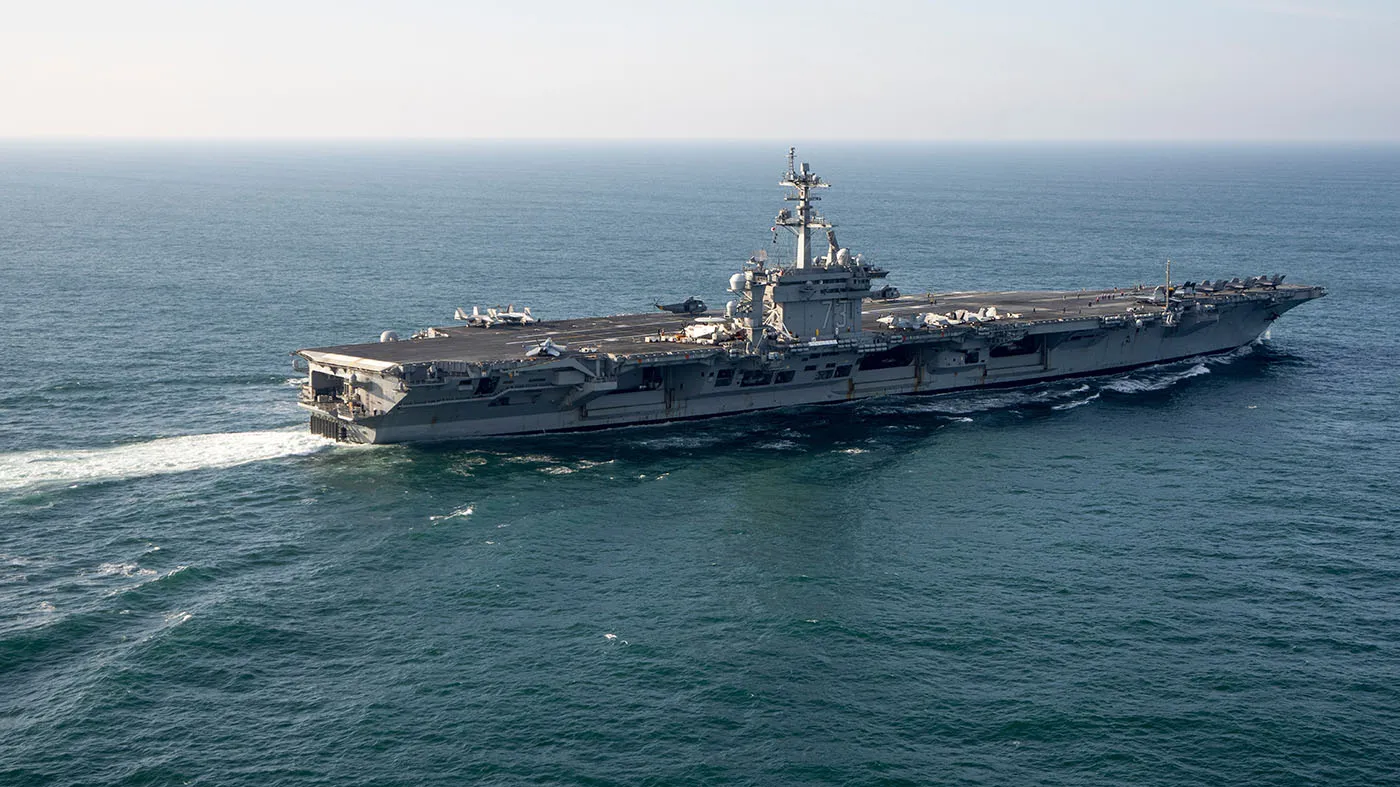
The USS George Washington, a Japan-based aircraft carrier, departed the Middle East, leaving the United States military with two aircraft carriers in the U.S. Central Command region, a military official confirmed to NewsNation.
The vessel spent about three months operating in the Middle East. That leaves the Pentagon with the USS George H.W. Bush and USS Theodore Roosevelt, which arrived in the theater this week.
The presence of three aircraft carriers in the Middle East at one point earlier this week was only the second time in over two decades that the United States had three carriers in the Centcom region at the same time.
The heavy U.S. presence in the region is helping enforce the naval blockade in the Strait of Hormuz, preventing ships from leaving or reaching Iranian ports.
Recently, the U.S. military has conducted some limited strikes against Iranian targets in the Strait of Hormuz, the key waterway through which around 20 percent of the world's oil and gas flow through.
President Trump has oscillated between authorizing major combat operations against Iran and letting the current combination of the naval blockade and economic sanctions choke off Tehran's economy.
The president indicated recently that he is not likely to greenlight new strikes, stating the war, which has dragged on for over eight months, is "effectively over."
Background on United States Aircraft Carriers and Central Command Operations
Aircraft carriers serve as mobile naval air bases, enabling the United States to project military power globally without relying on local land bases. The United States Central Command oversees military operations and relations in the Middle East, parts of Central Asia, and South Asia. The Strait of Hormuz connects the Persian Gulf and the Gulf of Oman, representing one of the most critical energy transit chokepoints in the world.
Regional Naval Strategy and Energy Transit
Naval blockades restrict maritime commerce and military movements to exert economic and strategic pressure on targeted nations. The Strait of Hormuz handles a substantial portion of global petroleum supplies, making security and freedom of navigation in the waterway a priority for international trade and energy markets. Military patrols and carrier strike groups operate in these waters to deter hostile actions and maintain open sea lanes.