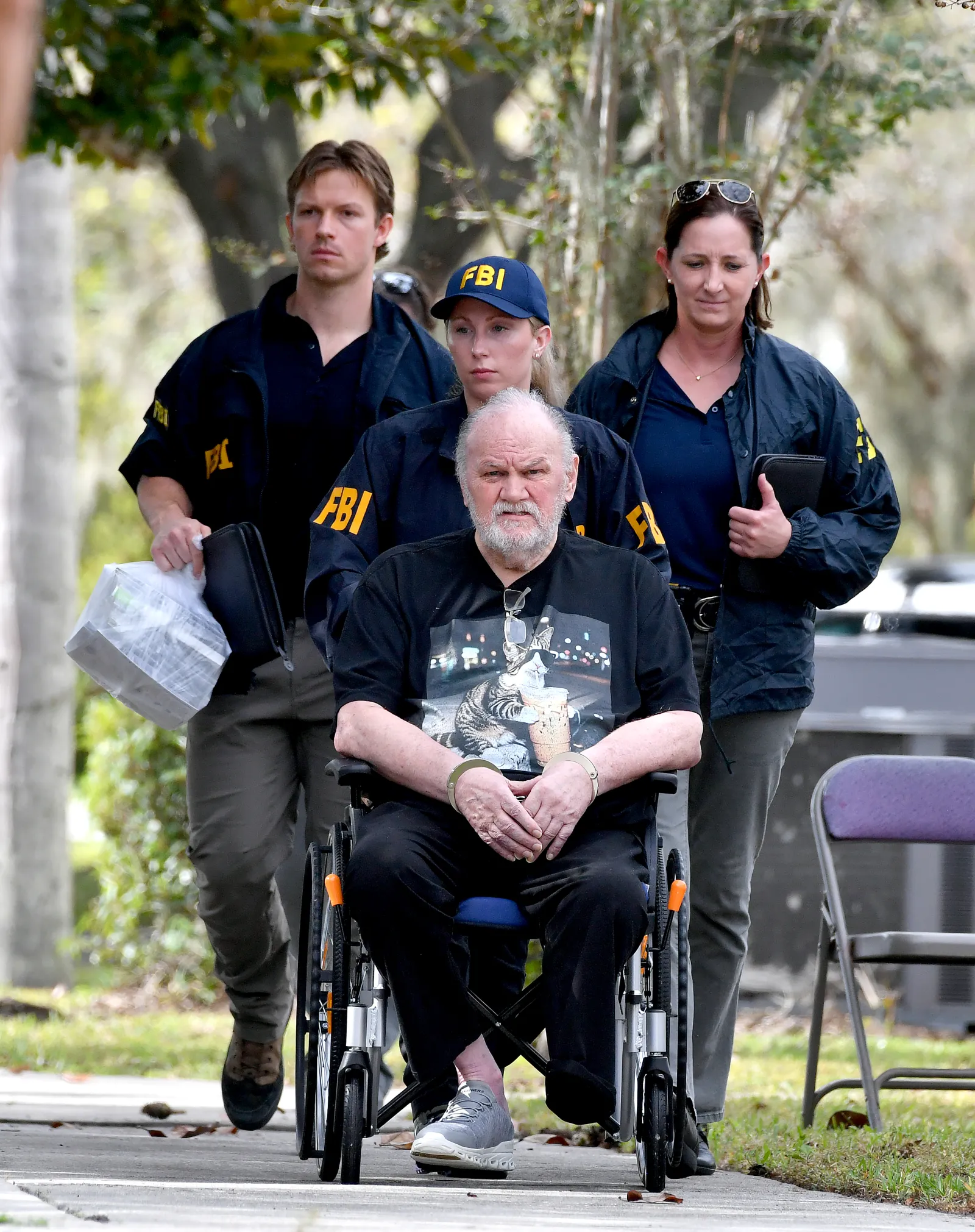
Thomas Markle, 81, appeared in a United States federal court in Florida charged with one count of possession of child abuse material after Federal Bureau of Investigation agents raided his care home.
Markle Snr was arrested earlier today when Federal Bureau of Investigation (FBI) agents raided his US care home amid a deepening probe into child sex abuse images. Meghan Markle's shamed dad was released back to his care home after an appearance at the United States District Court in the Middle District of Florida this evening.
Markle was told he couldn't have access to any smart devices or the internet as Judge Lindsay Griffin ordered an evaluation to see if he understood his rights. He listened on as Griffin summarised the allegations and described how the criminal complaint alleged he was depicted in two of the images.
Asked if he understood, Markle said "yes" in a low voice. He did not enter a plea, while Griffin recommended a preliminary hearing take place in California.
When asked by the judge if he had a passport as it needed to be handed in, the defence lawyer Mary Wolf said: "He doesn't remember where he put it." He will be subject to home detention and electronic monitoring meaning he will have to wear an ankle bracelet.
Agents seized approximately 78 items from storage units rented by Markle, including slides, film negatives, and books that contained suspected child sexual abuse material from two storage units rented by Markle. An affidavit attached to a criminal complaint issued by the Department of Justice describes three of the images seized by feds.
Two images depict an adult man, whom a witness identified as Markle Snr in the document, with a nude prepubescent girl. A third image described by the document is said to show a nude young girl in a room that appears to be part of a motel chain in the Philippines. Other photographs allegedly show Markle with children in various stages of undress.
If convicted, Markle would face a statutory maximum sentence of 20 years in federal prison. Markle has since appeared in court where he was read his rights and asked if he understood them by a judge.
The 82-year-old only spoke to mutter: "Yes, ma'am." The Duchess of Sussex's dad's hands reportedly trembled in fear and his leg wouldn't stop twitching as he sat in the dock.
It comes after The Sun revealed in a world exclusive that Markle Snr was being probed by cops in the Philippines after his son handed over child sex abuse images he found in his dad's things. Thomas Jnr, 60, told police he unearthed the horrific pictures and videos mixed up with innocent family mementos. He also contacted FBI investigators in the US who then launched their own probe which has come to a head today.
"Mr. Markle is accused of possessing child sexual abuse material (CSAM), including photographs depicting himself with minor girls," said First Assistant United States Attorney Bill Essayli on the charges. "These allegations are extremely serious, and we will prosecute Mr. Markle to the fullest extent of federal law."
FBI Director Kash Patel added: "Working with our Justice Department partners, our agents moved quickly, identified and located the explicit material, and arrested Mr. Markle in Florida. The FBI will use every single resource at our disposal to protect innocent kids - any predator who targets children will have zero safe haven in this country or anywhere they try to hide."
Among the haul taken away by police in the Philippines following an investigation were 7,500 images of underage children on devices allegedly belonging to Markle Snr. Philippines Interior Secretary Juanito Victor Remulla revealed some of the children in the vile images were as young as ten. They were among a hoard of material handed to Philippine authorities two weeks ago by his son Thomas Jnr. A second stash was then found in a lock-up in Mexico sparking a criminal probe there.
Role of the Federal Bureau of Investigation in Child Exploitation Cases
The Federal Bureau of Investigation operates specialized cyber divisions and field offices across the United States to track down distributors and possessors of illicit material involving minors. Agents coordinate with international law enforcement agencies, local police departments, and prosecutors within the United States Department of Justice to execute search warrants, raid properties, and seize digital storage devices or physical media such as film negatives and slides. These investigative operations often rely on digital forensics experts who examine seized hard drives, cloud accounts, and personal electronics to uncover hidden files.
Federal authorities also participate in task forces dedicated to identifying victims and apprehending offenders who store or share unlawful images across borders. When cross-border evidence emerges, investigators work through diplomatic channels and mutual legal assistance treaties to share intelligence with foreign police forces. This collaborative approach allows federal agencies to trace evidence discovered in foreign jurisdictions, such as stashes located in countries like the Philippines or Mexico, and connect them to suspects residing within American borders.
United States District Court Procedures and Pretrial Detention
The United States District Court system handles federal criminal cases through magistrate judges and district judges who oversee initial appearances, arraignments, bail hearings, and trials. During an initial appearance, defendants are formally informed of the charges filed against them by federal prosecutors, advised of their constitutional rights, and evaluated for legal representation. Judges determine whether a defendant qualifies for a public defender or if they must retain private counsel, and they also address pretrial release conditions based on factors such as flight risk and potential danger to the community.
Pretrial release conditions in federal court can include home detention, electronic monitoring via ankle bracelets, surrender of travel documents like passports, and strict prohibitions against accessing the internet or communication devices. Magistrates may order psychological or competency evaluations to ensure that a defendant fully comprehends the legal proceedings and the nature of the accusations against them. If prosecutors present sufficient evidence of potential risks, defendants may be subjected to strict monitoring while awaiting subsequent court dates or preliminary hearings in the designated judicial district.
International Law Enforcement Cooperation Across Borders
International cooperation between American law enforcement and foreign agencies plays a critical role in investigations involving suspects who travel or maintain assets overseas. Police departments in countries such as the Philippines and Mexico frequently coordinate with federal attachés stationed in foreign embassies to share tips, physical evidence, and digital forensic reports. Foreign interior ministries and national police forces examine local lock-ups, rented storage facilities, and abandoned properties to recover physical archives, computer equipment, and storage media associated with transnational suspects.
When family members or witnesses discover illicit material among personal belongings, they often alert local authorities in the country where the items are physically located before notifying federal authorities in the United States. This dual-reporting mechanism triggers concurrent or interconnected investigations across multiple jurisdictions, allowing foreign prosecutors to pursue local charges while federal prosecutors prepare indictments under United States federal statutes. Such coordination helps secure physical exhibits, witness testimony, and digital evidence from multiple countries before suspects face formal extradition requests or local court proceedings.
Statutory Sentencing Guidelines for Federal Child Exploitation Offenses
Federal statutes governing the possession and distribution of unlawful material involving minors outline severe penalties upon conviction in United States federal courts. Prosecutors within the Department of Justice rely on specific federal criminal codes to bring charges against individuals accused of acquiring, storing, or producing illicit images. Sentencing guidelines provide statutory maximum prison terms for offenders found guilty of possessing prohibited content, alongside mandatory supervised release terms following any period of incarceration.
Legal teams representing defendants in federal court review the sufficiency of search warrants, the handling of seized evidence by investigators, and the validity of statements made during custody. Judges weigh sentencing memoranda submitted by both the prosecution and the defence, taking into account the volume of material recovered from storage units, digital devices, or physical archives. Convictions under these federal statutes carry substantial prison sentences, reflecting the legislative intent to penalize offenses directed against minors.