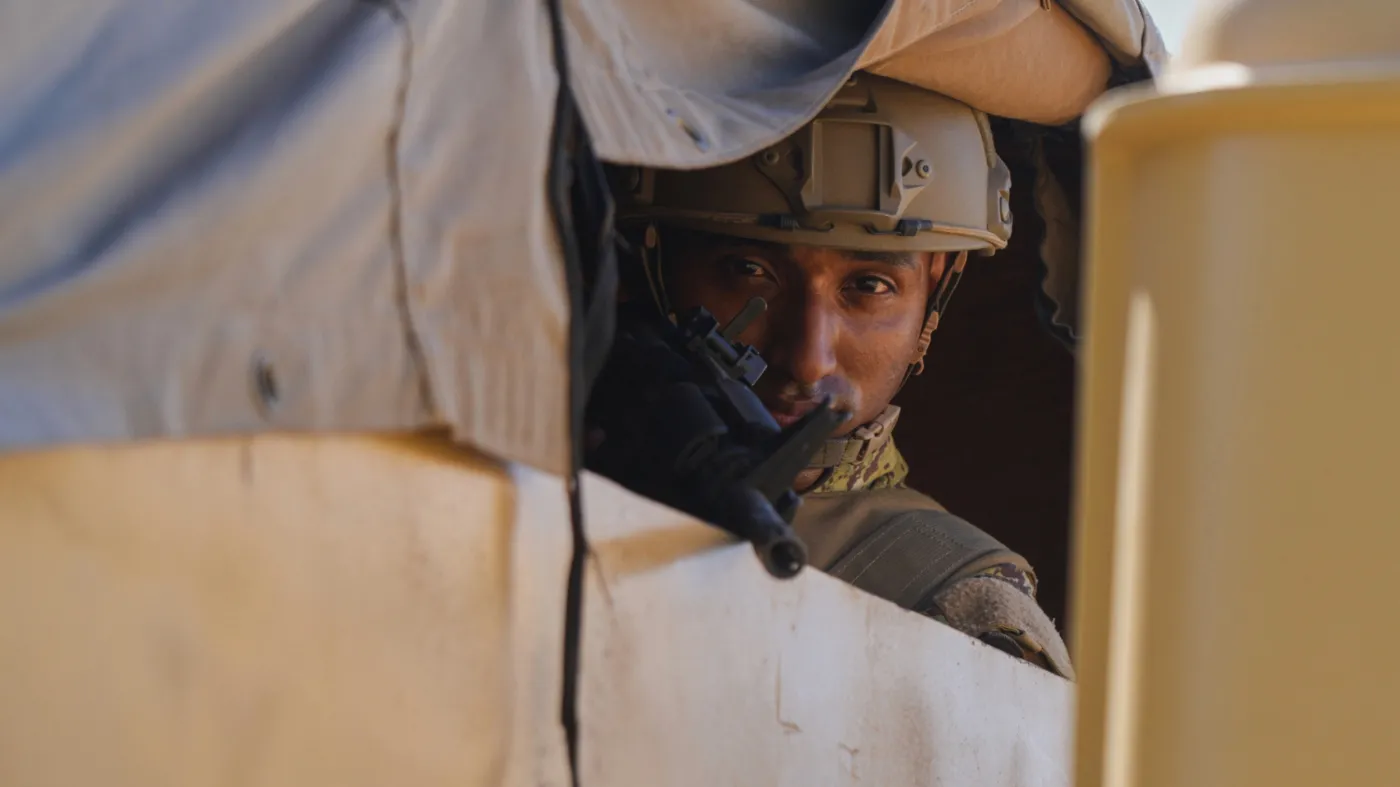
The crisis in Haiti has fueled fatigue and frustration within the international community. Neither the Organization of American States nor the United Nations has been able to reverse this human tragedy. No superpower has been willing to put boots on the ground. Yet in March 2024, the president of the smallest country in Central America, El Salvador's Nayib Bukele, declared his readiness to take on the challenge: "We can fix it."
Bukele has emerged as a prominent global figure in the fight against gangs and organized crime. He transformed his own country, once the most dangerous country in the Americas, into the safest nation in the Western Hemisphere. In 2025, El Salvador recorded 1.3 homicides per 100,000 inhabitants.
El Salvador Troops Deployed To Haiti
In January of 2025, El Salvador joined U.N. security efforts in Haiti. Then, in October, four aviation technicians were captured by Haitian gangs. Bukele called for the immediate release of the technicians, sending 2,000 more troops to Haiti and issuing a strong ultimatum: "We have already finished the gangs in El Salvador, and we can finish with you too."
Haiti is not a regular country with gangs. It has a nationwide gang coalition, which functions much like an army, under the name of Viv Ansanm (Live Together). In 2025, the group was designated by the U.S. as an international terrorist organization.
Violence And Casualties In Haiti
According to the United Nations, at least 5,519 people were killed and 2,608 were injured in Haiti between March 2025, and Jan. 15, 2026 in gang-related violence, with 1.4 million internally displaced.
Bukele sent a message to the Haitian people: "We can help you defeat them, but we are not invaders. We are people with the same courage as you. We must stand up, take back control of our communities, and bring those who are making us endure all this pain, all this suffering, under our control."
Initial Results Of The Salvadoran Intervention
The arrival of Bukele's troops has brought a sense of hope to Haitians after years of suffering, death and neglect. They were received with chants of "We are Bukele" and "Long live Bukele!" Hatian Prime Minister Alix Didier Fils-Aime thanked Bukele and said, "He understands our fight. He came to stand on the side of the Haitian people."
Since the arrival of elite troops from El Salvador, the situation has begun to shift. For the first time, a gang leader has been captured: Jean Saint Louis, alias "Kenken," was arrested by Salvadoran forces and the Haitian Coast Guard. Meanwhile, last week, Mathias Saintil, a member of the Boston Gang, was killed, and Wilson Joseph, the top leader of the 400 Mawozo gang, has requested U.N. mediation, expressing concern over the arrival of the Salvadoran troops.
Major Obstacles Facing The Mission
Bukele faces several challenges. Unlike in El Salvador, Haiti lacks the support of a strong government, a functional prosecutor's office, a robust judiciary or a high-security prison system in Haiti. Furthermore, he faces a massive coalition of gangs and is at a numerical disadvantage. Added to this are the differences in terrain, language and culture, which present an entirely unfamiliar environment.
Secretary of State Marco Rubio has also noted that security and coordination in Haiti are key components. He said that de-confliction is essential.
"What you can't have is gang suppression force running into Salvadorian soldiers and shooting at each other because they think the other side are gang members," he said. "You'll need a lot of strong coordination, because they're operating alongside one another."
Human Rights Concerns And Complex Forces
Amnesty International has also expressly called on the government of Haiti and the government of El Salvador to respect human rights. "The vast majority of Salvadoran military personnel recently deployed to Haiti are not part of the Gang Suppression Force, authorized by the UN Security Council, and therefore fall outside the mandate and monitoring mechanisms of the United Nations Support Office in Haiti."
The truth is, the crisis in Haiti is far more complex than the gang situation in El Salvador. Currently, Haiti is home to the U.N. Gang Suppression Force, in addition to forces working for security contractor Erik Prince, Bukele's troops, the Haitian police and military and the massive gang coalition known as Viv Ansanm.
Bukele's efforts in Haiti face a challenge of epic proportions, like a dark mirror of a new Vietnam in the Caribbean. Only time will tell whether his presence in Haiti brings change or chaos, a new hope or a greater havoc.
Arturo McFields is an exiled journalist, former Nicaraguan ambassador to the Organization of American States, and a former member of the Norwegian Peace Corps. He is an alumnus of the National Defense University's Security and Defense Seminar and the Harvard Leadership course.
Background On The Salvadoran Security Model
El Salvador achieved remarkable success under Nayib Bukele in suppressing powerful criminal organizations that plagued the country for decades. The government launched a massive state of exception in March 2022, suspending certain constitutional rights to grant police and military sweeping powers of arrest. Authorities detained more than 70,000 suspected gang members in subsequent operations, effectively dismantling the operational capacity of groups like Mara Salvatrucha and Barrio 18. This strategy transformed the country from one of the most violent places on Earth into a nation with minimal street crime, drawing intense international attention and earning Bukele widespread popularity among citizens seeking relief from cartel violence.
Historical Context Of The Haitian Crisis
Haiti has experienced persistent political instability, natural disasters, and institutional collapse over several decades, culminating in the assassination of President Jovenel Moise in July 2021. The power vacuum left federal governance severely crippled, allowing heavily armed criminal networks to seize control of large swathes of the capital city, Port-au-Prince, and surrounding regions. Essential infrastructure, including ports, hospitals, and major roadways, fell under gang influence, paralyzing the national economy and cutting off basic supplies for millions of residents. International bodies struggled to establish stable security frameworks, leading to successive humanitarian appeals and fragmented coalition deployments before the arrival of Salvadoran forces.
Structure Of Haitian Gang Coalitions
Criminal factions in Haiti historically operated as decentralized neighborhood gangs, but they evolved into highly coordinated syndicates capable of challenging state security forces directly. The Viv Ansanm coalition united rival factions under a single command structure, enabling coordinated attacks on prisons, police stations, and government buildings. This militarization of criminal groups created a security environment comparable to an insurgency rather than traditional urban crime, requiring heavy weaponry, armored vehicles, and tactical military training to counter effectively.
International Response And Security Oversight
Various global actors attempted to stabilize the Caribbean nation through financial aid, diplomatic pressure, and limited police training programs before authorizing broader interventions. The United Nations Security Council backed multinational police support frameworks, while private security contractors and bilateral military agreements introduced diverse armed groups into the operational zone. This multi-layered presence created complex command challenges, prompting senior diplomats to emphasize the absolute necessity of rigorous operational de-confliction to prevent accidental engagements between friendly forces operating in the same urban sectors.