Japan's traditional production committee system allows multiple companies to jointly finance films and split rights, which spreads financial risk across the industry. However, this method can also cap movie budgets based strictly on what local companies can raise, complicate participation for foreign investors, and delay choices because every single rights holder must approve decisions.
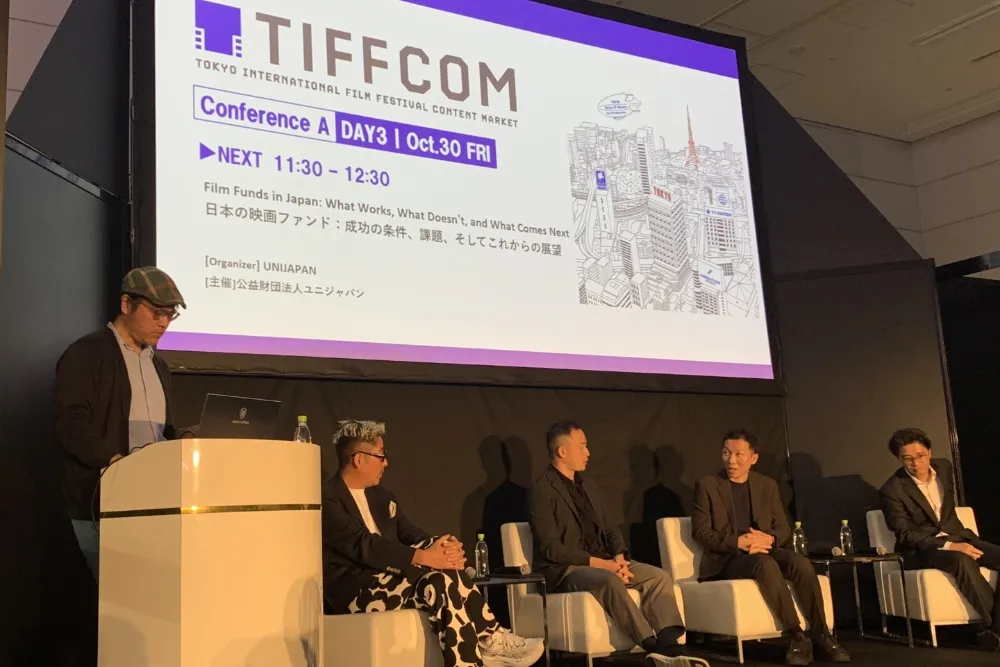
During a panel at TIFFCOM, which serves as the content market of the Tokyo International Film Festival, industry experts discussed whether alternative film funds can remove these restrictions while still adapting to the local market.
The session titled "Film Funds in Japan: What Works, What Doesn't, and What Comes Next" featured Kii Muneyuki, CEO and producer of K2 Pictures, which collaborates with directors such as Kore-eda Hirokazu, Miike Takashi and Nishikawa Miwa. Other speakers included Ibe Tomonobu, CEO of Tokyo startup Questry that uses digital securities to fund anime and other Japanese content, Nakagawa Keita, managing director at MUFG Bank, and Motoyanagi Yusuke, partner at law firm Nishimura & Asahi.
Kii highlighted the K2P Film Fund I as a model for this new approach. The fund closed in February at about JPY5 billion ($32 million) and plans to support around 50 movies over seven years. Operating as a blind pool, investors commit capital before specific movies are selected. Its financial backers consist of MUFG, the Development Bank of Japan alongside other companies and financial institutions, while a greenlight committee manages project selections. Kii stated that five films had been released in theaters in 2026.
According to Kii, a primary challenge for film funds involves distributing earnings back to creators, which includes profits from streaming platforms and other distribution windows following a theatrical release. He added that depending entirely on international box office earnings remains difficult, urging domestic companies to expand operations beyond simple distribution.
The panel contrasted Japanese methods with financial frameworks used in the United States and South Korea. American producers merge presales alongside completion guarantees to secure commercial bank loans, where a completion guarantee ensures a movie finishes on schedule and within budget rather than guaranteeing commercial success. Meanwhile, South Korea depends on a mix of public and private backing, using government-backed guarantees to help film projects obtain bank funding.
Nakagawa outlined a Japan-specific feasibility study commissioned by the Ministry of Economy, Trade and Industry. MUFG was chosen to execute the project on March 31. Spanning through February 2027, the research will apply actual data to build valuation and completion-guarantee models, while testing every stage from application and evaluation to drafting contracts. The study evaluates feasibility and does not guarantee that financing or completion guarantees will ultimately become available.
The conversation concluded by outlining four core priorities, which consist of regulation, capital, creators and cross-border business. These objectives involve determining which regulations require expansion and when, merging debt options with subsidies and completion guarantees, and embedding creator payouts into fund frameworks. Panelists also highlighted language barriers and tax obstacles affecting international investment, such as permanent establishment rules that can subject global investors to Japanese taxation.