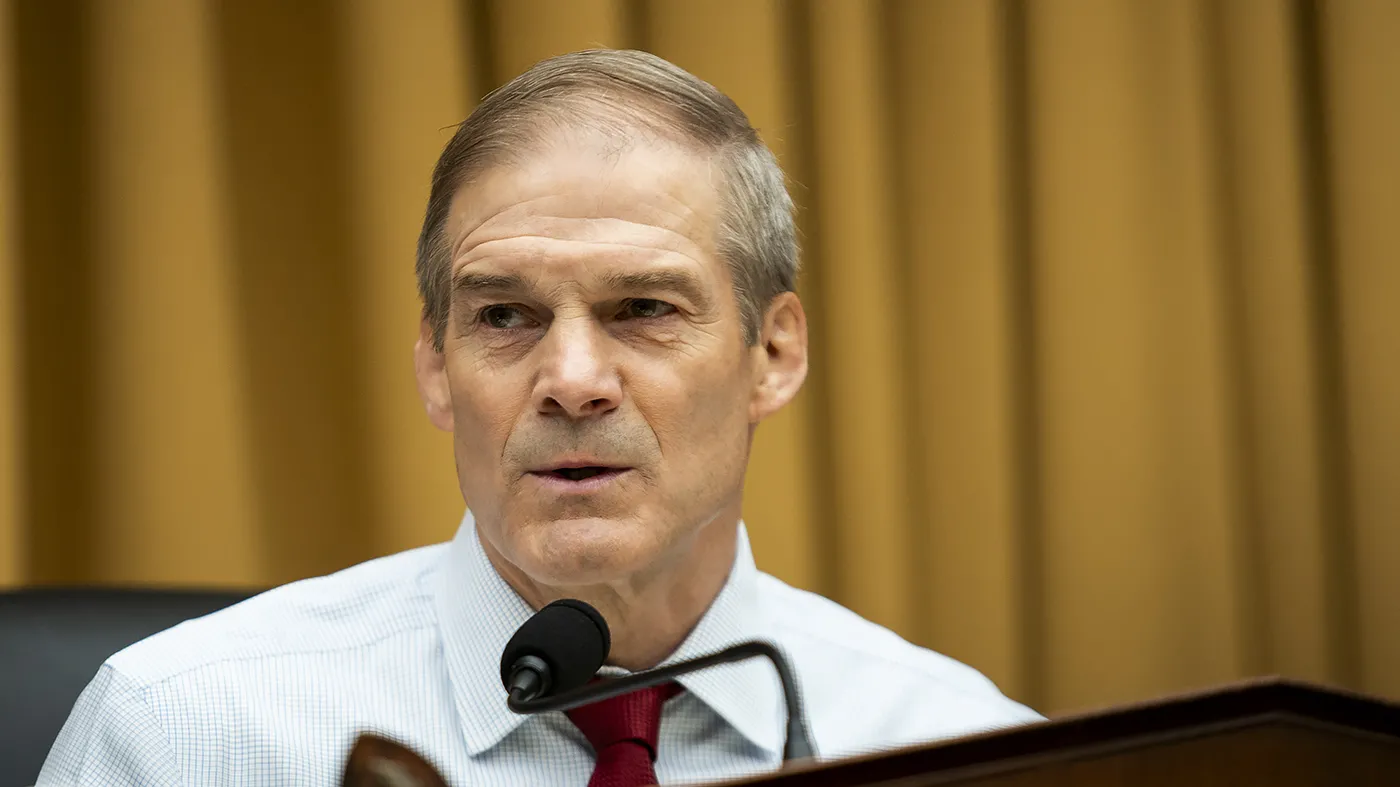
House Republicans elected Rep. Jim Jordan (R-Ohio) on Tuesday to lead their diminished conference in the next Congress, marking an extraordinary leap for a conservative icon who made his name on Capitol Hill antagonizing party leaders.
Jordan defeated Rep. Steve Scalise (R-La.), the outgoing House majority leader, in a closed-door election in the bowels of the Capitol Visitor Center by a vote of 106-73. Scalise has been in the top echelons of GOP leadership since 2014, holding the No. 2 spot in the conference since 2019, and his allies touted that experience as a reason to put the Louisiana Republican at the helm of the party.
But after the clobbering of Republican candidates in last week's midterms, many GOP lawmakers at the Capitol blamed party leadership for the heavy losses. Much of that anger was directed toward Speaker Mike Johnson (R-La.), but Johnson is stepping down from the leadership ranks at the end of the term. That left Scalise and Rep. Tom Emmer (R-Minn.), the GOP whip, who quickly became targets of a clean house sentiment that rapidly caught fire within the restive conference.
Jordan, a 20-year House veteran, took advantage of the angsty environment, portraying himself as a fresh face in leadership and a fighter ready to take on both Rep. Hakeem Jeffries (D-N.Y.), who's in line for the Speakership, and the new Democratic majority.
The Ohio Republican had also spent months on the campaign trail this year stumping for GOP candidates and building alliances that appear to have helped him in Tuesday's vote, which was influenced heavily by party newcomers following a wave of Republican retirements this cycle. In one sense, Jordan fits the outsider mold, as he is a co-founder of the House Freedom Caucus, one of the most conservative blocs in the lower chamber, and served as its first chairman. The group built its brand and gained its power on a willingness to attack its own party leaders in pursuit of smaller government as well as bolster other right-leaning priorities.
Jordan, a former champion wrestler, seemed custom built for the role, and the Freedom Caucus under his watch went out of its way to clash with then-Speaker John Boehner, a fellow Ohio Republican whom conservatives deemed too ready to compromise the party's values for the sake of bipartisan compromise. Under constant pressure from the group, Boehner resigned from Congress in 2015. More recently, however, Jordan has shifted toward the establishment and toed the party line.
After opposing Rep. Kevin McCarthy's (R-Calif.) failed bid for the Speakership in 2015, Jordan reversed course and threw his weight behind McCarthy, even as other conservatives booted him from power in 2023. That change of tune helped Jordan gain power by more conventional means, rising to win the top GOP spot on the House Oversight and Government Reform Committee and eventually chairing the powerful Judiciary Committee, a position he's held throughout the 119th Congress.
McCarthy, who has long feuded with Scalise, paid it back in the leadership contest by lobbying on Jordan's behalf. Jordan's shift to the center has also been evident in some of his policy positions, and once a staunch opponent of the government's warrantless surveillance powers, for instance, Jordan has more recently supported President Trump's efforts to expand that authority.
Scalise and Jordan's bitter battle to be minority leader was a rehash of their contest for the Speakership back in 2023, after McCarthy's ouster. Scalise had initially won his party's Speaker nomination, beating Jordan in a secret-ballot vote, but the Louisiana Republican withdrew from the race when it became clear he lacked the 218 votes to secure the gavel on the House floor. Jordan was later chosen to be the GOP's nominee, but he repeatedly fell short of the votes needed to preside over the chamber, and Johnson ultimately stepped in to fill the void.
Jordan wrote in his Dear Colleague letter to House Republicans last week that, for too long, Republicans haveoperated without a clear plan to survive the hour or the day in front of us.
This will not cut it against an emboldened and energetic Democratic majority, Jordan wrote, adding that he is battle-tested on the oversight front and know the Democrats playbook.
I know what it will take to lead our Conference in the minority, to stay unified, and to coordinate and calibrate our response to the Democrats tactics, Jordan wrote. We need a Leadership team that is active and engaged, forward-thinking and straight-shooting.
He will have his work cut out, and the blue wave that crashed into midterms has Democrats on track to control roughly 260 seats in the next Congress, a massive majority that will give Jeffries a comfortable cushion to move his party's legislative priorities. Democrats are also vowing to conduct exhaustive investigations into Trump, his family and his administration, making Jordan the first line of defense for his ally in the White House.
Background on House Leadership Contests
House leadership elections take place at the start of new congressional terms or when a vacancy arises in party ranks. Members of each party gather behind closed doors to select their nominees for Speaker, majority or minority leader, whip, and conference chair using secret ballots. These internal party battles often reflect broader ideological divisions within the broader political organisations. Conservatives frequently challenge moderate leaders over spending levels, legislative strategy, and negotiation tactics with the opposing party. The dynamics of these elections shifted significantly over the past decade as congressional caucuses grew more polarized and grassroots activist groups gained influence over lawmakers.
The Role of the House Freedom Caucus
The House Freedom Caucus was established in 2015 by a small group of conservative lawmakers seeking a more forceful voice for right-wing principles in the legislative process. Operating primarily as a cohesive voting bloc, the faction uses its collective leverage to demand procedural changes, spending cuts, and adherence to conservative policy goals. Its founding members included prominent lawmakers who frequently clashed with leadership during the tenures of former Speakers John Boehner and Paul Ryan. The caucus operates with formal rules and a rotating chairmanship, maintaining a distinct identity separate from the larger Republican conference while exerting considerable influence over key legislative battles and internal party elections.
Congressional Oversight and the Judiciary Committee
The House Judiciary Committee holds jurisdiction over federal civil and criminal law, constitutional amendments, administrative law, and anti-trust matters. As chairman of this influential committee, a lawmaker oversees extensive investigations, subpoena issuances, and hearings involving executive branch agencies and administration officials. The panel plays a central role in high-profile political disputes, impeachment inquiries, and judicial nominations. Committee leaders must balance legislative duties with aggressive oversight strategies, coordinating closely with party leadership to shape public narratives and respond to policy initiatives introduced by the executive branch or the Senate.
Future Outlook for the Minority Party
When a political party loses the majority in the House of Representatives, the conference must adjust its strategy from passing legislation to blocking opposing initiatives and conducting counter-investigations. Minority leaders rely on party unity, parliamentary procedures, and coordinated messaging to counter the legislative agenda advanced by the majority party. Navigating a significant minority status requires robust internal communication and disciplined floor votes to prevent defections. Leadership teams must also prepare for upcoming electoral cycles by supporting candidates in competitive districts and rebuilding party infrastructure across the country ahead of future midterms.