The Federal Aviation Administration (FAA) has air traffic control systems back online after a major telecommunications outage grounded all U.S. flights Friday evening.
The delay stranded passengers across the country and forced airlines to delay or cancel thousands of flights, a disruption that may take days to get back to normal. Those affected included everyday passengers, but also college football teams traveling to big matchups for Saturday.
Government officials have initially identified old equipment as the reason for the failure and have requested additional funding to modernize air traffic control systems.
Millions of passengers face delays
Nearly 4,000 flights within, into or out of the U.S. were delayed as of late Saturday morning, and more than 4,300 have been canceled, according to flight tracking website FlightAware.
Those delays and cancellations have only increased throughout the morning, and are concentrated at the busiest airports. Chicago's O'Hare International Airport, Hartsfield-Jackson Atlanta International Airport and New York's John F. Kennedy (JFK) International Airport remain the three with the most disruptions.
Fifteen percent of all flights in Atlanta, the world's busiest airport, have been canceled, with another nearly 20 percent delayed. Twenty percent of flights out of JFK have been canceled.
Airlines have begun accommodating passengers whose flights were disrupted. All four of the major airlines, Delta, United, Southwest and American, are waiving change fees for affected passengers, and Delta, United and Southwest are waiving fare differences to allow customers to change their flights at no additional cost.
Old communications systems seen as culprit
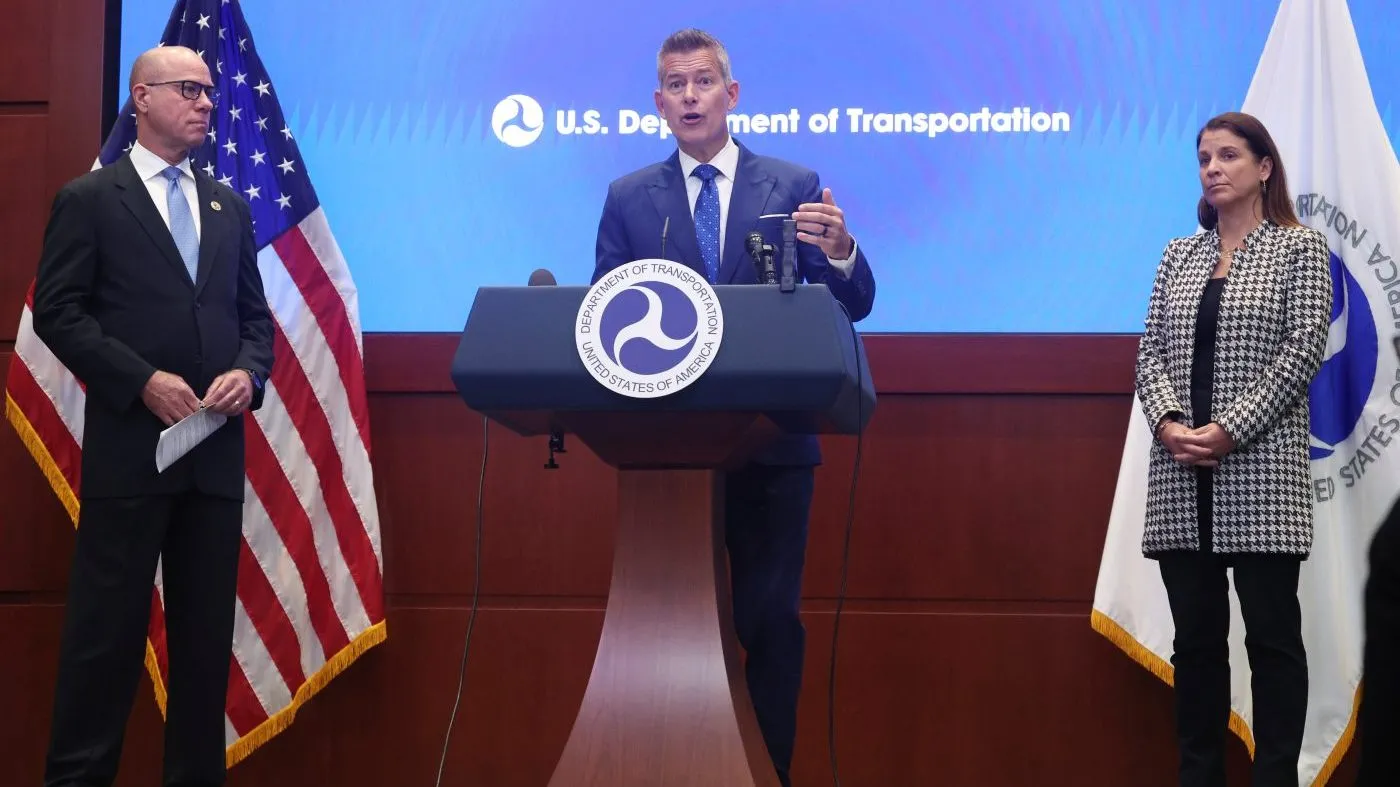
At a press conference Saturday, Transportation Secretary Sean Duffy said that a wire switch may have caused the telecommunications outage.
Duffy said a contractor called L3Harris was replacing an old copper wire with a new fiber cable, and that the FAA was investigating to see if that was the cause.
"So what we're working to determine was whether we had incompetence, meaning was it user error, installator error from L3Harris, or did they install a faulty router?" Duffy said. "We haven't determined what the fault was."
FAA Administrator Bryan Bedford said the agency has not identified any evidence of malice, such as a cyberattack.
"We see zero evidence of anything nefarious. It is an equipment issue," Bedford told reporters. "When we have this root-cause analysis complete we will share it with you."
College football teams race to make games
The travel disruptions hit right as college football teams were preparing to take off for anticipated Saturday matchups.
Games in the Big 12, Big Ten and Southeastern Conference were delayed Saturday, in some cases by several hours, due to the disruptions. The Ole Miss-Oklahoma game was moved to Sunday afternoon.
In the NFL, the league updated its officiating assignments to keep officials within driving distance of their homes amid the flight disruptions.
Trump officials plead for congressional dollars
At a joint press conference Friday night with Homeland Security Secretary Markwayne Mullin, Duffy asked Congress to pass more than $50 billion in funding for modernizing air traffic control systems in the U.S.
"I want $50 billion," Duffy told reporters. "Let's finish this job: new hardware, new software, new telecommunication."
Duffy has made a big push to modernize the FAA and air traffic control systems in his role as transportation secretary, pointing to decades-old systems that rely on old technology. Mullin echoed Duffy's claims, calling for a "complete overhaul of the system."
The transportation secretary shared his message to members of Congress.
"Give President Trump, give Duffy the money. Let them finish this job so we don't have to do a press conference at 8:30 at night ever again,'" Duffy said.
Garcia, Jeffries signal oversight
As federal officials say they are investigating the cause of Friday's incident, a key House Democrat is raising questions.
Rep. Robert Garcia (D-Calif.), the likely next chair of the House Oversight Committee, called the ground stop "quite disturbing" in an interview on MS NOW Friday.
"Whatever it is, I think deserves as much transparency as possible," Garcia said.
The California Democrat has already pledged to investigate the president and his allies, which the White House vowed to aggressively respond to.
Rep. Hakeem Jeffries (D-N.Y.), the likely candidate for Speaker of the House, released a statement accusing the administration of "failed leadership."
"American travelers deserve timely answers from the Trump Administration about how and why this happened and assurances that steps are being taken to ensure that our air travel system remains safe and functional," Jeffries said.
Background on the Federal Aviation Administration and Air Traffic Control
The Federal Aviation Administration operates one of the most complex and busiest air navigation systems in the world, managing tens of thousands of flights daily across the United States. Established to regulate and oversee all aspects of American civil aviation, the agency relies on a vast network of ground-based radar, communication links, and computer networks to guide commercial airliners, cargo carriers, and general aviation aircraft safely through national airspace. Many core components of this civil aviation infrastructure have remained in service for decades, leading transportation officials to repeatedly warn about the vulnerabilities associated with aging hardware and legacy software architectures.
Contractors such as L3Harris frequently perform scheduled maintenance, upgrades, and equipment replacements on behalf of federal agencies to transition older copper-based transmission lines to modern fiber-optic networks. These infrastructure modernization projects require precise technical execution across hundreds of regional air traffic control facilities, radar stations, and communication hubs spanning the continental United States and outlying territories. Federal oversight bodies and independent aviation safety experts have historically monitored these transitions closely to prevent service interruptions that could impact commercial schedules, national defense operations, and emergency medical flights.
Understanding Congressional Funding and Federal Oversight
Legislative appropriations for civil aviation infrastructure are approved by the United States Congress through regular budget cycles and specialized capital improvement bills aimed at long-term capital investments. The funding requested by cabinet officials is typically allocated toward comprehensive technology overhauls, hardware replacements, cybersecurity enhancements, and facility expansions managed by federal procurement officers. Committees in both the House of Representatives and the Senate maintain direct oversight authority over the Department of Transportation and the Federal Aviation Administration, holding public hearings to examine system failures, budget expenditures, and administrative performance.
Congressional leaders from both major political parties routinely use committee hearings, formal information requests, and public statements to demand accountability from executive branch agencies following major disruptions to public infrastructure. Oversight proceedings examine technical root causes, contractor performance, agency preparedness, and policy recommendations submitted by civil servants and independent technical experts. These investigative actions are designed to shape future legislative mandates, establish regulatory standards, and ensure that federal spending addresses systemic vulnerabilities across critical national transportation networks without compromising public safety or operational continuity.