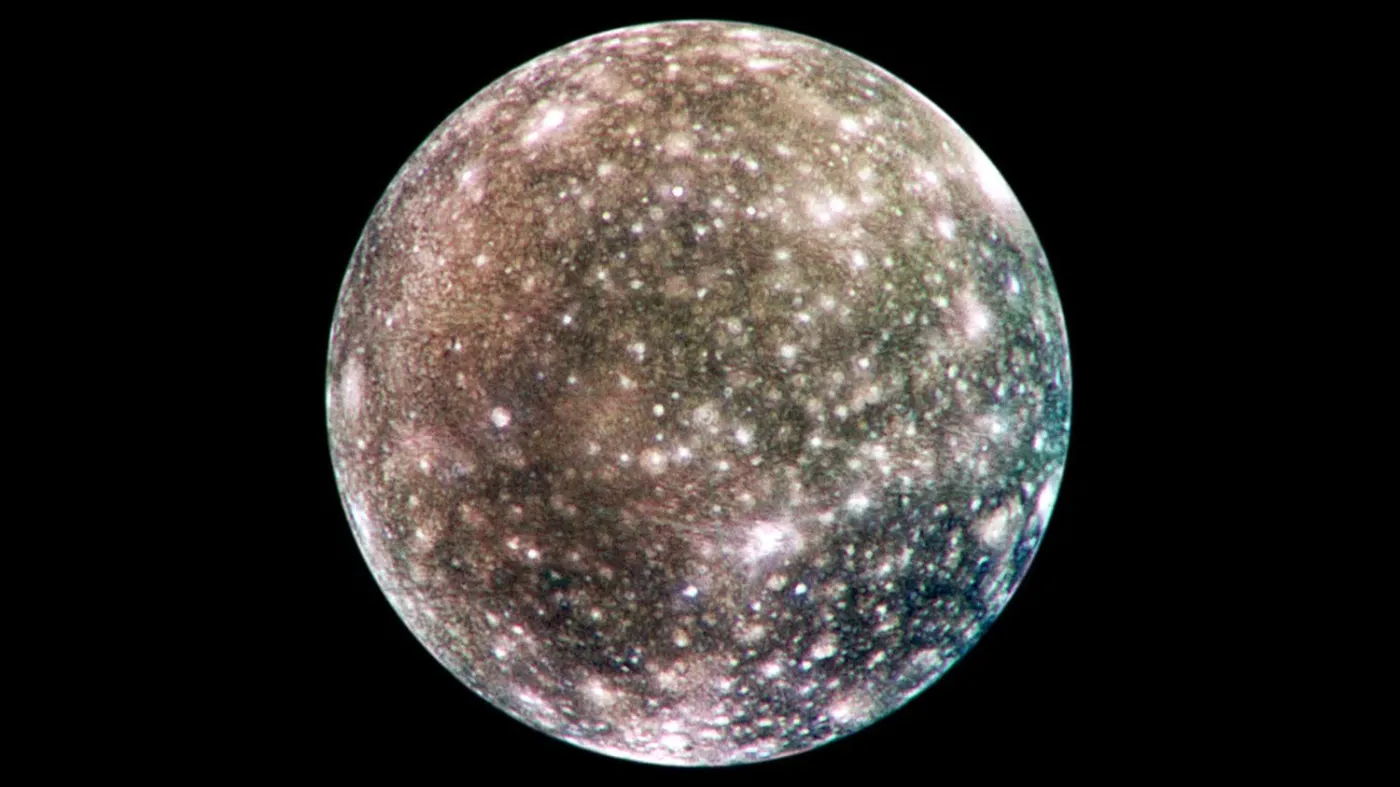
The Chinese National Space Administration is developing a mission to Callisto, a moon of Jupiter, dubbed Tianwen-4. The probe, the first by China to one of the outer planets, would represent a new phase in that country's evolution as a major space power.
The Tianwen-4 will consist of an orbiter and a lander. The orbiter will have 10 instruments, including multiple cameras, imagers, and spectrometers, as well as a particle detector and a magnetometer. The lander will have just two instruments: the Callisto Surface Composition Analyzer and the Callisto Lander Magnetometer.
The surface composition analyzer will be a spectrometer that uses a laser to analyze rocks. The instrument has become standard for probes that explore the surfaces of other worlds, including the Perseverance rover that uses an ultraviolet light source to analyze the Martian surface.
NASA notes that Callisto is the most heavily cratered moon in the solar system. Since it was discovered by Galileo, it was not thought to be a remarkable object, just a hunk of rock, metal and ice. But the Galileo mission, which orbited Jupiter from 1995 to 2003, discovered some aspects of Jupiter's second-largest moon that intrigued scientists.
It turns out that Callisto, like Europa, may harbor a salty ocean miles underneath its surface. If such an ocean exists, it could harbor life. Moreover, Callisto orbits Jupiter at a distance of 1,170,000 miles, which means that, unlike Europa, it is beyond the intense radiation belt of the largest planet in our solar system.
Current plans are to launch the Tianwen-4 in 2030 on a Long March Five rocket. It will use a Venus-Earth-Earth gravity assist trajectory to bring the probe to Jupiter space by 2035. The Chinese intend to explore Callisto for several years in the latter half of the 2030s.
The U.S.-China space rivalry has been a topic of conversation for the past several years, focusing on the second race to the moon. But missions such as the Tianwen-4 suggest that China intends to be a leader in all aspects of space exploration, both crewed missions to the moon and robotic probes to destinations such as Mars, with the Tianwen-1, and beyond.
So far, NASA has had Jupiter and the other outer planets to itself. Pioneer 10, Pioneer 11, Voyager 1, Voyager 2, New Horizons, currently on its way to Pluto, the solar probe Ulysses, and Cassini on its way to Saturn all conducted Jupiter fly-bys. Besides the aforementioned Galileo, the Juno probe is currently orbiting the largest planet in the solar system, delving into its secrets.
NASA's Europa Clipper is currently on its way to the Jovian system, due to arrive in 2030 to focus on the icebound moon Europa. The European Space Agency Jupiter Icy Moons Explorer is due to arrive in Jupiter space in 2031.
No dedicated missions have been funded for the other major moons of Jupiter, such as Io and Ganymede. NASA has a concept called the Io Volcano Observer, since that moon has at least 400 active volcanoes of interest to planetary geologists.
Future of Human Spaceflight and Bases in the Jovian System
The idea of sending humans to the Jovian system remains in the realm of science fiction for the time being. The problems of propulsion, life support and radiation shielding remain daunting. The moon and Mars will occupy astronauts' time for the foreseeable future.
Callisto would be the best place in the Jovian system to establish a base or colony. The gravity is about one-eighth that of Earth, slightly lower than that of Earth's moon. Since it is outside Jupiter's radiation field, massive shielding would not be necessary. The effects of micro-gravity and low gravity, especially on bone density, still apply, as recent experiments on the International Space Station indicate.
The Tianwen-4 should be able to determine what kind of resources are available on Callisto to sustain a community of humans and which have to be brought from Earth. Galileo has already found plenty of surface ice on the Jovian moon.
The current race back to the moon has garnered the most headlines, and rightfully so. But space policy makers should agree that the moon is just one place in a vast solar system. The Chinese seem to recognize this fact. The U.S. and its commercial and international allies should recognize it as well.
Background on Outer Planet Exploration and Jupiter Moons
Space agencies around the world have increasingly turned their attention toward the gas giants and their diverse satellite systems. Jupiter possesses at least 95 recognized moons, creating a miniature planetary system that offers significant scientific value. Historical missions by space agencies laid the groundwork for modern orbiters and landers by mapping trajectories and testing deep space communication over vast distances.
The technical challenges of reaching the outer solar system require complex gravitational assists, using the orbital energy of inner planets like Venus and Earth to accelerate heavy spacecraft. Power generation also shifts from solar panels to radioisotope thermoelectric generators because sunlight diminishes drastically past the asteroid belt. These engineering hurdles dictate long transit durations, turning outer planet exploration into multi-decade commitments for national space programs.
Understanding Callisto and Subsurface Ocean Potential
Callisto maintains a heavily cratered crust that has remained geologically stable for billions of years, offering an archive of early solar system history. Unlike its sibling moon Europa, which experiences severe tidal heating and intense radiation from Jupiter's magnetosphere, Callisto experiences lower geological stress and sits outside the harshest radiation belts.
Planetary scientists use advanced spectrometers and laser instruments to examine elemental compositions on planetary surfaces without physical contact. Detecting organic molecules or subsurface water layers helps researchers understand the distribution of volatiles across the solar system. Future data from dedicated orbiters will clarify whether internal heating mechanisms could sustain liquid water far from the sun.