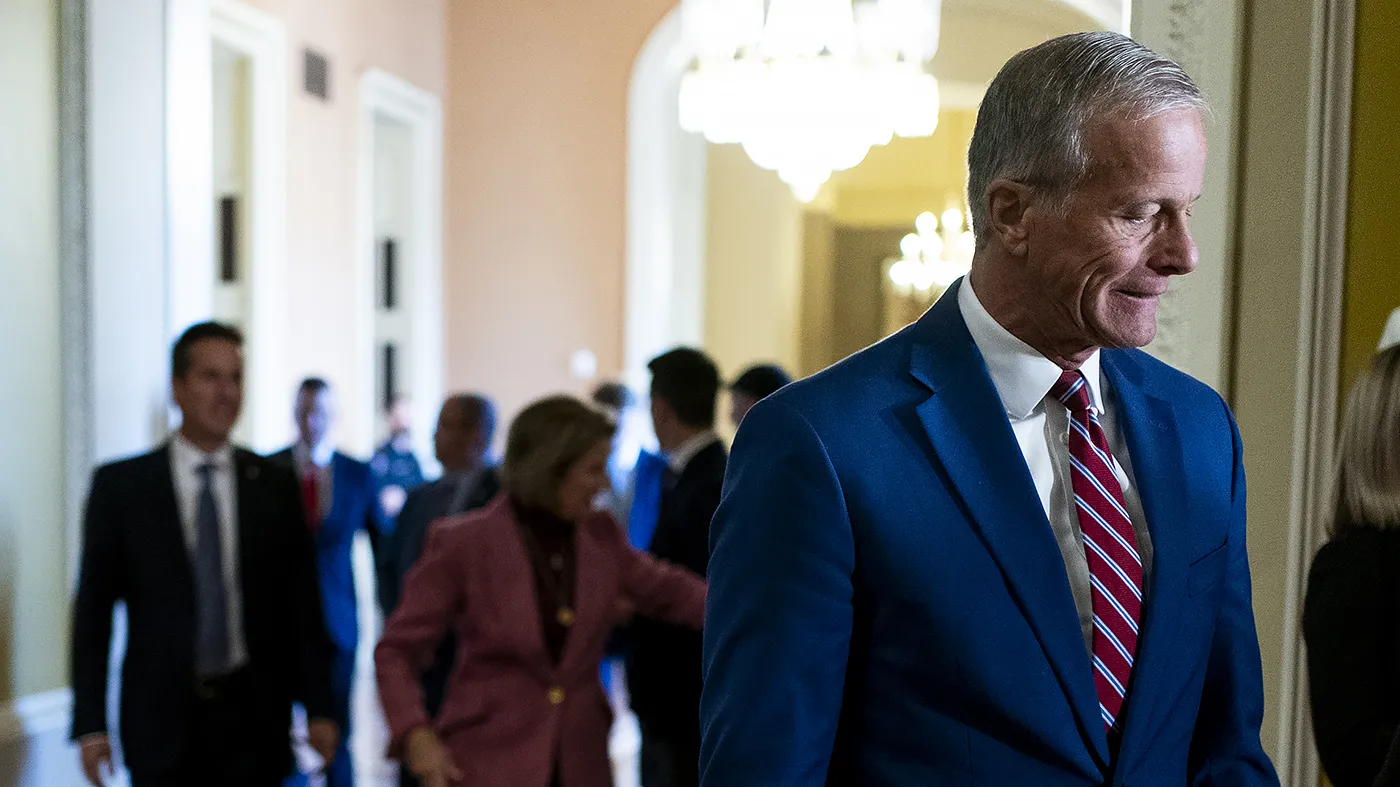
Senate Majority Leader John Thune (R-S.D.) is leery about advancing a budget reconciliation package to fund the Pentagon as he and other GOP senators fear there will be a revolt within their ranks over reforms projected to reduce Medicaid spending by as much as $1 trillion.
Thune has touted the changes to Medicaid that Republicans enacted last year in the One Big Beautiful Bill Act, also known as Working Families Tax Cut, as a big GOP accomplishment to rein in the growth of government.
But Thune is uncertain about whether he would be able to hold his conference together to fend off Democratic amendments to reverse Medicaid spending cuts if Republicans bring a budget reconciliation package to the Senate floor in the lame-duck session. That bill would provide an additional $350 billion to the Pentagon, something that President Trump has demanded.
Thune and other Senate GOP leaders are worried that Democrats could persuade a few Republican colleagues to join them in instructing the Senate Finance Committee to review the Medicaid reforms, which would open the door to later reversing them on the Senate floor.
"It's a real concern," acknowledged Senate Budget Committee Chairman Ron Johnson (R-Wis.), who would be tasked with managing a budget resolution and follow-up budget reconciliation package.
"We think we have colleagues in our midst who would try to overturn some of that stuff," Johnson said of the reductions in Medicaid spending that Republicans used last year to offset the cost of tax cuts.
Johnson called the Medicaid changes "modest reforms" that "bring the spending curve down a little bit."
But some Republicans worry that rural hospitals in their home states will get walloped by changes in the law slated to take effect next year and in 2028.
Sen. Josh Hawley (R-Mo.) said he supports keeping in place new work requirements for Medicaid beneficiaries, but he opposed provisions to reduce health care provider taxes, which states rely on to fund their Medicaid costs, and he opposed reductions in state directed payments.
"I'm for the work requirements but I imagine Democrats would want to reverse the provider tax for rural hospitals, I want to reverse the provider tax for rural hospitals," Hawley told The Hill.
The American Hospital Association has warned that limits on how much revenue states can collect through provider taxes could create unpredictability for state Medicaid programs.
Hawley also said he's told the Senate GOP leadership that he would insist on a vote to defund Planned Parenthood if he agrees to vote to begin the budget reconciliation process.
Other Republicans who could vote to reverse Medicaid funding cuts include Sens. Lisa Murkowski (R-Alaska), who is up for re-election in 2028; Sen. Susan Collins (R-Maine), who just lost her re-election bid; and retiring Sen. Thom Tillis (R-N.C.), who warned his colleagues against steep Medicaid cuts last year.
Polling showed that six in 10 midterm election voters said they were "very concerned" about health care costs and 33 percent of voters cited cuts to programs such as Medicaid and the Supplemental Nutrition Assistance Program (SNAP) as a reason to vote against Republicans.
A KFF analysist of The Voter Poll by SSRS, which was conducted from Oct. 19 to Nov. 3, found that voters who were concerned about health care costs preferred Democratic candidates over Republicans by a 2-to-1 margin in key Senate battlegrounds such as Alaska, Iowa, Kansas, Maine, Michigan, Ohio and Texas.
Complicating the political calculus for Thune is that Sen.-elect Sherrod Brown, the Democrat who won the Ohio Senate race, is due to replace Republican Sen. John Husted (R-Ohio) by Dec. 15, which would shrink the Senate GOP majority to 52 votes right when a budget reconciliation package is likely to come to the floor.
Sen. Mike Rounds (R-S.D.) noted that some of the Medicaid cuts included in last year's One Big Beautiful Bill Act survived by only a single vote.
He warned they could be reversed after Democrats pick up a seat in the lame-duck session once Brown, the Democrat, gets sworn into office.
"I think everything is at risk just because there were a number of areas in which savings were made, remember we only won those by one vote in a lot of cases. We will be down one person by that time" a budget reconciliation package comes to the Senate floor in December, Rounds said.
"Even if everybody voted the same, we would lose those votes because we're short one member by the 15th of December. It's just a matter of math," he said.
Rounds said keeping the Medicaid and Supplemental Nutrition Assistance Program (SNAP) reforms in place are critical to protecting the landmark individual and business tax cuts that Trump signed into law.
"It's a matter of maintaining the entire tax bill," he said. "If you start chipping away at all the provisions of it, it makes other areas more difficult to continue on.
"No tax on Social Security benefits for a lot of people was really valuable. There were offsets. When it comes to 'No Tax on Tips,' there were offsets," he added, arguing that popular tax breaks would be at risk if the offsets that were used to limit their impact on the federal deficit are erased.
Thune has warned his Republican colleagues that mustering 51 votes to begin debate on a budget resolution is only part of the challenge of using the budget reconciliation package to circumvent a Democratic filibuster.
He has repeatedly cautioned them that they would need to repeatedly muster a majority to fend off Democratic attempts to unwind core elements of the One Big Beautiful Bill Act, Trump's signature legislative accomplishment.
"We're talking to all of our members and getting an assessment of where folks ultimately will come down," Thune said of his efforts to feel out how GOP senators would vote on a budget reconciliation package.
"It's a function not just of being able to get on the bill, it's also being able to protect it and defend once it's on the floor," he said. "That's a different question for our members than whether you can get on the bill."
He said that fighting off Democratic amendments to reverse Medicaid spending reductions and other reforms and other poison bills "is probably the most challenging part."
Understanding Budget Reconciliation and Legislative Processes
Budget reconciliation is a special legislative process in the United States Congress that speeds up the passage of certain budgetary legislation. Created by the Congressional Budget Act of 1974, reconciliation bills are exempt from the standard filibuster in the United States Senate, meaning they can be approved with a simple majority vote rather than the usual sixty votes normally required to close debate on major legislation. This mechanism applies strictly to spending, revenues, and the federal debt limit. Lawmakers frequently use reconciliation to push through major fiscal packages when control of the White House and Congress is divided or when the governing party has a narrow majority.
The History and Impact of Medicaid Provider Taxes
Medicaid provider taxes are fees that state governments levy on healthcare providers such as hospitals, nursing homes, and pharmacies. States use the collected revenues to help finance their share of the federal Medicaid program, which then triggers matching federal funds. This financial structure allows states to increase payments to healthcare providers and maintain broader healthcare coverage without raising broad-based income or sales taxes. Federal policy changes that restrict or limit provider taxes can therefore create significant budget shortfalls for state agencies and rural medical facilities that depend heavily on these directed payments to keep their doors open.
The Role of the American Hospital Association
The American Hospital Association represents thousands of hospitals, health systems, and other healthcare organizations across the nation. Founded in 1898, the Washington-based organization advocates for hospitals in legislative and regulatory arenas, providing analysis on how federal policies affect patient care and hospital finances. Its policy analysts frequently issue warnings regarding federal spending caps and structural adjustments to major healthcare programs, emphasizing how legislative shifts might impact the financial stability of community hospitals and regional medical centers.