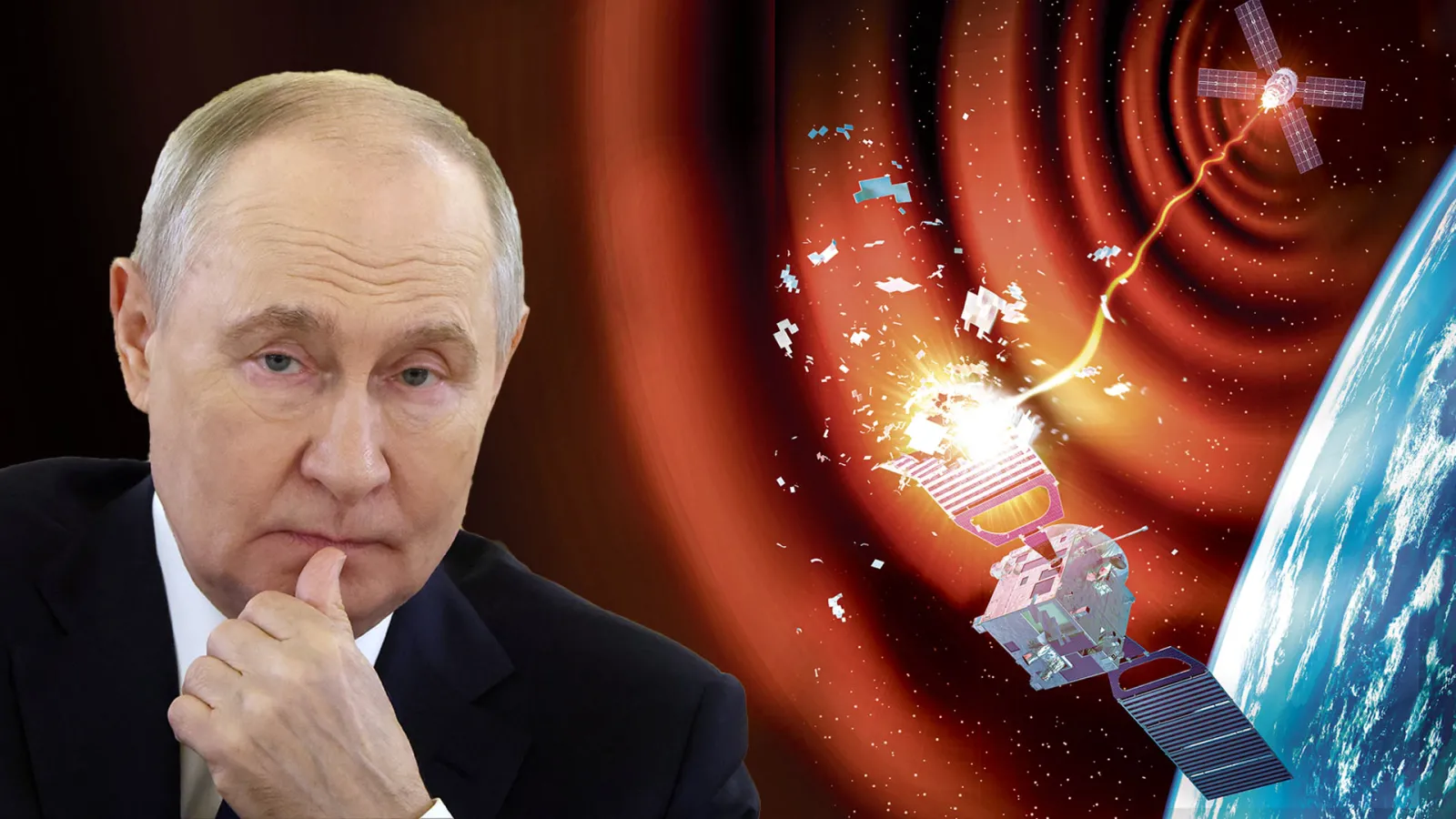
After his twitching finger pressed the nuclear button, Vladimir Putin's space bomb would obliterate the swarm of satellites that are key to our way of life. Emitting a giant electromagnetic pulse and then creating a vast radiation cloud, the nuke would wipe out spy satellites, Starlink and other space communication we've come to rely on. Agriculture, shipping, weather monitoring, mapping and finance would face severe disruption causing panic and market meltdown in Western societies.
It might sound like something from an excitable sci-fi novel, yet Western intelligence sources believe Russia may be preparing to send a nuke into space in just DAYS. So, are Britain and its allies ready to meet the doomsday threat? TikToking Prime Minister Andy Burnham has found time to film with a constellation of at least 30 fame-hungry social media influencers in just four months. Now, something with a little more gravity has arrived in his in-tray.
According to credible German media reports, Russia is preparing to launch a nuclear-armed satellite in the next 60 days. Intelligence sources told the outlets that the Sputnik-S satellite has been taken out of storage in Moscow and the Kremlin may be planning to launch it imminently. The intel has been disseminated to Western allies which would doubtless include Britain. It's unclear which agency provided the original information.
Head of the European Space Agency Josef Aschbacher said that sending nuclear weapons into space was "the ultimate nightmare scenario". While German government spokesperson Stefan Kornelius insisted Berlin was taking the intelligence reports "very seriously", on Monday, Nato chief Mark Rutte vowed to defend against a space nuke. The alliance's Secretary General said: "I can assure you, we will always make sure we defend every inchof Nato territory. That includes making sure we are safe when it comes to the space element."
Speaking alongside Rutte, German Chancellor Friedrich Merz did not confirm or deny the intelligence leaks of a Russian nuclear-primed satellite. However, Merz insisted the reports "reveal the level of escalation Russia is evidently prepared to pursue". Russia has been quick to deny it is preparing to blast a nuke into space. Kremlin spokesman Dmitry Peskov dismissed stories citing "unknown sources" as "hardly worth taking seriously".
While the Russian embassy in Berlin said it rejected "unfounded allegations" and said the media reports were part of a "propaganda campaign". Yet, a declassified report released by the US Defense Intelligence Agency (DIA) last month warned of Russia's space bomb plans. If detonated, it said the nuke could wipe out "thousands of satellites operated by countries and companies around the world, as well as the vital communications, navigation, scientific, meteorological, commercial and national security services they provide."
The DIA report added that it would "also leave lingering radiation belts, which could persist for years and damage satellites that initially were only temporarily disrupted". So why do the US military know with such certainty the devastation a nuclear bomb in space would unleash? Well, the Americans have already done it five times. The largest, launched from Johnston Atoll in the middle of the Pacific on July 9, 1962, had a series of unintended consequences.
The Starfish Prime warhead, carried by a Thor missile, was detonated 13 minutes 41 seconds after lift-off at an altitude of 250 miles. In the vacuum of space, it caused an electromagnetic pulse that was so large it sent many of the instruments used to measure the blast off the scale. Another surprise came when 300 street lights, numerous burglar alarms and telephone calls in Hawaii, 900 miles from the detonation point, were knocked out. Then it caused a blood-red and neon-green twilight to spread above thousands of miles of ocean.
Watching at "Rainbow Bomb" hotel rooftop parties in Hawaiian capital Honolulu, locals witnessed an eerie crimson aurora for several minutes. Up in space came another unintended consequence, Starfish Prime disabled half the world's satellites. Back in 1962, that wasn't disastrous. Today, with the global space economy worth £479billion, it would be catastrophic. Researchers say a space nuke detonated now would destroy most of the 16,000 satellites in low Earth orbit (LEO).
The global economy increasingly relies on the satellites orbiting hundreds of miles above our heads. Western militaries and spy agencies employ satellites for reconnaissance and manoeuvres. And Ukraine expertly uses Elon Musk's Starlink for battlefield comms, piloting bomber drones and air defence warnings against Russian drones. It's why Russia's war-mongering President Putin is threatening a space nuclear race. But why would Putin detonate a space nuke when it would also take out his own satellites?
Bleddyn Bowen, co-director of the Space Research Centre at Durham University said: "Russia, too, stands to lose the use of very useful military and civilian satellite infrastructures in such a scenario. This is merely nuclear sabre-rattling." Yet, Moscow security analyst Dmitry Stefanovich has pointed out that Russia is far less reliant on space infrastructure for its military and economy than the Western allies. Creating nuclear havoc in space would, in his words, strategically "flip the chessboard".
In 1967, the Outer Space Treaty signed by Britain, the US and the Soviet Union, banned nukes and other weapons of mass destruction from space. However, two years ago, Russia vetoed a UN Security Council resolution to reaffirm the ban. Britain's then UN Ambassador Barbara Woodward said: "There was nothing in this resolution that any law-abiding state committed to peace and the prevention of an arms race in outer space could reasonably object to. And yet Russia did."
When Putin launched his maniacal war on Ukraine in 2022, the first assault wasn't with tanks and infantry but a cyberattack on a commercial satellite system. Star wars are already here. Two Russian satellites have been observed approaching ageing European ones to intercept communications. To thwart them, the Europeans then manoeuvre them away. Analysts have likened the jousts to World War Two-style fighter plane dogfights in space.
Doubtless, Putin is enjoying the frisson of danger the reports of his potential nuclear satellite have sent through Western governments and intelligence agencies. A man whose scheming evil now extends to the serenity of space.
Background on the Space Race and Nuclear Tests
The history of high-altitude nuclear detonations dates back to the Cold War when both the United States and the Soviet Union tested the boundaries of atmospheric and space weaponry. The Starfish Prime test conducted by the United States in July 1962 remains the most famous example of such a blast. Detonating a 1.4-megaton warhead at an altitude of 250 miles above the Pacific Ocean created an artificial radiation belt that crippled several operational spacecraft of that era. Scientists and defense analysts have studied these historical records for decades to understand the vulnerability of modern orbital infrastructure.
Modern telecommunications, global positioning systems, and financial transactions depend heavily on spacecraft operating in low Earth orbit. The deployment of mega-constellations by commercial entities has dramatically increased the density of objects circling the globe. A high-altitude electromagnetic pulse generated by a nuclear explosion would bypass traditional physical defenses and induce massive electrical currents in unprotected electronic components. This physical reality forms the basis of current warnings issued by defense intelligence agencies regarding orbital warfare.
International Treaties Governing Outer Space
The foundational legal framework for orbital security is the Outer Space Treaty of 1967, which prohibits signatory nations from placing weapons of mass destruction into orbit around the Earth. The United States, the United Kingdom, and the Soviet Union were among the original parties that signed the agreement to keep celestial bodies free from military escalation. Despite these long-standing international commitments, geopolitical tensions have eroded arms control frameworks over recent years. Diplomatic efforts at the United Nations have repeatedly stalled as major powers clash over the definition and prohibition of anti-satellite capabilities.