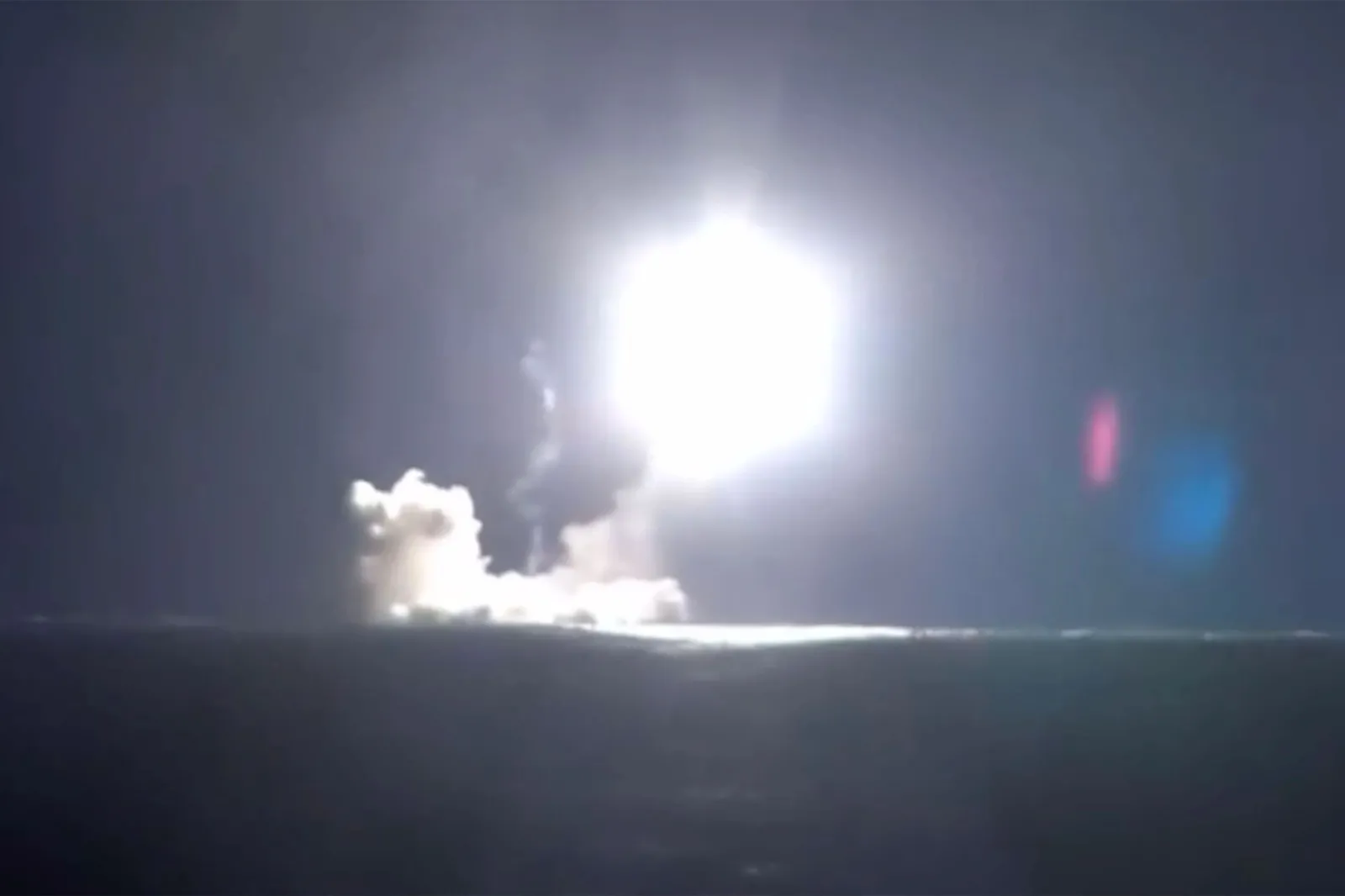
Russia announced that a Borei-class nuclear submarine fired a Bulava intercontinental ballistic missile, which travelled thousands of miles before striking a remote Arctic test range about 300 miles east of Norway.
The Kremlin said the 12-metre missile, capable of reaching 5,000 miles, is 100 times more powerful than the bomb dropped on Hiroshima in 1945.
The launch was reported just hours after three of Britain's four nuclear-armed submarines returned to sea for the first time in years.
Last week RAF Typhoon fighters joined France in a simulated nuclear strike, the first joint doomsday exercise, and earlier this month French President Emmanuel Macron observed a French navy submarine fire an upgraded M51.3 missile.
Macron remarked, "To be free, one must be feared. And to be feared, one must be powerful."
Russian footage released on Wednesday showed the Bulava missile fired from the Generalissimo Suvorov (K-553), a Borei-A-class vessel of the Pacific Fleet, launching from the Sea of Okhotsk north of Japan toward the Chizha range in Arkhangelsk.
The Defence Ministry said the crew carried out the test in line with a combat-training plan, targeting the Chizha site on the Kanin Peninsula, which lies on the Barents Sea about 300 miles from Norway and a similar distance from Finland, a NATO member since 2023.
Moscow called the test "successful," though independent verification is pending.
In the UK, Defence Secretary Wes Streeting urged households to keep at least three days of food and water, warning of sophisticated state-backed cyber attacks that could disrupt supply chains and payment systems.
The Bulava entered service in 2013 and can carry up to ten nuclear warheads; each Borei-class submarine can hold up to 16 missiles.
The US-based Centre for Strategic and International Studies described the system as a core element of Russia's future strategic nuclear force.
Britain's deterrent submarines carry Trident 2 missiles, each capable of delivering more explosive power than all weapons used in World War Two, though a recent test of a Trident reportedly failed to ignite, according to The Sun.