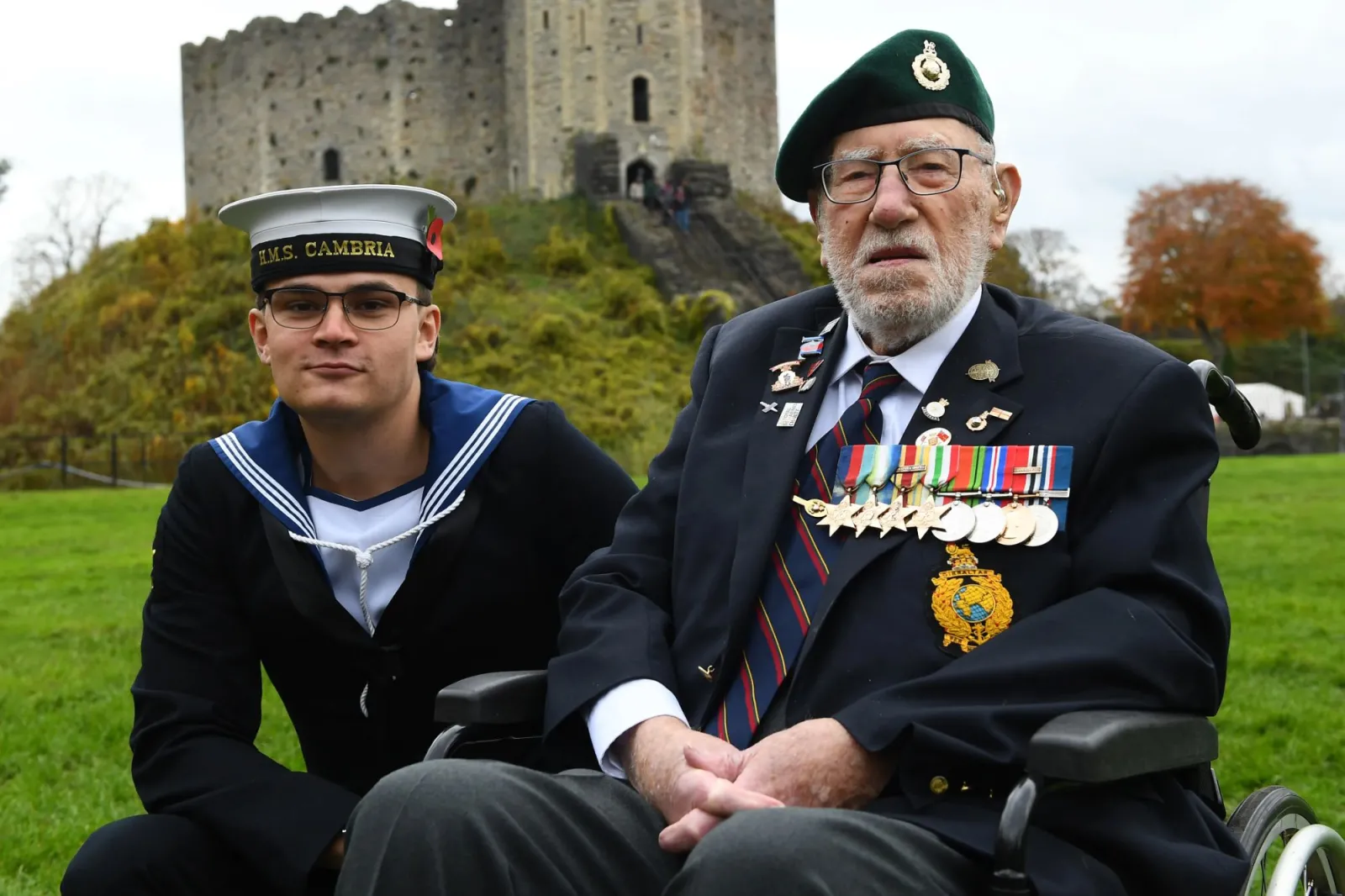
A young Royal Navy sailor is urging his generation to join the Armed Forces after he was inspired by one of Britain's last World War Two heroes. Able Seaman Dylan Williams, 24, was stunned to learn that 102-year-old John Eskdale spent more than four hours in the water when his ship, HMS Charybdis, was hit by a German torpedo in the English Channel in October 1943. Brave John, a rookie in the Royal Marines at the time, survived, but 462 of his comrades drowned or froze to death. As the nation falls silent at 11am to honour the fallen on Remembrance Sunday, Dylan says we must never forget what John and his fellow servicemen and women did.
He said: "I've loved every minute talking with John, it's been a privilege." He added: "His story is remarkable. So many from that generation had similar experiences. He is an inspiration. Would I recommend a career in the services? Yes. I've had an amazing time. I'm travelling to places, making memories with friends, while also gaining valuable qualifications. These things wouldn't have happened if I had stayed at home." The two men, born 78 years apart, met at the Royal British Legion's Field Of Remembrance at Cardiff Castle, where 5,000 small wooden crosses have been planted in the grounds in honour of those who lost their lives in conflict.
John, of Lydney, Gloucs, also urged youngsters to follow in his footsteps, saying: "I like to see young people getting an education, going on to university and doing well. But Britain needs its armed forces, especially at the moment. When you leave the services, it's the comradeship you miss the most." John welled up as he told Dylan that he still misses his friends lost in the tragedy 83 years ago. He recalled: "They were the best, they gave their lives so their world could be free. You try to remember the good times, and there were many of those. But when Remembrance Day comes around, that's what you do, you remember. It has never left me. I'll think about it until the day I die."
Describing the aftermath of the torpedo attack as he waited to be rescued from the water, John said: "It was horrendous. The last half-hour was worst. It was so cold, I was giving up hope. I heard men drowning and calling for their mothers." His thick uniform, soaked with diesel from the sunken ship, kept his body temperature high enough to survive. Dylan listened astounded as John told how he went on to join a military intelligence unit alongside James Bond author Ian Fleming. And the younger man said John's military career should be an inspiration to Gen Z, adding: "To hear John's story is an incredible privilege. I feel lucky to shake his hand, sit down with him and listen to how he survived that day.
People my age don't know what happened back then, they see it as history and that's it. But they should know the sacrifices made. More people of my generation should consider a career in the Armed Forces. It's the best thing I've ever done. I've travelled the world and got a trade." Dylan, from Cardiff, joined the Royal Navy aged 18 and trained as an engineer. He said: "Meeting John is special. I think it's hard to fully comprehend exactly what he went through that day and I'm just thankful that we have learned a lot through the years and we have better equipment now. I'll be telling my mates about John and how it's important to remember the sacrifices made by the people not just of World War One and World War Two, but every war since."
- 10,000 veterans will join the Royal British Legion's March Past the Cenotaph in London.
Background on World War Two Naval Convoys and HMS Charybdis
HMS Charybdis was a Dido-class light cruiser of the Royal Navy that was launched in 1940 and saw extensive service during World War Two. The vessel operated primarily in European waters, including the Mediterranean and the English Channel, before meeting its fate in October 1943. German torpedo boats operating from occupied French ports ambushed the British warship during an operation off the coast of Brittany. The loss of life was severe because of the speed of the sinking and the freezing conditions of the autumn sea. Many sailors who survived the initial blast succumbed to hypothermia while waiting for rescue vessels to arrive in the dark waters.
Military operations in the English Channel during this period involved constant threats from German surface craft, aircraft, and U-boats. The Royal Navy relied on convoys and escort destroyers to protect strategic supply lines and troop movements around the British Isles. Veterans like John Eskdale experienced firsthand the brutal realities of naval warfare when their ships were targeted by enemy forces. The survival of individual sailors often depended on sheer endurance, timely rescue efforts, and unpredictable factors like heavy woolen uniforms soaked in heavy oils.
The Royal British Legion and Remembrance Traditions
The Royal British Legion organizes annual tributes across the United Kingdom to honour members of the armed forces who have died in the line of duty. The Field Of Remembrance at Cardiff Castle is one of several dedicated sites where thousands of wooden crosses are planted by veterans, serving personnel, and members of the public. These displays allow visitors to pay personal respects and reflect on the human cost of armed conflicts spanning from the First World War to modern peacekeeping missions.
Remembrance Sunday involves nationwide silences, church services, and parades featuring veterans, cadets, and active military personnel. The march past the Cenotaph in London gathers thousands of former service members representing different branches of the armed forces and various eras of military engagement. These national events serve to educate younger generations about historical sacrifices and maintain institutional continuity within the British military community.
Modern Careers in the British Armed Forces
The British Armed Forces encompass the Royal Navy, the British Army, and the Royal Air Force, offering technical training, educational opportunities, and global travel to new recruits. Young individuals entering the services today undergo rigorous training programs to gain specialized engineering, logistics, and combat roles. Modern recruitment campaigns focus on highlighting personal development, transferable technical skills, and lifelong camaraderie among service personnel.
Recruiting members from Generation Z remains a key focus for military leadership as older cohorts retire and geopolitical security challenges evolve. Programs within the services provide structured career paths, competitive compensation, and pension schemes designed to attract young adults seeking stability and adventure. Service members often highlight the unique bonds formed through shared hardships and disciplined teamwork during their time in uniform.