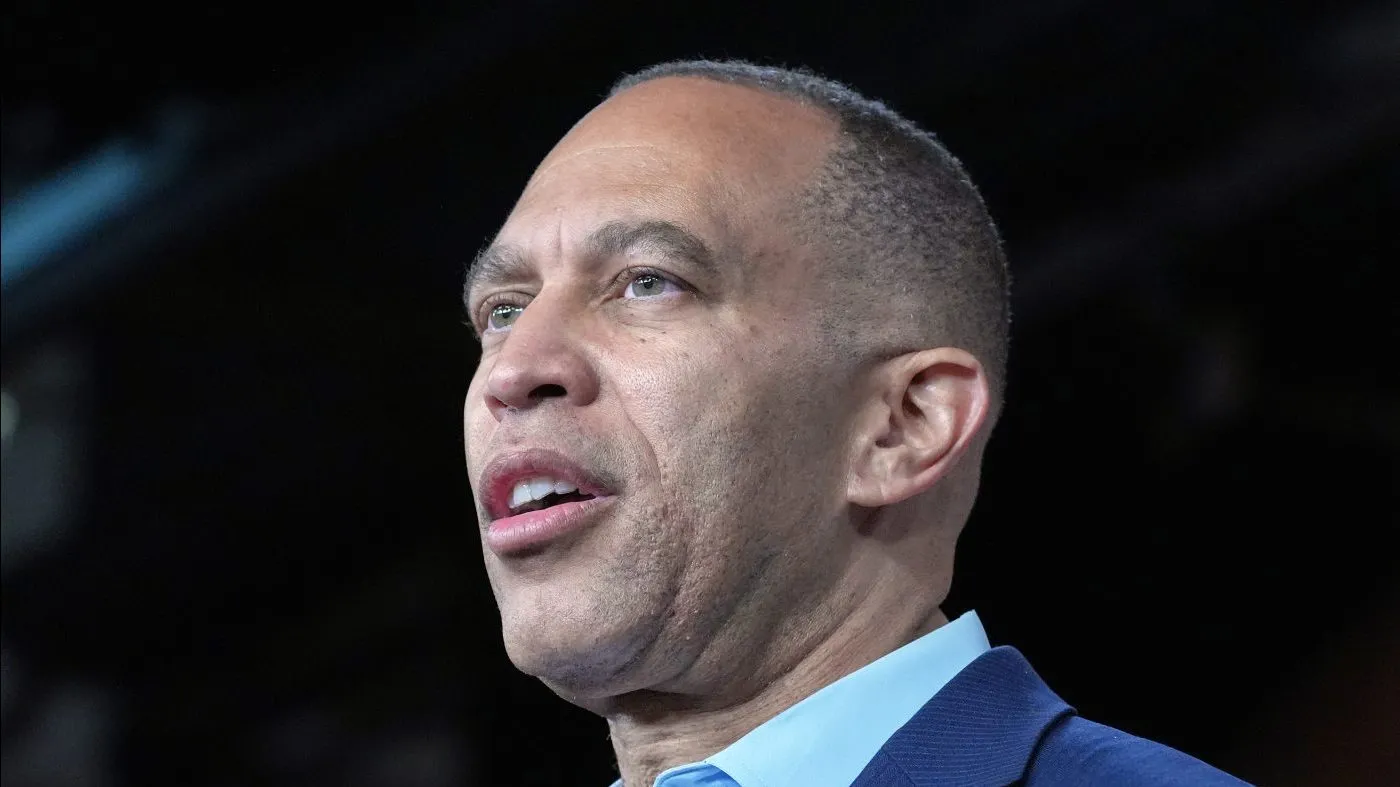
House Democrats on Wednesday nominated Rep. Hakeem Jeffries (D-N.Y.) to become the next House Speaker, putting the Brooklyn native one step closer to entering the history books as the first Black lawmaker to hold the gavel.
The tally was a lopsided 251 to 11, affirming Jeffries's popularity within the caucus and setting the stage for him to win the Speakership in the next phase of the two-step process, which will occur on Jan. 3 with a vote of the full House on the chamber floor.
The outcome was no surprise as Hakeem Jeffries ran uncontested, and the vast majority of Democrats had lined up behind him heading into the closed-door vote. The blue wave that crashed into the midterms gave Jeffries a boost, providing him with ammunition to claim a popular vision and an enormous cushion to absorb defectors.
Still, some Democrats have also questioned Jeffries's leadership record in the first two years of President Trump's second term, saying he simply didn't fight hard enough to counter the administration as it stretched the limits of executive power in its approach to immigration enforcement, the Iran war, government spending and a host of other issues. Some outside liberal groups have spent the weeks since the midterms scrambling to recruit a more liberal alternative, though none emerged.
Still, Hakeem Jeffries took nothing for granted heading into Wednesday's vote and took pains to huddle with all the various ideological groups within the diverse caucus, from the left-wing Progressive Caucus to the centrist Blue Dogs. He also met with a long list of Democrats in the incoming freshmen class, which includes some of his most public critics.
Amid the grumbling, Hakeem Jeffries took the unusual step of calling for his nomination to be decided by recorded vote, a last-minute and unexpected twist since he faced no challenger and other leaders were likely to be promoted by fast-track votes of acclamation. Many thought Jeffries would do the same, but the recorded tally allowed him to gauge precisely how much support he has heading into the Speaker vote of the full House on Jan. 3, when the bar for success will be much higher while needing 218 votes on the floor to secure the gavel early next year.
Wednesday's vote was by closed-ballot, meaning Democrats were free to make their choice anonymously, and the final count is a demonstration that, despite some criticism, Hakeem Jeffries has the overwhelming support of his troops heading into Jan. 3 and the last two years of the Trump presidency.
Shortly before the nomination of Hakeem Jeffries, House Democrats voted to promote Rep. Ted Lieu (D-Calif.) to chairman of the House Democratic Caucus, a step up from the vice chairman seat he's held over the last four years. Top deputies including Reps. Katherine Clark (D-Mass.) and Pete Aguilar (D-Calif.) are also expected to keep their positions of power, rising to majority leader and Democratic whip, respectively, in votes scheduled to be held later Wednesday morning.
That team has been in place since 2023, when former Speaker Nancy Pelosi (D-Calif.) and her long-time lieutenants Reps. Steny Hoyer (D-Md.) and Jim Clyburn (D-S.C.) stepped out of the top leadership ranks to clear the field for a younger crop of rising stars in the party. Hakeem Jeffries already made history during that process, becoming the first Black lawmaker to lead either party in either chamber, and his ascension to Speaker would mark another chapter, putting him second in line to the presidency and making him the de facto leader of the national Democratic Party, at least until a 2028 presidential nominee emerges.
Hakeem Jeffries is already forecasting some of the issues he intends to prioritize next year, with the early list featuring efforts to reverse Medicaid cuts adopted by Republicans last year and expand ObamaCare tax credits, which Republicans allowed to expire at the start of 2026. He is also vowing to focus intently on accountability amid numerous accounts of administration officials using their power to advance personal interests, while Democrats are already planning a long list of investigations into Trump, his Cabinet, his family and other allies as a first order of business next year, setting the stage for an explosive clash between the White House and Congress under the newly divided government.
Hakeem Jeffries will have his share of challenges, however, as the midterms have elevated the number of centrist Democrats who hail from purple districts and are advocating for moderate policies that can win bipartisan support and become law. They will clash with the liberal wing of the caucus, which also boosted its numbers and wants to adopt progressive priorities including Medicare for All and the end of military aid to Israel, leaving Hakeem Jeffries and his leadership team caught in the middle of those competing groups.
Background on House Leadership and the Democratic Caucus
The leadership structure of the United States House of Representatives involves various roles that dictate the legislative agenda and party strategy. The Democratic Caucus comprises members from diverse political backgrounds representing different regions across the country. Internal elections determine who holds positions such as the party leader, caucus chair, whip, and policy committee heads. These internal processes reflect the ideological balance and priorities of the party members in Congress.
The Role of the Speaker of the House
The Speaker of the House serves as the presiding officer of the United States House of Representatives and is second in the presidential line of succession behind the Vice President. The position holds significant influence over the legislative process, committee assignments, and the scheduling of bills for floor debate. To secure the position during the full chamber vote in January, a candidate typically requires a majority of the members voting, which generally translates to 218 votes in a fully seated House.
Recent Legislative Priorities and Congressional Dynamics
Congressional leadership often focuses on healthcare policy, federal spending, tax provisions, and oversight of the executive branch. Debates frequently center on programs such as Medicaid and the Affordable Care Act, alongside broader fiscal management and budgetary allocations. Investigations and committee hearings represent tools used by the legislative branch to exercise oversight regarding administration policies and executive branch actions.