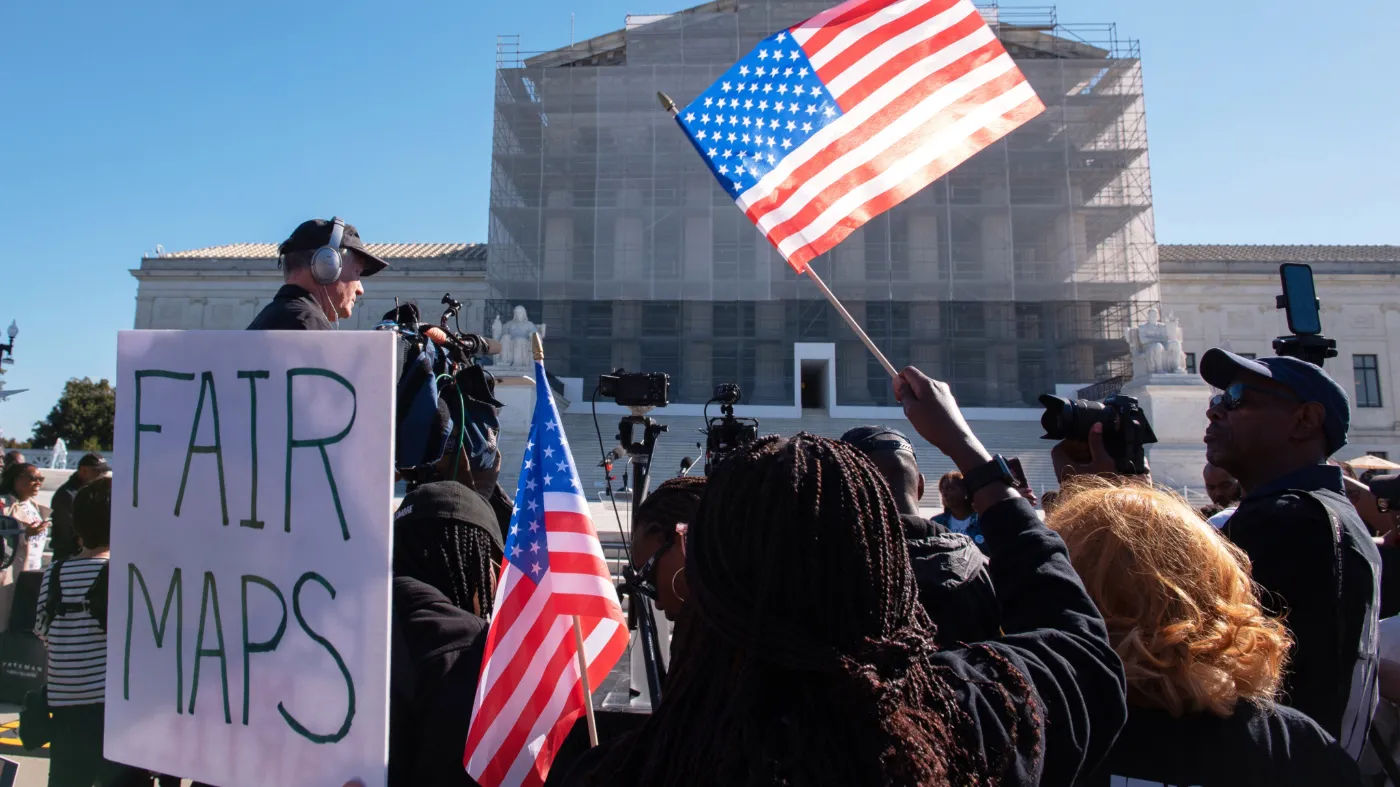
The political left has grown intensely frustrated over the weakening of the Voting Rights Act by the conservative majority on the U.S. Supreme Court. The final development in this trend was Louisiana v. Callais this past term, which established that a violation of the Voting Rights Act requires intentional racial discrimination and prohibited creating Black congressional districts without such proof. The court also noted that gerrymanders driven by political goals are not automatically racially discriminatory, even when they harm Black voters.
However, this deep focus on the Voting Rights Act tends to obscure a much larger and more immediate threat to American democracy. The real force undermining Black political representation in the United States is not Callais, but a 2019 ruling on a separate legal issue, Rucho v. Common Cause, which determined that political gerrymanders cannot be challenged in federal court regardless of how extreme they become. Partisan gerrymanders were classified by the court as non-justiciable political questions, making Rucho the primary reason Black political representation is vanishing in several states.
To grasp how Callais and Rucho interact, observers only need to examine recent political shifts in Tennessee. Memphis historically featured an urban core of Black voters concentrated within one compact congressional district situated next to a large, white-dominated suburban and rural district. That previous map, adopted in 2022, aligned with standard legislative districting practices based on residential patterns across America.
Following the Callais ruling, the Tennessee state legislature eliminated the traditional prohibition against mid-decade congressional redistricting and fractured Memphis into three sprawling districts. Two of these newly drawn districts extended all the way to Nashville, located 200 miles away. The resulting congressional map ignored traditional districting norms such as geographic compactness and the preservation of political boundaries, resembling a plate of spaghetti rather than a standard district map, which ultimately produced three white districts and zero Black districts.
This entire process was executed intentionally, raising questions about whether it violated the Callais ban on deliberate racial discrimination. Legal analysts suggest it likely did not violate the rule, largely because Callais strongly implied that political gerrymanders do not qualify as racially discriminatory simply because Black voters experience electoral losses. Republican lawmakers in the Tennessee legislature openly admitted that their redistricting effort aimed to eliminate a likely Democratic congressional district in Memphis, classifying the maneuver as a political gerrymander where Black voters served merely as collateral damage, which remains permissible under Callais.
Background on the Supreme Court Rulings
The legal framework surrounding legislative redistricting has evolved significantly through key Supreme Court decisions over the past decade. The Voting Rights Act of 1965 was originally enacted to prohibit racial discrimination in voting, serving as a powerful tool for minority voters. Subsequent legal challenges and shifting court majorities have altered how federal courts evaluate legislative maps, culminating in the 2019 Rucho decision and the recent Callais ruling. Legal scholars have debated the exact boundaries between permissible partisan mapmaking and illegal racial discrimination for many years, leading to intense legislative battles in state capitals across the nation.
How Congressional Action Can Counter Gerrymandering
While reversing the Callais precedent through Congress remains exceptionally difficult due to constitutional hurdles, lawmakers possess clear authority to address the issues created by Rucho. The Supreme Court declined to police partisan gerrymandering because it found no explicit constitutional standard for a fair legislative map, leaving the matter open to legislative intervention. Congress holds broad discretionary power under Article I of the Constitution to regulate congressional elections, meaning federal lawmakers could pass a statute banning maps where partisan interests outweigh traditional districting principles. Such a law could explicitly outlaw mid-decade redistricting and bizarrely shaped districts, making the map used in Tennessee clearly illegal and restoring Memphis to a compact, single district.
Impact on Future Elections
Implementing a federal restriction on extreme partisan mapmaking would not immediately expand minority representation, but it would successfully curb the most aggressive gerrymandering efforts by state majorities. Although House Republicans scramble to finish agenda before Democrats take over in various legislative contexts, the persistent threat of partisan maps remains a central concern for future control of the legislative branch. Even during election cycles featuring strong voter enthusiasm, effective gerrymandering continues to alter outcomes, as demonstrated when three white Republicans won office under the contested Tennessee map. If political parties wish to secure sustainable majorities in the future, addressing the legal loopholes highlighted by Rucho remains an essential legislative priority.