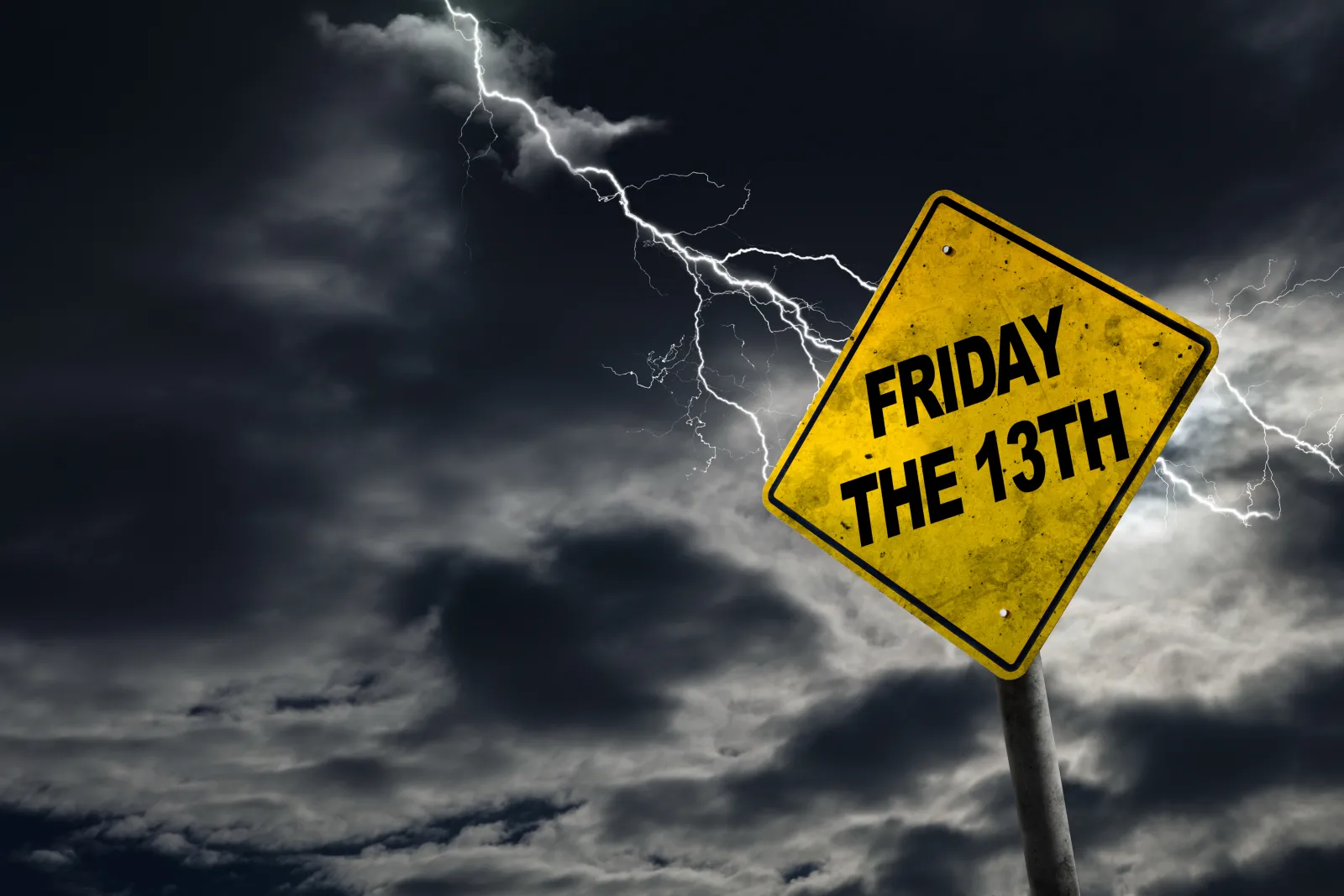
Superstitious souls are bracing for a day of fickle fortune today, as the calendar shows Friday the 13th for the third time this year. Millions across the United Kingdom dread the arrival of what is traditionally known as the unluckiest date in the diary. Some of the true stories behind the date,s dastardly reputation are even more shocking than the slasher movies. Here is everything you need to know about Friday the 13th.
How Often Does Friday The 13th Happen In A Year
Friday the 13th appears at least once in every calendar year because of the way the Gregorian calendar cycles through months and weekdays. Calendar patterns mean some years have one Friday the 13th, while others have two or even three. The alignment depends on the day the year begins and whether it is a leap year. The year 2026 started on a Thursday, which means there are three months where the 13th lands on a Friday, specifically February, March, and November. According to mathematicians studying the calendar cycle, the 13th day of any month is slightly more likely to fall on a Friday than any other weekday.
Why Are People Scared Of Friday The 13th
The fear of Friday the 13th is so widespread that it has its own name, friggatriskaidekaphobia, which is also known as paraskevidekatriaphobia. Frigga refers to the Norse goddess of love and fertility associated with Friday, while triskaideka is Greek for thirteen, and phobia means fear. When Norse and Germanic tribes who worshipped Frigga converted to Christianity in the early Middle Ages, legend has it that she was labelled a witch and banished to a mountaintop. It was believed that every Friday she would meet with eleven other witches and the devil himself, totalling thirteen, and together they would plot terrible things for the coming week. Psychologists and cultural historians say the word reflects a long tradition of unease about the number 13 itself.
The Origins Of The Superstition Behind The Date
Historians say the superstition likely developed from several overlapping traditions rather than a single event. One commonly cited influence comes from Christianity, noting that at the Last Supper, Judas Iscariot was the 13th guest at the table before the crucifixion of Jesus, which according to Christian tradition happened on a Friday. Over time, the two symbols became linked with misfortune. In Norse mythology, there is a story about 12 gods dining together in Valhalla when Loki, a trickster figure, arrived uninvited as the 13th guest and caused chaos. By the 19th century, the superstition had spread widely in Europe and North America, eventually becoming part of popular culture. In 1980, the first film in the slasher franchise Friday the 13th cemented the myth in the public psyche through a clever marketing strategy by director Sean S. Cunningham, who took inspiration from the massive success of John Carpenter,s 1978 horror film Halloween, which was also named after a spooky date.
Historical Events Associated With Friday The 13th
While many fear the date because of superstition, statisticians and researchers have found no evidence that bad luck or unusual disasters happen more often on Friday the 13th than on any other day. Nevertheless, some really unlucky and horrific events have taken place on Friday the 13th over the years, helping to reinforce the date,s dark reputation. On March 13, 2026, Saudi Arabia cut oil production by 20 percent after the shutdown of two offshore oil fields, which triggered what energy analysts have called the largest supply disruption in the history of oil markets. On February 13, 2026, three people, including two British tourists, were killed in an avalanche near Val-d,Isere, France. On October 13, 2023, Israel carried out strikes on nuclear sites in Iran, leading Iran to describe the attack as a declaration of war. On March 13, 2020, the United States declared a national emergency due to the COVID-19 pandemic and many global lockdowns began. On November 13, 2015, a series of coordinated Islamist terrorist attacks across Paris and Saint-Denis resulted in 130 deaths and hundreds of injuries. On January 13, 2012, cruise liner Costa Concordia struck a rock off the Italian coast and with over 4,000 people on board, the ship capsized and 32 passengers and crew died. On August 13, 2010, a 13-year-old boy was struck by lightning in Suffolk at exactly 13:13. On October 13, 2006, 36 inches of snow fell on upstate New York, causing around £85million,s worth of damage. On September 13, 1996, legendary rapper Tupac Shakur died in a Las Vegas hospital from gunshot wounds sustained in an unsolved drive-by shooting. On October 13, 1989, the Dow Jones Industrial Average dropped 190.58 points in the Friday the 13th mini crash, the second largest single-day drop at the time. On October 13, 1972, Uruguayan Air Force Flight 571 crashed in the Andes, with 16 survivors resorting to cannibalism before rescue over two months later, and on the same day, a flight from Paris crashed near Moscow, killing all 174 passengers. On November 13, 1970, the Bhola cyclone struck Bangladesh and India, claiming up to 500,000 lives. On March 13, 1964, Kitty Genovese was stabbed and raped over 30 minutes in New York, with 38 witnesses reportedly failing to call police, an incident that gave rise to the psychological concept of the bystander effect. On September 13, 1940, Nazi forces dropped five bombs on Buckingham Palace, killing one person and destroying the Royal Chapel. On January 13, 1939, devastating bushfires tore through Victoria, Australia, on what became known as Black Friday, killing 36 people and destroying 75 percent of the state. On July 13, 1877, Nathan Bedford Forrest, Confederate general and founding Grand Wizard of the Ku Klux Klan, was born. On Friday 13th, 1829, daredevil Sam Patch, known as The Yankee Leaper, jumped 125 feet into the Niagara River near the famous Falls in front of more than 8,000 spectators and was never seen again. On October 13, 1307, King Philip IV of France ordered the mass arrest of the Knights Templar, the majority of whom were burned at the stake. Additionally, Professor Heinz von Foerster devised a mathematical equation in 1960 that calculated the end of the world would occur on Friday November 13, 2026.
Background On Calendar Math And Cultural Phobias
Calendar structures rely on fixed math regarding leap years and the standard seven day week repeating across months of varying lengths. The Gregorian calendar ensures that the thirteenth day of any month lands on a Friday more frequently than on any other day of the week. Societies across centuries have assigned symbolic weight to numbers, with twelve often representing completeness, such as the months of the year or the signs of the zodiac. Thirteen consequently breaks that perceived harmony, leading to cultural avoidance in architecture, aviation, and hospitality where floors, rows, and rooms are routinely omitted.
Impact Of Phobias On Daily Life
The Stress Management Center and Phobia Institute in North Carolina estimated that up to 21 million Americans are affected by a fear of Friday the 13th. About one in five adults in the UK, roughly 10 to 13 million people, admit to feeling uneasy, superstitious, or terrified of Friday the 13th, according to research from 2017. This psychological burden leads some people to avoid travelling, conducting business deals, or making major life decisions on the date. Psychologists document these avoidance behaviors as a manifestation of anxiety tied to cultural conditioning rather than rational danger.