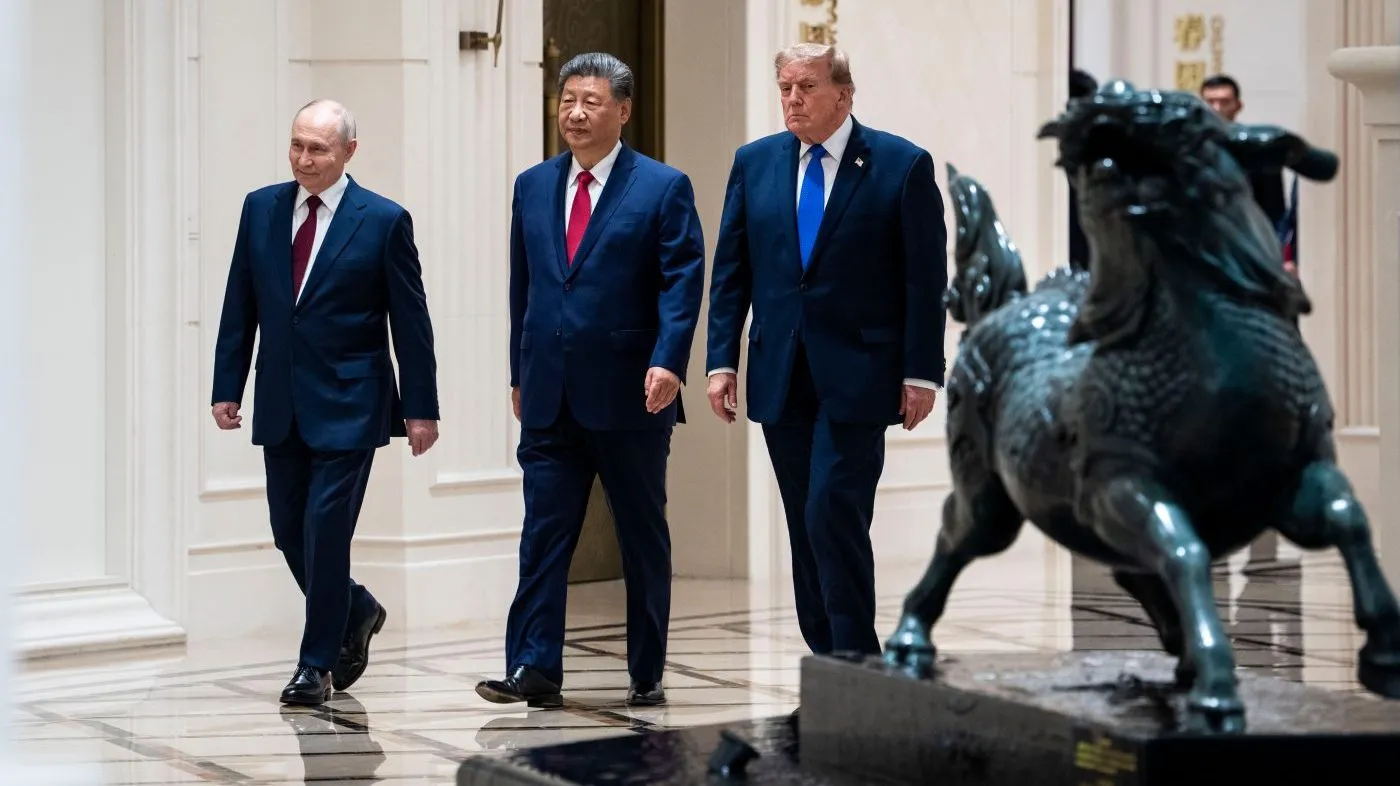
President Donald Trump announced that China and Russia had committed to engage in dialogue over nuclear threats after a summit with Presidents Xi Jinping and Vladimir Putin last week. The meeting, held on the sidelines of the Asia-Pacific Economic Cooperation (APEC) summit, produced a joint declaration that the three leaders would discuss ways to reduce the risk of nuclear war. Trump highlighted the declaration's emphasis on nuclear non-proliferation and called the combined nuclear stock of the United States, China and Russia "unacceptable."
Summit Outcomes
During a White House press briefing, Trump said that the leaders had agreed to a "vague agreement to reduce the risk of nuclear war," noting that Xi referred to nuclear weapons as a "sword of Damocles" hanging over humanity. Trump added that the United States, China and Russia together hold 92 percent of the world's nuclear power and must reduce the danger they pose. "The power is unacceptable. It's unacceptable," Trump said, stressing the need for cooperation to stop the proliferation of nuclear weapons worldwide.
In the joint declaration, the three countries reiterated that a nuclear war must never be fought and pledged to conduct dialogue on reducing nuclear risks and preventing the spread of nuclear weapons. Trump emphasized that the leaders would "cooperate to stop the proliferation of that nuclear threat throughout our planet."
Current Nuclear Stockpiles
According to the Bulletin of the Atomic Scientists, China had an estimated 410 nuclear warheads in 2023. Trump said Beijing now has 600 warheads. Russia possesses about 5,420 warheads as of March, while the United States holds roughly 3,700 in its arsenal. These figures illustrate the vast disparity between China and the United States and Russia, a point raised by analysts who say China is reluctant to discuss armament numbers because it seeks to close the gap with Washington and Moscow.
New START Expiration
The New Strategic Arms Reduction Treaty (New START) between Washington and Moscow, which limited U.S. and Russian strategic nuclear weapons for more than half a century, expired after President Trump rejected the Kremlin's proposal to extend it for another year. Trump insisted that Beijing be included in a "new, improved and modernised" agreement. Secretary of State Marco Rubio stated that true arms control in the 21st century requires China's participation because of its rapidly growing stockpile.
Expert Views on the Declaration's Ambiguity
Yun Sun, director of the China program at the Stimson Center think tank, said the three leaders' agreement is "simply a deal to talk, not act," and that it is unlikely to yield progress during the two years Trump has left in office. Sun explained that China believes there is a disparity between its nuclear capability and that of the U.S. and Russia, and therefore sees arms control talks as nonsensical until it reaches parity.
Evan Sankey, an analyst at the Cato Institute, echoed Sun's assessment. He noted that nuclear risk reduction includes clarification of strategic intent, nuclear doctrine, and stability policy, such as crisis communications or notifying other nations ahead of intercontinental missile tests to avoid panic. Sankey suggested that Trump could push for a trilateral version of the nuclear risk reduction center that currently exists between the U.S. and Russia.
China's Position on Non-Proliferation
Sun said China views nuclear non-proliferation as an issue for other countries, "an Iran problem, a North Korea problem, other countries' problem", and does not see it as a call for China to address its own nuclear behavior. Sankey added that while China may not discuss warhead numbers yet, there are other areas of arms control it could negotiate.
Potential Areas of Cooperation
Both analysts noted that the United States, Russia, and China share a common interest in preventing other nations from acquiring nuclear weapons. Sankey suggested that the three could work together to curb North Korea's nuclear program, perhaps by capping it and pressuring Kim Jong Un, with Russia's help as well.
Background
The United States has maintained a strategic deterrent since the Cold War, with a triad of land, sea, and air delivery systems. China's nuclear program began in the 1950s and has grown steadily, reaching an estimated 600 warheads by 2024. Russia inherited the Soviet Union's arsenal and continues to modernise its nuclear forces, including new intercontinental ballistic missiles and submarine-launched ballistic missiles.
The New START treaty, signed in 2010, capped the number of deployed strategic nuclear weapons at 1,550 for each side and limited the number of deployed launchers to 700. Its expiration in 2021 marked the end of a 50-year period of formal arms-control limits between the two largest nuclear powers.
China's reluctance to engage in formal arms-control talks stems from its strategic goal of achieving nuclear parity with the United States and Russia. Beijing has increased its nuclear production capacity and has tested new missile systems in recent years, signaling a desire to strengthen its deterrent.
Trump's administration has taken a hard-line stance on nuclear non-proliferation, pushing for the inclusion of China in any future arms-control agreements and advocating for stronger measures to curb North Korea's nuclear ambitions.
What Happens Next
With the New START treaty expired, the United States and Russia have no formal framework to limit strategic nuclear weapons. The next steps depend on the political will of the U.S. administration and the willingness of Moscow and Beijing to negotiate new terms. Analysts predict that without concrete commitments, the three nations will continue to expand or modernise their arsenals, potentially increasing global nuclear risk.
Trump's call for a trilateral nuclear risk reduction center could provide a platform for dialogue, but its effectiveness will hinge on the depth of engagement and the willingness of all parties to address concrete disarmament measures.
Key Points
- Trump said China and Russia will discuss nuclear risk reduction after a summit with Xi and Putin.
- China has about 600 warheads; Russia 5,420; the U.S. 3,700.
- The New START treaty expired after Trump rejected its extension.
- Experts warn the joint declaration is vague and unlikely to curb nuclear growth.
- China views non-proliferation as an issue for other countries, not itself.