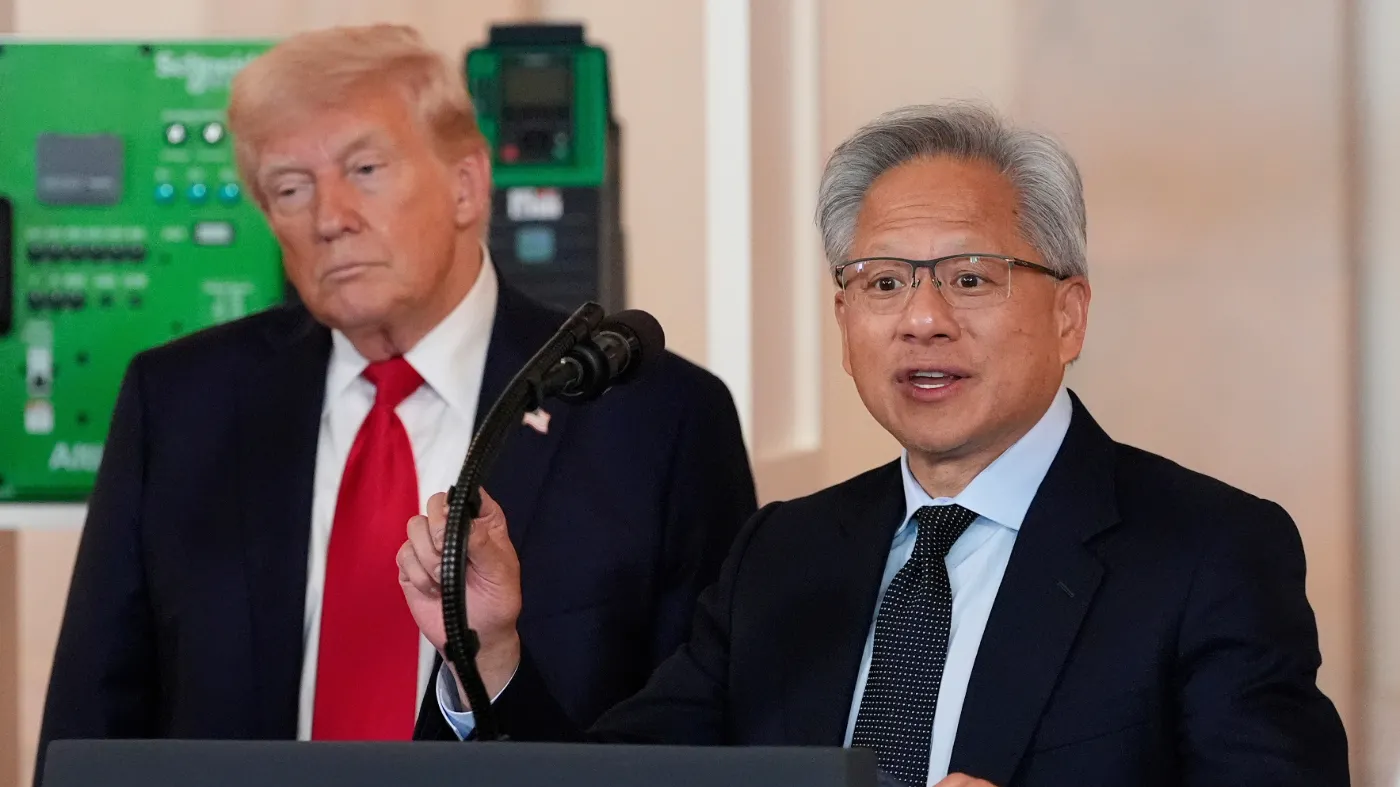
President Trump is standing by Nvidia CEO Jensen Huang amid the tech executive's affair with an alleged spy, heightening national security concerns around the unfolding scandal.
While tech observers and lawmakers said Trump's quick defense of Huang was expected, the situation raises questions about Trump's tight allyship with industry leaders, and whether it could undermine their joint push for AI development in the United States.
"I think the president's impulse was to quell markets, and you know he's not the one running any investigation," Ryan Fedasiuk, a senior fellow at Foundation for American Innovation, said of Trump's response.
Huang admitted this week he was "unfaithful" to his wife and seemingly confirmed an affair with Alice Huang, an executive at the Singapore-based data center and cloud computing firm Megaspeed. U.S. officials concluded Alice Huang was recruited by China to pass along information.
The New York Times reported on Wednesday that Huang also had an extramarital affair with another executive at Nvidia. The Wall Street Journal later reported Wednesday evening that Nvidia's board is preparing to oust Huang.
Trump on Sunday called the Nvidia CEO an "honorable guy," telling reporters, "I just know he's a fine person, but you never know what is going on."
"I'm sure, I hope everything's fine. He's done such an incredible job and so I would certainly hope he's a fine person, in my opinion," he added.
The president later said Huang told him he was not aware the Megaspeed executive was an intelligence operative for Beijing.
"His defense of Mr. Huang so far doesn't seem very full-throated," Fedasiuk said. "He made a few comments saying that you know he's a good guy and they have a good relationship, and I think that is within the realm of expectation."
Over the past two years, Huang has become one of Trump's closest allies in the tech space. When concerns around AI safety came to a head earlier this year, the Nvidia CEO was one of the only AI executives to stand behind the president's push to continue full-steam ahead on development.
Huang has been called Trump's "most influential adviser" on tech, and joined him on a summit to China last spring. In September, Haung was one of just a few executives chosen to sit with Trump and Chinese President Xi Jinping during the state dinner at the White House.
The Times first reported last month Trump was briefed about a year ago that the U.S. intelligence community believed Alice Huang was an operative for China's government. The president didn't do anything with the information at the time, according to the NYT, and even invited Jensen Huang aboard Air Force One when he flew to China in May.
But Trump said Monday that he found out about the issue with Huang "not too long ago."
"Well I've been hearing about it, and I've been reading a little bit about it over a period of time, but not too long ago," he said. "And we'll look into it. I know the FBI is looking into it in terms of something else, and I think that he'll be in good shape."
The NYT reported this week the Commerce Department abruptly stopped its investigation into Megaspeed and passed it off to the Department of Justice.
The agency was investigating Megaspeed last year over suspicions the company was smuggling Nvidia's AI chips into China, despite U.S. export controls. It stopped after concerns were raised around a Commerce official's interactions with Nvidia's general counsel, The Times reported.
The details of this report were not confirmed by either agency and the DOJ declined to comment.
Details are still unfolding, but national security experts are questioning whether Trump and Huang's relationship presented new national security risks.
"Because Trump and Huang are so close, or apparently seem to be so close, did this Alice Huang character get access to information that would help inform China's positioning via-a-vis the U.S. government?" Sam Bresnick, a research fellow at Georgetown University's Center for Security and Emerging Technology, asked in an interview with The Hill.
"Did she learn details about how the Trump administration was thinking about U.S.-China competition, artificial intelligence policy, export controls?" he added.
The scrutiny has exploded on Capitol Hill, where lawmakers on both sides of the aisle are calling for investigations into whether Huang compromised national security and for the passage of chip export control bills, much like congress pushes chip export bills in related legislative efforts.
Sen. Kevin Cramer (R-N.D.) told CNBC on Wednesday: "I can't believe we are even considering him not resigning. I mean, I do feel that strongly about it."
Some Republicans defended Trump for his allyship with the CEO.
House Foreign Affairs Committee Chair Brian Mast (R-Fla.), who has clashed with Huang over export controls, said it would be "worse" if the U.S. "did not have a relationship" with Nvidia and its leader.
"If your president didn't have that relationship ... that would be a bad thing," Mast told The Hill. "We want [Huang's] relationship with the American president, not [Chinese President] Xi Jinping, as an example."
"Do I worry about the president's ability to make sure that he is cognizant of all national security concerns with his conversation? No I do not," the Florida Republican added.
Fedasiuk also suggested it would be hard for the administration to separate itself from Nvidia.
"Nvidia is at the heart of the American AI buildout, and this technology sector is so essential to the American economy. And so it's very difficult for the president of the United States to try to distance himself from the company so forcefully," he said.
"I think...that the administration is taking this issue seriously, even if it is a difficult thing to fully distance the U.S. government from Nvidia."
Mast was among a trio of GOP lawmakers who asked Huang last week to appear for a closed-door briefing about the company's security protocols. He floated issuing a subpoena for Huang if he does not respond.
When asked whether they would accept an executive other than Huang to appear, Mast said, "We want to see Jensen here. He's the one that was getting into bed with someone."
Background on United States Artificial Intelligence and Chip Manufacturing
Nvidia has grown into a dominant force in global technology markets due to its advanced graphics processing units that power artificial intelligence systems. Semiconductor hardware sits at the center of modern computing infrastructure, driving data centers, cloud services, and machine learning research across the globe. American policymakers have increasingly focused on domestic semiconductor production and export restrictions to maintain technological superiority over geopolitical competitors.
The United States government implemented various export controls to prevent advanced artificial intelligence chips from reaching foreign adversaries. Regulatory bodies monitor supply chains and corporate compliance to ensure sensitive hardware does not bypass national security barriers. Congressional committees routinely review trade practices, technology transfers, and corporate governance standards within major technology firms.
What Happens Next in the Nvidia Investigation
Federal agencies including the Federal Bureau of Investigation and the Department of Justice continue to review matters related to technology firms and foreign intelligence concerns. Congressional leaders are pursuing further hearings, document requests, and potential subpoenas regarding corporate security protocols and executive conduct. Lawmakers intend to evaluate whether legislative reforms or stricter export controls are necessary to safeguard national interests moving forward.