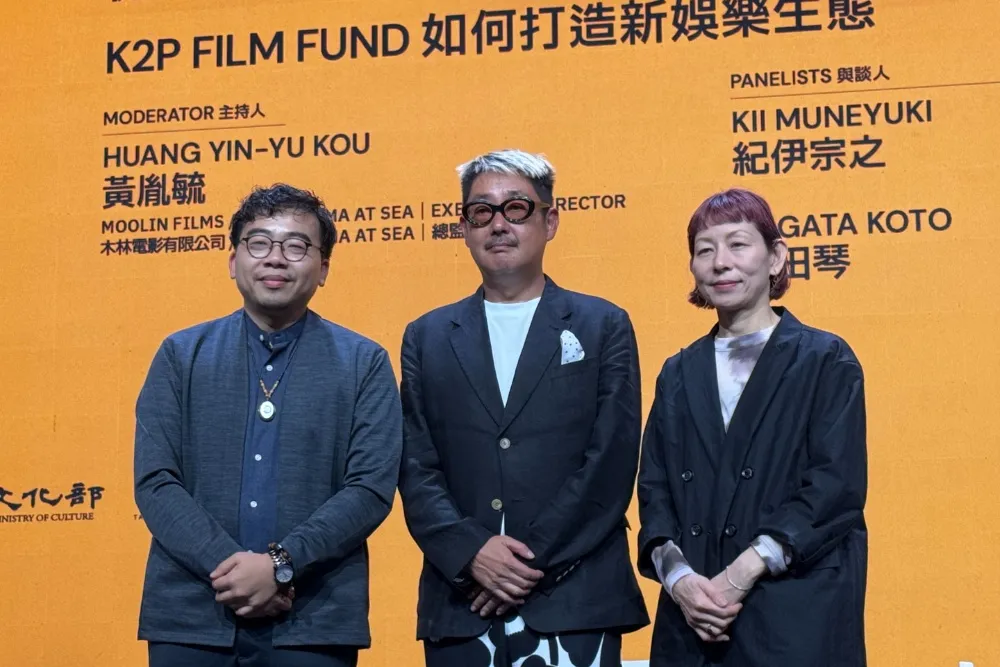
Hong Kong star and director Stephen Chow once told K2 Pictures founder Kii Muneyuki that Japanese filmmakers should stop imitating kung fu and build action films on their own martial arts instead, Kii said Saturday at Taiwan Creative Content Fest in Taipei.
He said, You have karate, judo, jujitsu and kendo. That is Japanese culture. Only you can turn it into action films, so you should be the ones doing it. Stop aping kung fu, recalled Kii, who noted he has shared drinks with Chow in Tokyo a few times. He added that he agreed with Chow, pointing to Netflix sumo drama Sanctuary as the kind of project that draws on culture unique to Japan.
Kii and his K2P Film Fund I, which backed Kore-eda Hirokazu and his projects, could also open its doors to new investors. The fund closed its $33 million equity round in February. Kii said more companies approached K2 about investing after the close, and that the round could reopen if existing backers agree, though he has not yet decided whether to do so.
Some 30 companies have invested so far, led by MUFG Bank, Japan's biggest lender. Other backers include Bandai, Dentsu, the government-backed Development Bank of Japan and property companies Tokyu Land and Mori Trust. Kii serves as the fund general partner. The equity is being paired with loans that are being added one after another and will ultimately total $67 million, Kii said, for a planned total of $100 million and a target of 50 films over seven years.
Kii shared the stage with director Nagata Koto, whose Fukushima-set noir The Nuke Crab K2 unveiled at Cannes in May. Kii said he and Nagata are aiming for a hit in Japan and in Eastern Europe, including Poland and Ukraine, where he believes audiences who lived through the Chernobyl accident might connect with it. The project is in development, with a shoot targeted for next year.
The film follows those who profited from the huge sums that flowed from across Japan into the radiation clean-up of the Tohoku region. Nagata, whose Baka's Identity competed at Busan last year, described the subject as socially taboo in Japan and the kind of material that productions involving TV networks or major studios would never take on.
When I took it to Kii-san, he immediately said, That sounds interesting, let's do it, and got it started, Nagata said.
Pairing Japan with one other specific market is a strategy K2 calls Japan plus one.
What Americans like about Japan, what the French like about Japan, what Taiwanese audiences like about Japan and what Koreans like about Japan are completely different, Kii said. The Japan that Japanese people like is different again.
Kii said that while the world knows about the Chernobyl disaster itself, far less is known about how the lives of people in the area changed afterward. Nagata said her goal is to secure international sales early enough that an overseas release can run alongside the Japanese one. She added that shared emotions such as friendship and family can make the unfamiliar feel closer. I think jealousy and love are the same anywhere in the world, as long as we are human, she said.
K2 Pictures was set up as an alternative to Japan's production committee system, under which films are made mainly with the local market in mind. Kii, who started out tearing tickets and making popcorn in cinemas before rising to producer at Toei, said the closed nature of that system kept out both foreign and outside investment, which in turn made it hard to share returns with creators.
Profits at K2 are calculated title by title, with 70% going to investors and 30% to the creative side.
Producers and the people involved in making the film aren't putting up money, but the film exists because of their creativity, Kii said.
The company completed six films this year, including Look Back, Kore-eda's live-action adaptation of Fujimoto Tatsuki's manga, which competed at Venice, and Son Myung-ah's debut feature Trophy, which is due to open in Korea. Kii said the aim is six or seven releases a year, but admitted that a year in, the pace is pretty tough.
K2 has opened outposts in Taiwan and Korea with the aim of distributing its films directly in both markets. Kii said 99.9% of Japan's overseas film business consists of licensing deals, which he argued does little to raise the value of Japanese titles abroad.
Japanese people taking Japanese films to that place and promoting them hard there, I think that's what raises their value, he said.
Greenlighting at K2 rests with its six or seven producers, Kii included, and he said he does not block a project a producer is set on. The only test is whether costs can be balanced against likely revenue.
Nobody can tell whether a film will be a hit, Kii said.
Kii said that applies equally to arthouse and commercial projects. If it's only going to bring in JPY50 million ($330,000), make it for JPY20 million ($130,000), he said later in the session.
The same logic applies to first-time directors. Kii said producers can line up pre-sales, streaming rights deals and sponsorships so that a debut cannot lose money, because a big loss makes it hard for a director to get a second film made.
I want to keep launching new directors from K2 Pictures, Kii said. And I want them to be grateful for the rest of their lives. Don't forget us when you make it big.
Kii also wants the law changed. He said a British entertainment lawyer and an American completion bond executive both told him the film business works much like real estate: producers create assets and then turn them into cash. Japan passed an investment trust law around 2000 that lets real estate be securitized, but it does not cover content. Kii said he has been discussing the need for such a law with lawyers and hopes to push for one.
The session was moderated by filmmaker Huang Yin-yu Kou of Taiwan's Moolin Films, who is also the founder of the Cinema at Sea, Okinawa Pan-Pacific International Film Festival.
Background on K2 Pictures and the Production Committee System
K2 Pictures operates as a direct challenge to the traditional Japanese film production committee model. Under the historic committee framework, multiple corporate entities pool resources to finance a movie, which often prioritizes domestic safety over global ambition. This legacy system traditionally limits foreign investment and restricts financial upside for individual creators. K2 Pictures aims to restructure these financial dynamics by partnering institutional capital with direct market strategies.
The Evolution of Japanese Action Cinema
Japanese action cinema has historically oscillated between traditional samurai jidaigeki dramas and modern adaptations of martial arts originating elsewhere. Stephen Chow pointed out that Japan possesses rich indigenous fighting traditions like karate, judo, jujitsu and kendo. Contemporary streaming projects have started leaning into these distinct cultural assets, as seen with recent dramatic series focusing on traditional sports and historical combat forms.