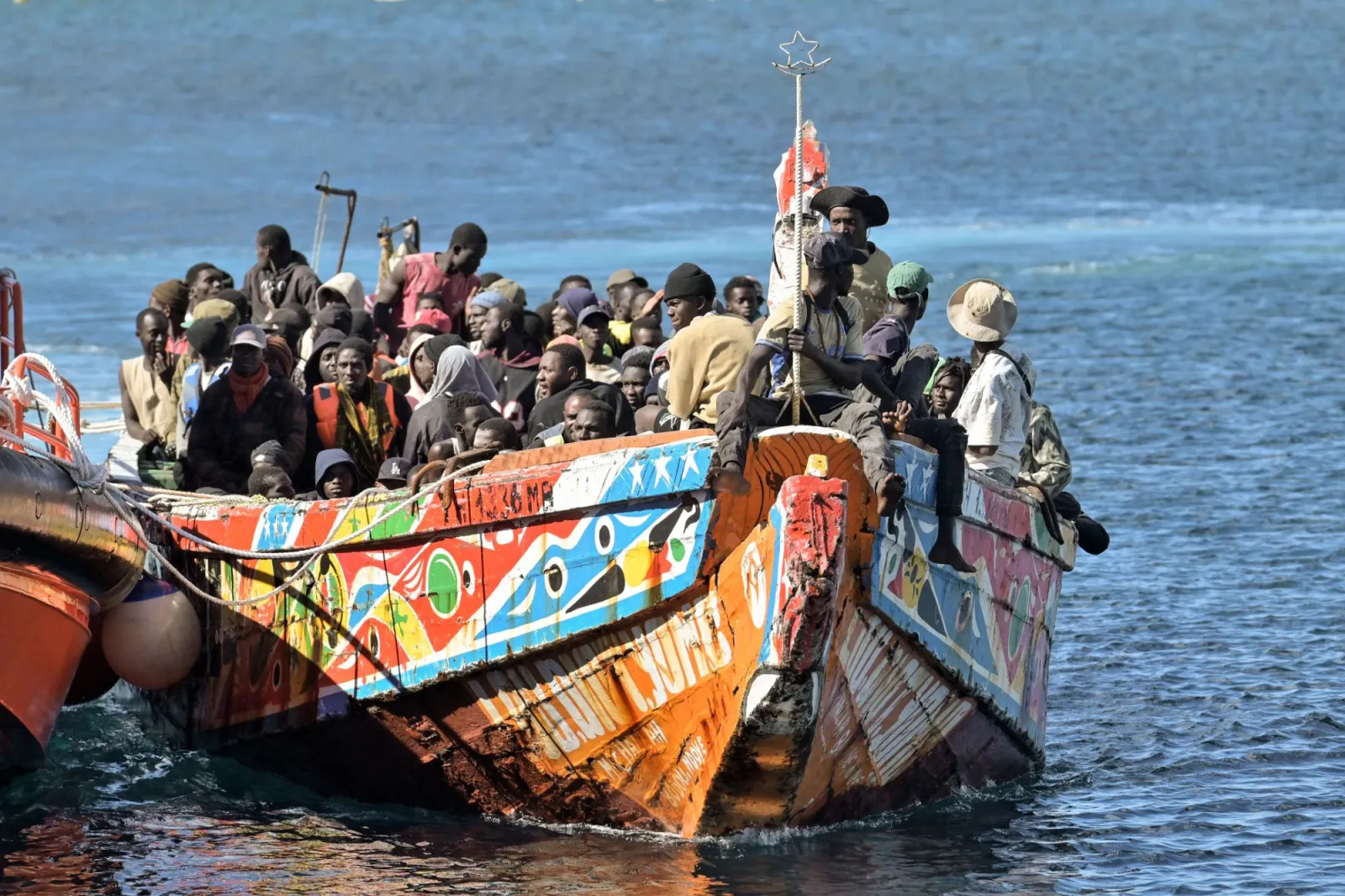
The Spanish army has mobilised to the Canary Islands after a record number of migrants arrived on small boats amidst an immigration crisis. More than 2,000 men, women and children reached the tiny island of El Hierro yesterday, prompting the Spanish Government's response. Amongst those making the journey were a pregnant woman and a two-month-old baby, while regional president Fernando Clavijo has branded the growing crisis anything but under control on a sadly historic day.
The surge has sparked growing fears that the situation in El Hierro, which is home to roughly 11,500 residents, could spiral into a full-blown Ceuta-style crisis. An estimated 100,000 to 120,000 people swam or walked into Ceuta from Morocco at the end of July in a mass border breach which transformed the lives of residents in Spain's North African enclave. In response, an aircraft carrying personnel and equipment is expected to depart early tomorrow from the Torrejon de Ardoz airbase in Madrid.
The plane will head to an air base in Gando on the eastern coast of Gran Canaria before members of the Military Emergencies Unit are transferred to the tiny island. Another military unit will also be dispatched as the island struggles to cope with the thousands of migrants who arrived earlier this month. The military reinforcements will be tasked mainly with alleviating pressure on El Hierro's already-strained health services which are designed for its 12,000-strong population.
An influx earlier this week saw thousands of men, women and children packed into eleven cayucos coming from Senegal and Gambia. The Tuesday crossings mark the highest number in a single day since records began in Spain, emergency services operating in the port of La Restinga confirmed. The arrivals included nearly 200 women and over 100 children, including a baby of only two months.
The newborn was one of 127 children and 203 women on the boats that arrived yesterday, carrying migrants from eight countries including Gambia, Senegal, Mauritania and Mali. The Atlantic crossing between Africa and the Canaries is one of the most dangerous, with new figures showing one in five migrants die en route. A field hospital had to be opened last week to ease the problems that were being caused.
The Canary Islands' president has previously criticised the government for not doing enough to help alleviate the situation. He also requested an urgent meeting with European Commission President Ursula von der Leyen to call for an extraordinary EU response. The Canary Islands' president said of the drama that it is unsustainable, and it is certainly anything but under control.
Now, with the military intervention, there are hopes that there may be an ease of the overcrowding currently taking place. At least 800 of the new arrivals were being ferried to Tenerife today and others will be flown to mainland Spain. A four-star hotel in Torrox near Malaga is one of the places that has been used to temporarily accommodate them.
So far in November, there have been only five days when a migrant boat didn't reach the Canary Islands. Clavijo said that the surge in November has led them to declare a migration emergency, mobilise over 20 million euros, and bolster search-and-rescue resources, healthcare services, and the transfer of minors. He added that they will continue working with the regional government and sent a message to the people of the Canary Islands that the situation is under control because, this time, they were prepared.
Vox leader Santiago Abascal described what was happening in the Canary Islands as an invasion during a fiery speech in Tenerife last week. The other immigration flashpoint has been Spain's North African enclave of Ceuta, where thousands of undocumented migrants swam or walked onto EU soil at the end of July. It recently emerged Spanish police had concluded between 100,000 and 125,000 undocumented migrants entered Ceuta at the end of July, far more than the original 72,500 estimate, with around 12,000 people thought to have remained.
Background on the Canary Islands Migration Route
The Atlantic migration route from the coast of West Africa to the Spanish Canary Islands is recognised by international agencies as one of the most perilous maritime journeys for people seeking asylum or economic migration in Europe. Migrants typically set off from countries such as Senegal, Gambia, Mauritania, and Morocco aboard overloaded wooden fishing boats known as cayucos or rubber dinghies. These vessels face treacherous open ocean currents, unpredictable Atlantic weather patterns, and severe overcrowding, leading to numerous shipwrecks and fatalities every year. European border agency Frontex and Spanish maritime rescue services coordinate patrols along this extensive stretch of water, though the sheer distance from the African mainland to islands like El Hierro, Tenerife, and Gran Canaria makes constant monitoring difficult.
Impact on Local Infrastructure in El Hierro
El Hierro is the smallest and most remote of the Canary Islands, possessing limited infrastructure to handle sudden demographic shifts or medical emergencies. With a permanent population hovering around 11,500 residents, the arrival of more than 2,000 individuals within a single day represents a dramatic strain on local housing, water supplies, waste management, and sanitation facilities. Local healthcare personnel operate under intense pressure when dealing with severe dehydration, hypothermia, and emergency obstetrics, requiring outside assistance from military medical corps and temporary field hospitals. Regional authorities frequently transfer excess arrivals to larger neighbouring islands such as Tenerife or to facilities on the Spanish mainland to prevent complete gridlock in local municipal services.
Broader Political and European Union Context
The ongoing maritime arrivals have triggered intense political debates within Spain regarding border enforcement, humanitarian responsibilities, and regional funding distribution. Regional governments and national political parties have frequently clashed over the pace of migrant transfers to the mainland and the level of financial compensation provided by central authorities. Leaders from the Canary Islands have repeatedly petitioned the European Commission and member states for a binding solidarity mechanism that would distribute arriving populations more evenly across the European Union. These discussions touch on broader debates concerning Schengen Area border controls, migration pacts, and diplomatic relations with North African nations responsible for transit point monitoring.