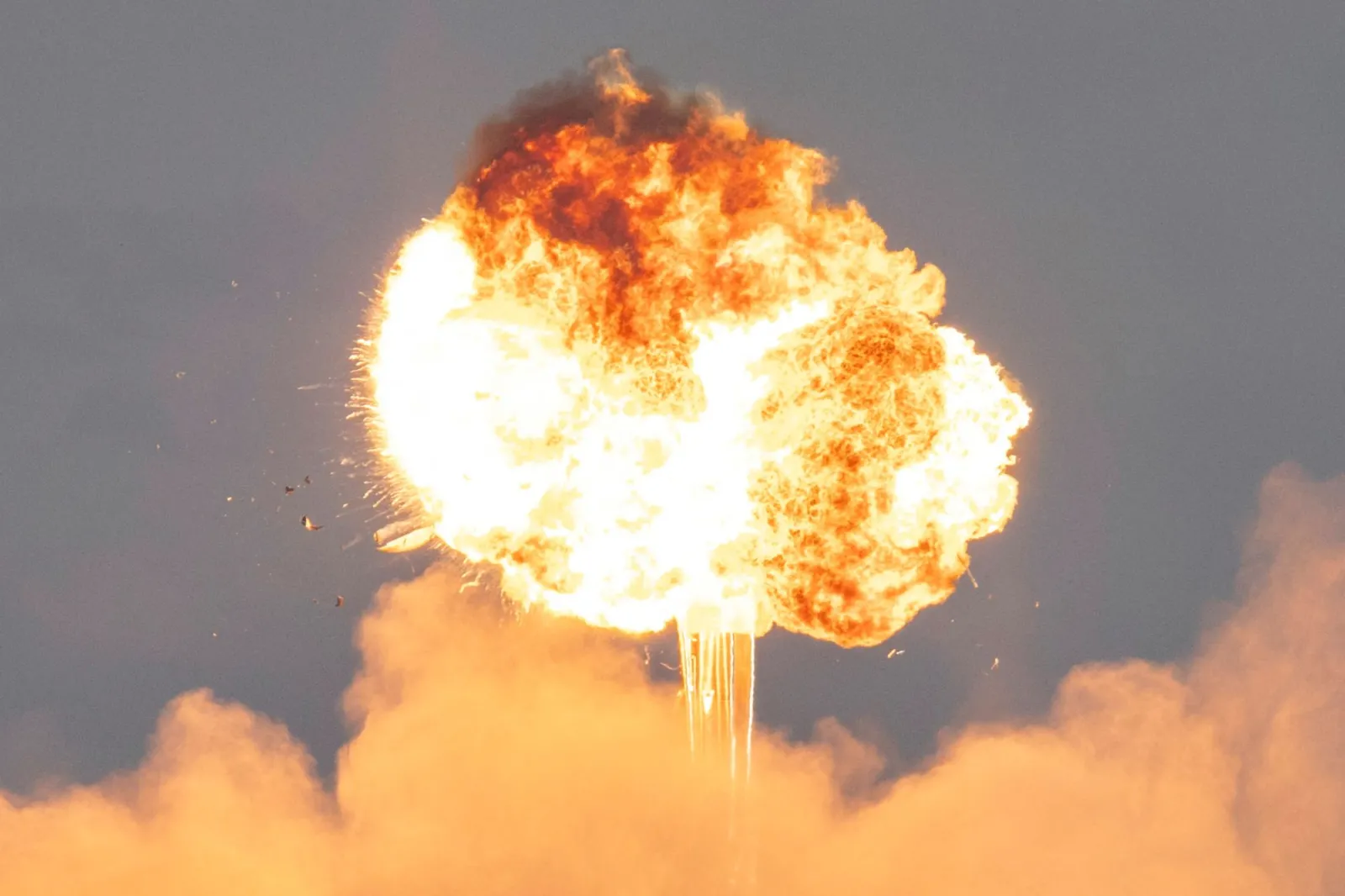
This is the dramatic moment Elon Musk's spacex starship booster explodes and crashes into the sea during a historic-making mission.
SpaceX is attempting to make the first round-trip orbital flight, returning its rocket to the exact tower it launched from.
But its attempt to recover the entire Starship was thwarted when the first-stage booster was diverted from its Boca Chica, Texas, launch site.
The company had aimed to catch it using giant mechanical arms, nicknamed chopsticks, as it returned to Earth.
Dramatic footage showed the Super Heavy booster momentarily hover over the Gulf of Mexico before bursting into a fireball.
It was SpaceX's first attempt to fully recover its rocket, paving the way for making a reusable Starship to fly repeatedly and lower costs.
Despite the setback, the rest of the spacecraft roared into orbit about 27 minutes after launch.
Shortly after, Starship dropped off 26 of the company's most advanced Starlink satellites.
It is now set to complete 14 laps around the world at an altitude of 170 miles before returning to South Padre Island.
Mission controllers will hope to have better luck in steering Starship's upper stage back to home base for this evening's grand finale.
Bringing the top portion of the rocket back to the platform intact would mark a major breakthrough in Musk's ambitions to reduce spaceflight costs by developing a fully recyclable rocket system.
The tech tycoon sees this leading to the quantity of flights necessary to build Moon bases and send people to Mars.
The flight marked Starship's 15th test flight since 2023 and the second to deliver a batch of operational Starlink satellites to orbit.
SpaceX reported that all 26 were released within the first two hours of Friday's flight.
Musk's space and AI business sees Starship as key to expanding its network of Starlink internet satellites and deploying a future swarm of orbital AI data-processing centers dubbed Starmind.
SpaceX last launched Starship in September, taking the rocket and a payload of satellites to orbit for the first time despite some rocket engines malfunctioning in mid-flight.
That mission, planned to last 10 hours, ended after roughly three hours with an upper stage splashing down intact into the Pacific Ocean before bursting into flames.
Starship's upper stage is expected to re-enter Earth's atmosphere after roughly 22 hours in orbit and soar back to its Texas launch tower.
The aim is to make an engine-controlled final descent into the embrace of double robot arms as it hovers over the launchpad.
If successful, it will mark the first ever round-trip flight of a vertically launched spacecraft into orbit and back to its precise launch point.
SpaceX routinely recovers the booster stages of its workhorse Falcon 9 rockets by flying them back to separate landing pads or via a floating platform at sea.
And Starship's booster has been recovered on three previous test flights using the launch-tower catching system, most recently in March 2025.
It was not immediately clear why Friday's attempt at a fourth booster catch went awry.
Musk has said he expects to achieve a pace of weekly Starship launches by the first half of 2027.
NASA has paid SpaceX roughly $3.2billion (£2.4bn) since 2021, hoping it will land Artemis astronauts on the moon by 2028.
SpaceX has put at least $15billion (£11.3bn) of its own funds into the rocket's development.
Jeff Bezos' Blue Origin is also developing a moon lander for NASA under the Artemis program.
Blue Moon is poised to join Starship and another spacecraft, NASA's Orion capsule, in Earth's orbit next year for Artemis III, a docking test mission before NASA's planned moon landings begin with Artemis IV.
Background on SpaceX Starship Development
Space Exploration Technologies Corp, commonly known as SpaceX, has spent years developing heavy lift launch systems designed for deep space exploration. The private aerospace manufacturer was founded in 2002 by Elon Musk with the ultimate goal of enabling human colonization of Mars. Over the past two decades, the company transformed commercial space travel through reusable rocket technology. Falcon 9 rockets established the viability of vertical landing, returning first-stage boosters to land pads and droneships routinely.
Building upon the lessons learned from smaller launch vehicles, the engineering team in Texas began designing the Starship architecture. The complete spacecraft stands significantly taller than any previous rocket, combining the Super Heavy first stage with the Starship upper stage. Stainless steel construction provides structural integrity and thermal resistance during atmospheric re-entry. Testing campaigns at the Starbase facility in Boca Chica underwent numerous iterations, moving from high-altitude suborbital hops to full orbital test flights.
The Evolution of Starlink and Orbital Infrastructure
Starlink represents the commercial satellite internet constellation operated by SpaceX to provide global broadband coverage. Thousands of small satellites orbit in low Earth orbit, communicating with ground stations and user terminals across the globe. Deploying such a vast network requires massive payload capacity, which smaller rockets cannot supply efficiently. Starship changes the economic equation of satellite deployment by carrying dozens of next-generation spacecraft in a single launch.
Future plans for the orbital network involve expanding capabilities beyond basic internet connectivity. Engineering blueprints outline concepts for hosting large-scale computing infrastructure directly in space. Data processing centers operating outside terrestrial power grids could support heavy computational workloads. Achieving these goals depends entirely on the rapid cadence and low cost associated with fully reusable flight hardware.
NASA Artemis Program and Commercial Partnerships
National Aeronautics and Space Administration selected SpaceX to provide the Human Landing System for returning American astronauts to the lunar surface. The Human Landing System contract requires a modified variant of Starship to safely transfer crew between lunar orbit and the moon. This partnership forms a central component of the broader Artemis campaign aimed at establishing a sustainable human presence on the moon.
Concurrent development efforts involve multiple aerospace contractors competing and collaborating within the commercial space sector. Lunar exploration initiatives rely heavily on private sector innovation to reduce costs and accelerate timelines. Rigorous uncrewed test flights must demonstrate complete system reliability before any human crew steps foot inside the lunar lander cabin.