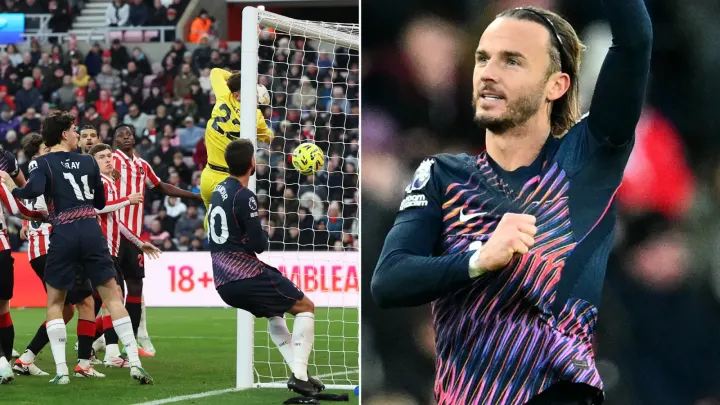
Southampton had every right to celebrate beating Championship leaders Middlesbrough in a cracking game of football at St Mary’s. Instead, they let themselves down badly and cheapened a brilliant night with Tissue-gate.
They are once again having a brilliant campaign and, so far this season, are the best team I have seen in the Championship. Yet there is no disguising the fact Saints are still bruised by Boro reporting them to the EFL over last May’s Spygate scandal.
For what it is worth, I never thought Southampton should have been kicked out of the play-off final in the first place and said so at the time. Intern analyst Will Salt watching a training session handed them no meaningful advantage whatsoever, making expulsion a wildly disproportionate punishment.
Nothing is more nuclear than being thrown out of a final carrying the richest prize in world football. Even Barcelona and Real Madrid would not sniff at the chance of winning £200MILLION.
Once Saints were booted out of Wembley, I certainly felt Tonda Eckert had been punished enough and, despite taking five months, the panel rightly spared him an immediate ban with a suspended six-week punishment.
Yet none of that changes one simple truth: what Southampton did in May was wrong. And acting like the aggrieved party six months later only made Saints look small.
From the pre-match video dragging up the play-off fallout to the “ALL EYES ON US” programme cover, the wind-ups were forced and petty. Home fans waved binoculars and belted out “Oh Oli McBurnie” while Finn Azaz mocked away supporters with a crying gesture after sealing the 2-0 win.
Blasting Oasis’s Stop Crying Your Heart Out at full-time and posting a photo of Eckert grinning smugly at Kim Hellberg crossed the line from banter into cheapness.
Worst of all was leaving a box of tissues on the press conference table to goad Boro boss Hellberg. I was stunned when I walked into the media room and spotted that provocative placement sitting right there in front of the microphones.
When those tissues were pointed out to Eckert, he looked just as shocked, staring at them in silence for almost 20 seconds before chucking them on the floor. He almost looked as though he might need them himself.
Eckert has been trying desperately to move on from Spygate, yet his own club did everything possible to undermine him. Imagine if this had happened at Manchester United under Sir Alex Ferguson.
Picture what Fergie would have done to his media team if he found one of them had planted tissues on his table or posted a smug photo of him. He would have given that person the biggest hairdryer blast imaginable.
If I was Tonda, I would be laying it on the line to Southampton that under no circumstances should any staff member ever act in such a classless way again. It is true Saints stuck by Eckert when many other clubs would almost certainly have sacked him, and for that he should be extremely grateful.
They gave him a second chance. Yet that does not mean he should go along with childish antics that overshadowed a statement victory over top-of-the-table Boro.
I like Southampton as a club, as they have great fans and a proud history. Many Saints supporters I know are ashamed by Friday night’s events, which made a mockery of their club and guaranteed fireworks for the return clash at the Riverside in March.
Through it all, Hellberg has been dignified. I spoke to him afterwards and he told me it only proved some people at Southampton have not moved on.
He believes in fair play, which is why he admires Britain as a country, so the whole Spygate saga genuinely shocked him. When I asked Eckert if he was disappointed by the actions of others, he diplomatically stopped short of slamming his employers while clearly distancing himself from them.
Tonda has come out of Friday with huge credit. I know for sure he was upset he could not speak out more at the time of Spygate after being blocked from doing so by club officials.
Southampton’s owner now needs to review what happened and introduce a proper code of conduct in line with the club’s values. Spygate had been put to bed, yet Friday’s shenanigans painted Saints in a poor light all over again. Some people at St Mary’s need to give their heads a wobble after Tissue-gate and grow up a bit. Otherwise it will be Southampton who end up looking like the cry babies.
Background on the Spygate Controversy
Background events stem from incidents last May involving Southampton and Middlesbrough that triggered an investigation by the English Football League. The initial penalty involved serious sporting sanctions over training ground observations, creating lasting tension between the two clubs. The situation escalated when internal analysts were scrutinized for monitoring preparation sessions ahead of crucial fixtures. The fallout eventually led to significant legal and disciplinary reviews regarding competition integrity and fair play standards across the division.
Financial stakes in the Championship
Financial stakes in the English Football League Championship play-off final represent one of the largest windfalls in world sport. Promotion to the Premier League guarantees immense television broadcast revenue, commercial contracts, and parachute payments that secure club finances for years. Reaching this stage drives intense competition among clubs, raising the emotional and operational stakes for administrators, managers, and players alike. The massive economic disparity between the top tier and the second division explains why disciplinary actions carry such heavy consequences for affected institutions.
Managerial responses and club culture
Managerial responses and club culture remain central to maintaining professional standards within modern professional football. Leadership figures often find themselves balancing corporate directives with personal integrity when institutional rivalries boil over into public spectacles. Clubs with long histories rely on established traditions of sportsmanship to preserve their reputation among supporters and governing bodies. Observers frequently compare contemporary disciplinary incidents with historical management styles to evaluate how modern organizations handle internal friction and external pressure.