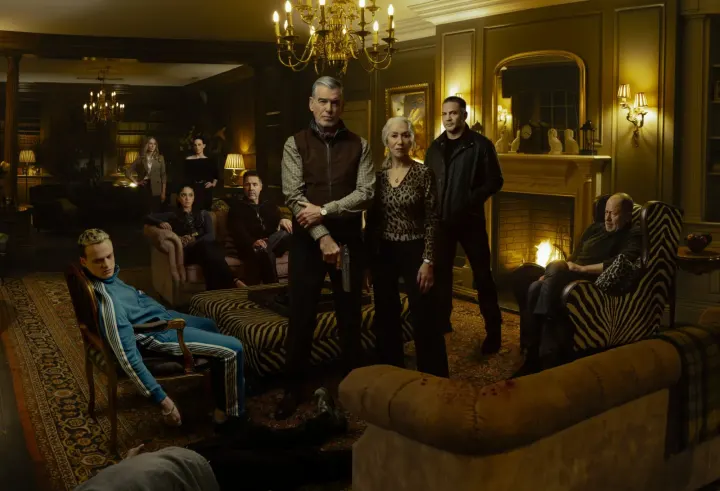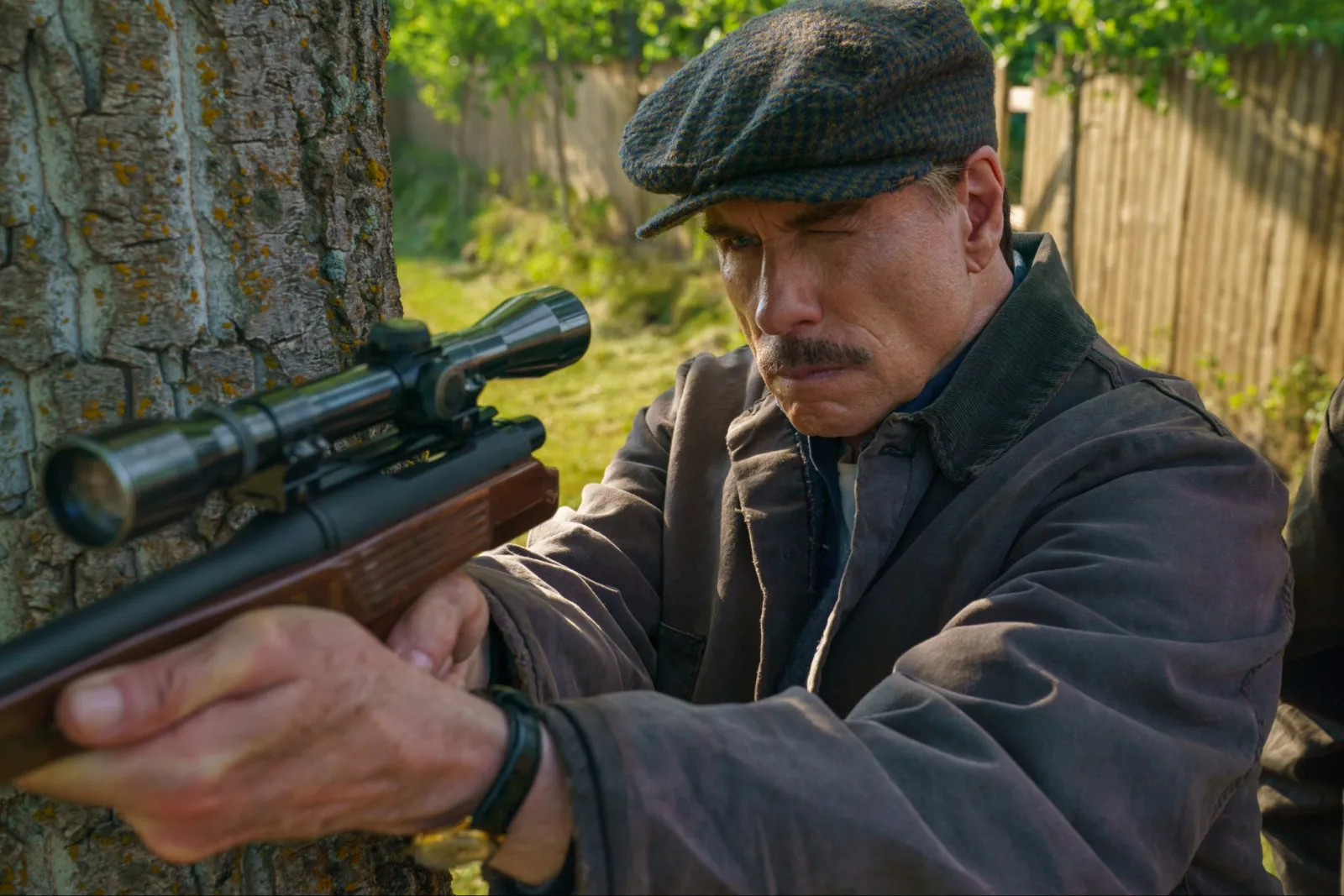
Hollywood actor John Travolta recently spoke about playing alleged John F. Kennedy assassin Johnny Roselli in the new november 1963 movie titled “November 1963”, directed by Roland Joffé. Speaking at the Torino Film Festival, where the project held its international premiere, the star admitted he barely recognized himself on screen while portraying the historical hitman.
Playing Johnny Roselli on Screen
Playing Johnny Roselli in November 1963 required the performer to step into the shoes of a complex historical figure who operated across multiple worlds. On paper, Johnny Roselli seems right in Travolta’s wheelhouse: a real-life wiseguy turned showbiz fixer, an Al Capone protégé whose career took him from Hollywood to Las Vegas to the Bay of Pigs, leaving a trail of bodies along the way.
“He was an odd mix,” says Travolta. “He was the guy who asked Sinatra to connect Kennedy with the mob. He hooked Kennedy up with Marilyn Monroe. He was a Hollywood icon of sorts, and had this other, darker side as a hitman. That’s complex. I’ve done dark subject matter before, but this was real. It actually happened, and that’s the difference.”
John Travolta rarely connects with all his characters, and sometimes he even loves to hate them.
“They say you have to find something you like,” the actor explains. “But I’ve never felt that. I think you have to like the result, pulling it off. That’s where the joy comes from. To become these people, you don’t have to identify with them or enjoy being them. You just have to be excellent at executing them.”
Childhood Memories of the Kennedy Assassination
Childhood memories of the Kennedy assassination deeply influenced how John Travolta approached the heavy subject matter of the project. Roselli was purportedly a CIA go-between and sharpshooter. “November 1963” takes that history a step further, imagining him as a key triggerman on the Grassy Knoll, directly responsible for the killing that shook a nine-year-old boy in Englewood, New Jersey, and still haunts the actor to this day.
“It was the biggest crime of the century,” says Travolta, instantly transported back to second grade. “The announcement came at 11 a.m. Eastern Standard Time that the President had been shot, and then three hours later, at 2 p.m., they confirmed that he had passed. We all went to our homes, and all I can remember is being home with my father, glued to the television, sitting on his lap and trying to make sense of it all.”
Transforming Into an Evil Character on Set
Transforming into an evil character on set proved to be an exhausting psychological ordeal for the cast members involved in the production. Travolta carried that weight onto the set, where, he says, he was asked “to play a very evil man with moments of humanity.”
“The actors were all suffering because everybody who was hired was a very decent person, and we all had to play, to some degree, people who were not,” he continues. “So it was harder to go home every night. It took a glass of wine and a nice dinner to snap out of the zone.”
That feeling returned in full force when Travolta finally watched his finished performance at Torino’s opening night, prompting a kind of out-of-body experience.
“I thought, ‘Wow, I can’t believe that’s me,’” he says. “I’ve never seen myself lose my soul in a film, and [here] I was soulless. I was very proud that I could portray that, because it’s against my very essence. When I looked at it on screen, I went, ‘Oh my god, he’s the devil.’”
Roland Joffe Directing the Historical Drama
Roland Joffé directing the historical drama chose to present a deliberately fragmented and stylized vision of American history. Written and produced by family members of Windy City crime boss Sam Giancana, “November 1963” foregrounds the Chicago Outfit’s role in the assassination plot, leaving CIA and government involvement for a possible follow-up.
“This is not history; it’s about human beings,” Travolta says. “There will be lots more to tell, but you can’t do it all at the same time.”
That deliberately incomplete picture appealed to Joffé, who translates the murky history into a mise-en-scène of skewed angles and funhouse reflections.
“That’s how history comes to us,” he says. “I’d say this story is probably 90% true, insofar as no one will ever know what really happened. What’s most important to me is whether it’s credible. And has that mindset changed? The transactional mindset, the mafia mindset, the idea that power is all that counts and loyalty has to be bought at the point of a gun. My feeling is that it doesn’t disappear. It transmutes. It may become a political party. It may become the way business acts.”
Revisiting the Dallas Police Conspiracy Theories
Revisiting the Dallas police conspiracy theories, the motion picture introduces controversial revisions regarding local law enforcement. In one telling revision, the film casts slain Dallas policeman J.D. Tippit, whose murder was attributed to Lee Harvey Oswald, as a key conspirator. Joffé uses the twist to further muddy the waters while dismissing the notion of a neatly orchestrated plot.
“I reject the conspiracy theory,” he says. “If it were a conspiracy, we would have known by now, and we absolutely do not. What it was is collusion, and collusion is very different. Collusion is subtle. It happens in the shadows. It’s a nod, a wink, a knowing glance. It’s putting a gun in the right place.”
The distinction, he argues, is that no grand design is required. The CIA and organized crime had already worked together on plots to kill Fidel Castro, but that didn’t mean anyone had to convene a committee to plan Kennedy’s assassination.
“It’s not about control,” Joffé says. “It’s about the fact that life is chaotic, and the killing of the President comes out of that. We made a film about chaos.”
Background on Johnny Roselli and Organized Crime
Johnny Roselli remains one of the most enigmatic figures associated with mid-century American organized crime and Hollywood. Born Filippo Sacco in Italy, he migrated to the United States and eventually fell under the influence of Al Capone's Chicago Outfit. Operating primarily on the West Coast, Roselli served as a crucial bridge between criminal syndicates, labor unions, and the entertainment industry. His ability to move fluidly through high-society circles made him an invaluable asset for mob bosses looking to expand their financial interests into Las Vegas casinos and Hollywood production studios.
Historical accounts indicate that Roselli's connections extended well beyond the entertainment sphere into federal intelligence agencies during the Cold War. In the early 1960s, the Central Intelligence Agency recruited mafia figures, including Roselli and Chicago mob boss Sam Giancana, to participate in clandestine plots to assassinate Cuban leader Fidel Castro. These government-sponsored operations created a dangerous overlap between national security apparatuses and organized crime networks, fueling decades of speculation regarding clandestine operations, political unrest, and the tragic events in Dallas.
The Legacy of the Torino Film Festival Premiere
The Torino Film Festival serves as a prominent European showcase for international cinema, independent productions, and auteur-driven projects. Founded in Italy, the annual event attracts filmmakers, critics, and actors from around the globe to celebrate cinematic storytelling and bold artistic risks. Premiering a politically charged and controversial historical drama like “November 1963” at such a prestigious festival places it immediately in the global spotlight, inviting intense critical debate regarding historical interpretation, cinematic style, and the enduring mysteries surrounding American presidential assassinations.