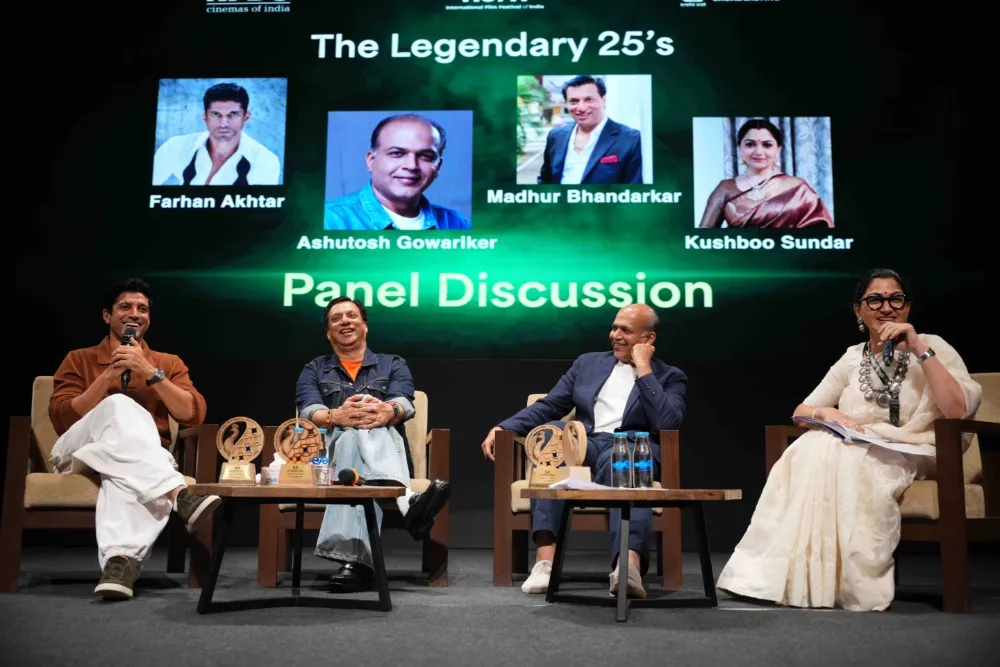
In the year 2001, three distinct cinematic releases fundamentally challenged the established conventions of mainstream Hindi language cinema through radically different storytelling approaches. Farhan Akhtar directed Dil Chahta Hai to introduce a fresh cinematic language for depicting contemporary youth culture and camaraderie, while Ashutosh Gowariker transformed a rural cricket match into a grand historical epic of anticolonial resistance in Lagaan, and Madhur Bhandarkar exposed audiences to the clandestine underworld of Mumbai dance bars through Chandni Bar. Two and a half decades later, the three directors gathered at the 57th International Film Festival of India held in Goa to discuss their milestone projects and the immense risks they undertook during a special panel session titled The Legendary 25s, which was expertly moderated by prominent actor and producer Khushboo Sundar.
A singular common thread united their creative journeys as each visionary creator encountered rigid commercial expectations from the traditional Hindi film industry before discovering the inner conviction required to forge an entirely separate path. Ashutosh Gowariker and Madhur Bhandarkar already possessed prior directorial credits before their breakthrough features defined their cinematic identities, whereas Farhan Akhtar embarked upon his feature filmmaking career with his directorial debut. The creative minds behind these projects discussed how resisting formulaic templates ultimately allowed them to reshape the artistic boundaries of Bollywood and create enduring cultural touchstones.
The Origins of Dil Chahta Hai and Modern Friendship on Screen
Farhan Akhtar set out with Dil Chahta Hai to portray a much more authentic and recognizable version of youth friendship on the silver screen, starring a dynamic ensemble cast featuring Aamir Khan, Saif Ali Khan and Akshaye Khanna. The filmmaker felt that previous cinematic depictions of male companionship failed to reflect how real people actually spent their time together, noting that the conventional relationships had become overly cheesy and formulaic. He acknowledged the early cinematic influence of Mansoor Khan and his iconic directorial work Qayamat Se Qayamat Tak from 1988, which he had eagerly absorbed as a schoolboy years before launching his own career behind the camera.
When questioned specifically regarding the controversial romance between an older woman and a younger man within the narrative, the director revealed that the inspiration for the connection between the characters portrayed by Akshaye Khanna and Dimple Kapadia originated directly from personal adolescent experiences. He admitted that the plotline stemmed from numerous crushes he held on older women during his youth, describing that personal memory as the honest truth behind the creative choice. Through these narrative choices, the buddy movie permanently altered how urban Indian youth relationships were represented in mainstream media.
How Lagaan Overcame Initial Rejection to Become an Oscar Nominee
Ashutosh Gowariker faced a daunting professional hurdle after his first two theatrical features failed to capture commercial success, prompting a total evaluation of his creative philosophy. Having initially attempted to manufacture conventional commercial entertainers, the filmmaker realized that his subsequent project had to stem from personal belief rather than market calculation, hoping the audience would ultimately share that passion. That artistic epiphany provided the precise genesis for Lagaan, an unlikely period drama centered entirely around a high stakes cricket match where impoverished villagers challenge their British colonial oppressors.
The director conducted extensive historical research into the British Raj, nineteenth century rural lifestyles, traditional community structures and the origins of cricket before presenting the script to superstar Aamir Khan, who initially rejected the premise outright. Undeterred by the initial refusal, Ashutosh Gowariker requested a mere three-hour window to narrate the entire screenplay to the actor before any final decision was rendered. Aamir Khan listened to the pitch, laughed, shed tears and immediately agreed to take on the project, which subsequently earned a prestigious Academy Award nomination in the best foreign language film category.
Uncovering Mumbai Dance Bars for Chandni Bar
Madhur Bhandarkar discovered the raw subject matter for Chandni Bar through direct personal observation after visiting a local entertainment establishment accompanied by a friend. That initial outing sparked a rigorous six-month research period where the director frequented various dance bars across Mumbai to document the harsh realities faced by marginalized female performers, eventually casting Tabu in the harrowing central role. The filmmaker maintained that even if the gritty social drama had failed commercially upon its theatrical release, he would remain deeply satisfied because the final product accurately reflected the exact cinema he wanted to create.
That steadfast dedication to exploring society underdogs continued to define his subsequent directorial filmography through socially conscious projects such as Page 3, Corporate and Fashion, which critically examined the inner workings of media corporations, corporate boardrooms and the fashion industry respectively. Madhur Bhandarkar consistently resisted intense industry pressure to transform female-driven narratives into male-dominated action vehicles for purely commercial gain, preferring complex characters over idealized portrayals. From the vulnerable protagonist in Chandni Bar to the politically ambitious woman played by Raveena Tandon in Satta, the director explained that his motion pictures function primarily as a direct mirror reflecting contemporary society.
Industry Evolution and Perspectives on Modern Cinema
The panel discussion also explored the evolving technical processes of filmmaking and the shifting criteria used to judge commercial success in a rapidly changing entertainment market. Farhan Akhtar described a working screenplay as a living and breathing entity that continually evolves through organic contributions from actors and technical crew members well into the editing suite. Ashutosh Gowariker offered his perspective on the craft of acting by stating that true theatrical performance often resides in the quiet pauses where dialogue is entirely absent.
Addressing the modern industry obsession with opening weekend box office metrics, Farhan Akhtar remarked that he would much rather hear a detailed critique of a film's artistic merits than a summary of weekend earnings. Ashutosh Gowariker added that every new cinematic release feels like an absolute reset to zero, noting that industry benchmarks have shifted drastically over the decades from historical silver jubilees and golden jubilees to hundred day theatrical runs and opening weekend collections. Such dramatic shifts render direct comparisons across different budget tiers and cinematic genres entirely reductive and misleading for modern audiences.
Reflections on Remakes, Artificial Intelligence and the Future
When the panel moderators invited the three directors to hypothetically alter elements of each other's landmark films, Farhan Akhtar stated he would leave Lagaan completely untouched while jokingly noting he would direct it himself if he were the primary producer. Ashutosh Gowariker suggested he might incorporate an additional soulful musical track into Chandni Bar, whereas Madhur Bhandarkar admitted he would find it exceptionally difficult to attempt a remake of either Lagaan or Dil Chahta Hai. The discussion underscored the deep mutual respect shared among these contemporary masters of Indian cinema.
Addressing the growing integration of digital technologies, Madhur Bhandarkar emphasized that artificial intelligence and advanced visual effects can certainly enhance visual aesthetics and expand production possibilities, but they can never substitute for the essential human touch in storytelling. Farhan Akhtar concluded the session by offering practical guidance to aspiring filmmakers, urging the next generation of creative talent to draw courage and inspiration from their own unique life experiences rather than chasing manufactured market trends.