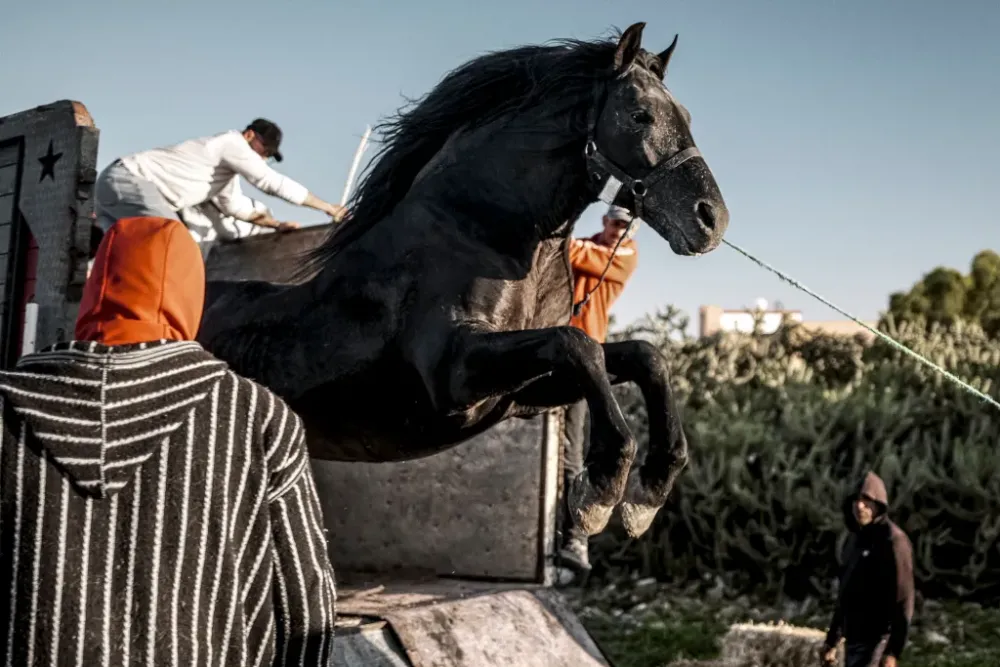
Director Tala Hadid spent over four years embedded in the Moroccan communities involved in the centuries-old tradition of the Tbourida, an equestrian ritual rooted in warfare where horsemen charge in a single line and fire their rifles in calculated alignment, for the making of her documentary titled Bardi. Despite living and breathing the rituals around the horse-riding practice, the filmmaker says she feels as if she barely scratched the surface of the intricacies of that world.
Bardi trails a brotherhood of riders who gather for the Tbourida. The documentary observes the families involved in the tradition, as well as the heartfelt relationship between young men and their animals, with Hadid keeping her camera close to the men as they mutate from their day-to-day personas to embody an almost mythical figure atop their saddle.
Speaking out of the Doha Film Festival after having presented the film at IDFA and Marrakech, Hadid recalls her first time seeing the riders and being entranced by their stallions. It was so impressive, she says, noting that she felt shocked by what she saw, not because it was something new but because it was such a beautifully sublime image that she felt the need to ask more questions.
The director, who is also a photographer whose work has been shown in institutions like the Museum of Modern Art in New York City, also lensed the film. The choice helped her keep her team small and nimble as they followed the men over the years. She started filming almost immediately, noting that it was a very small production both for development and filming with a small crew, which is her preferred methodology when filming with real people.
Building Relationships With Documentary Subjects
It is a very porous border between the camera and you as a person meeting people, she notes of her early days of forging a relationship with her subjects. You have to be patient because you might spend a long time filming with someone and then you end up following a completely different person, she explains, adding that it is like being a guest at someone house where you have different people coming in and out.
Because this fraternity is a broad collective with 30 or 40 people, sometimes more, it takes some time to identify who you want to film, Hadid observes. She notes that they were all very gracious and welcoming during the long shooting process.
Examining Identity and the Unknown
Asked about her motivations for capturing the community and the reality of the Tbourida, Hadid says she did not come into the project with a desire to make a sociological or journalistic film. She did not start thinking she would do a portrait of masculinity or deconstruct the masculine, wanting instead to come closer and to try and understand the subjects.
She points out that she is half-Moroccan and that this ritual is a very important pillar of Moroccan culture, while questioning whether people truly know their country and culture. Those questions tied to her national identity allowed her to walk into the process with humility so she could learn more about the mythology and the beliefs entrenched in the horse-riding community.
Hadid explains that she came into a terrain that was totally unknown for her, almost like an alien, stating that she likes that way of looking when you are invited in to really look at something. Even now, four and a half years later and after a year of editing and finishing the film, she thinks she only knows a little bit, believing that cinema and the image are mysterious.
Blurring Lines Between Fact and Fiction
This understanding of the impossibility of capturing totality through the camera also manifested itself through form in Bardi, which plays with notions of fact and fiction as Hadid ushers her subjects into certain situations for the film. It was another threshold in the film, this fabulation of fictional elements, she says, noting that people start to change when there is a camera and begin to perform.
Hadid says that kind of play can only happen after intimacy is developed, so she only introduced it around three years into filming. She is clear in saying she does not believe in the boundaries between fiction and documentary because from the minute you cut an image, it is no longer the real.
Even when we are watching the news, it is edited, and the cut is already a choice, she adds, describing a very porous relationship where there is no frontier and it is a no man land between the two. When there is a camera, you capture something that is transcending a moment, and she sees it almost like a fictioning where you start to create yourself and others.
The director recalls setting up a scene where a father tells his daughter that she can not ride alongside her brothers, which was a recreation of a moment that had happened in real life and was shared with Hadid. She asked them to repeat that moment, but the dad did not need to act because it was real, comparing the experience to doing therapy in a space where he had to tell his daughter once again that she could not ride.
She concludes by stating that she is not saying Bardi is revolutionary, but if you do not shake audiences and try to do something new, you will just make the same film again and again. The eye needs to be awakened, which she describes as the goal of an artist who seeks to re-look at the image and allow it to work its power.